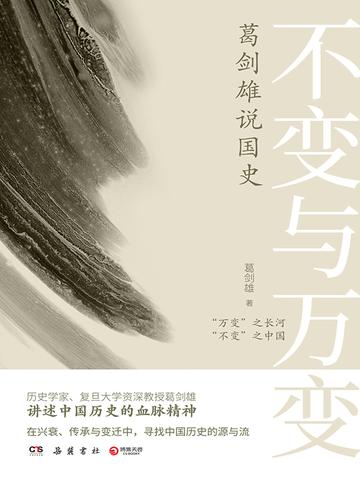
The ever-changing river, the "unchanged" China. Ge Jianxiong, a historian and senior professor at Fudan University, talks about the blood and spirit of Chinese history, looking for the origin and flow of Chinese history in the rise and fall, inheritance and changes.
If we compare ancient China to a collaborative system as sophisticated and huge as the human body, then the land is its skeleton, people are its flesh and blood, and the court and politics are its nerve centers. The long history of China has continued and developed in the process of their mutual influence and integration, and it has become the China we have today.
Reader comments
After reading this book, what impressed me most was not the historical knowledge, because I have read many knowledge points in other books. The most profound thing is the author's analysis. Those analyzes that dig beyond the surface to get to the bottom of things often make me feel like, "So that's how it is" and "Why didn't I think of that?" The people of the Tang Dynasty were open-minded. At that time, widowed women were encouraged to remarry, and the court would set an example. Some princesses not only remarried, but also married several times. But it was very different during the Ming and Qing Dynasties. Social morality restricted widows to remain widowed for life, and the court would also grant "chastity archways" to set an example for chastity women. Why are the customs of different dynasties so different? This is actually related to the population at that time. After the war, the population of the Tang Dynasty dropped sharply and there was an urgent need to increase the population. Therefore, the state took various measures to promote fertility. It not only encouraged widows to remarry, but even ordered local officials to force widows to remarry. As the population surged during the Ming and Qing Dynasties, there was no need to encourage widows to remarry to increase the birth rate. Advocating the concept of chastity was exactly in line with social needs.
"Sun Tzu's Art of War" says that soldiers have no constant momentum, and water has no constant shape. "Change is the only constant", but "all changes remain true to their origins". China has a history of five thousand years and has gone through many dynasties. They are constantly changing and emerging before people's eyes. "Unchangeable and Ever-Changing: Ge Jianxiong on National History" reveals for us the unchanging laws hidden deep in history. Let us learn to see the essence through phenomena, look at problems from a macro level, and grasp the true pulse of historical development through complex historical data.
After reading this book, I learned: In fact, in the history of war, humans often use city walls, passes, trenches and other fortifications to prevent the other party's attack and strengthen their own defense based on geographical conditions. There are city walls like this all over China and other places in the world. Early city walls, such as the Great Wall, were built between the vassal states in the Spring and Autumn Period and the Warring States Period. These walls often took advantage of natural terrain, such as on ridges, rivers, or valleys.
The word "China" has a long history. In history, "China" represents orthodoxy. To establish and maintain a political power, it must regard itself as the representative of "China". The author of this book, Professor Ge Jianxiong of Fudan University, compares China to a person of flesh and blood, divided into three parts, explaining the history of China from the perspective of China's skeleton, flesh and blood, and spiritual center. In the form of special topics, the author carefully digs into the changes in Chinese history from aspects such as territorial changes, capital changes, population policy changes, diplomacy, and sages.
This is a historical classic written by Ge Jianxiong, a senior history professor at Fudan University. The book introduces in detail the splendid history and evolution of Chinese civilization, as well as the roots and origins of Chinese history in the changing times: from the rough and powerful bronze civilization of the Xia, Shang and Zhou dynasties, from the Spring and Autumn Period and the Warring States period when a hundred schools of thought contended, from the graceful and luxurious Tang Dynasty to the elegant and elegant Song Dynasty, from the vulgar and refined Yuan Dynasty to the restrained and quiet Qing Dynasty. After reading this book, you will have a deeper understanding of the mighty Chinese history.
This is a historical classic written by Ge Jianxiong, a senior history professor at Fudan University. The book introduces in detail the splendid history and evolution of Chinese civilization, as well as the roots and origins of Chinese history in the changing times: from the rough and powerful bronze civilization of the Xia, Shang and Zhou dynasties, from the Spring and Autumn Period and the Warring States period when a hundred schools of thought contended, from the graceful and luxurious Tang Dynasty to the elegant and elegant Song Dynasty, from the vulgar and refined Yuan Dynasty to the restrained and quiet Qing Dynasty. After reading this book, you will have a deeper understanding of the mighty Chinese history.
This book is very interesting. Professor Ge Jianxiong tells Chinese history very vividly! Just like the human body, land, people, and politics throughout history have all influenced each other. Especially the Kyushu mentioned in it reminds me of the vast land of our country. I want to study hard, learn more about history, and contribute to the future of our motherland!
Insightful; put forward one's own point of view
Love this historical background knowledge
I learned a lot of new knowledge and concepts.
The selection of materials is unique, the historical materials are detailed, the insights are unique, and the perspective is broad.

After reading this book, what impressed me most was not the historical knowledge, because I have read many knowledge points in other books. The most profound thing is the author's analysis. Those analyzes that dig beyond the surface to get to the bottom of things often make me feel like, "So that's how it is" and "Why didn't I think of that?" The people of the Tang Dynasty were open-minded. At that time, widowed women were encouraged to remarry, and the court would set an example. Some princesses not only remarried, but also married several times. But it was very different during the Ming and Qing Dynasties. Social morality restricted widows to remain widowed for life, and the court would also grant "chastity archways" to set an example for chastity women. Why are the customs of different dynasties so different? This is actually related to the population at that time. After the war, the population of the Tang Dynasty dropped sharply and there was an urgent need to increase the population. Therefore, the state took various measures to promote fertility. It not only encouraged widows to remarry, but even ordered local officials to force widows to remarry. As the population surged during the Ming and Qing Dynasties, there was no need to encourage widows to remarry to increase the birth rate. Advocating the concept of chastity was exactly in line with social needs.
"Sun Tzu's Art of War" says that soldiers have no constant momentum, and water has no constant shape. "Change is the only constant", but "all changes remain true to their origins". China has a history of five thousand years and has gone through many dynasties. They are constantly changing and emerging before people's eyes. "Unchangeable and Ever-Changing: Ge Jianxiong on National History" reveals for us the unchanging laws hidden deep in history. Let us learn to see the essence through phenomena, look at problems from a macro level, and grasp the true pulse of historical development through complex historical data.
After reading this book, I learned: In fact, in the history of war, humans often use city walls, passes, trenches and other fortifications to prevent the other party's attack and strengthen their own defense based on geographical conditions. There are city walls like this all over China and other places in the world. Early city walls, such as the Great Wall, were built between the vassal states in the Spring and Autumn Period and the Warring States Period. These walls often took advantage of natural terrain, such as on ridges, rivers, or valleys.
The word "China" has a long history. In history, "China" represents orthodoxy. To establish and maintain a political power, it must regard itself as the representative of "China". The author of this book, Professor Ge Jianxiong of Fudan University, compares China to a person of flesh and blood, divided into three parts, explaining the history of China from the perspective of China's skeleton, flesh and blood, and spiritual center. In the form of special topics, the author carefully digs into the changes in Chinese history from aspects such as territorial changes, capital changes, population policy changes, diplomacy, and sages.
This is a historical classic written by Ge Jianxiong, a senior history professor at Fudan University. The book introduces in detail the splendid history and evolution of Chinese civilization, as well as the roots and origins of Chinese history in the changing times: from the rough and powerful bronze civilization of the Xia, Shang and Zhou dynasties, from the Spring and Autumn Period and the Warring States period when a hundred schools of thought contended, from the graceful and luxurious Tang Dynasty to the elegant and elegant Song Dynasty, from the vulgar and refined Yuan Dynasty to the restrained and quiet Qing Dynasty. After reading this book, you will have a deeper understanding of the mighty Chinese history.
This is a historical classic written by Ge Jianxiong, a senior history professor at Fudan University. The book introduces in detail the splendid history and evolution of Chinese civilization, as well as the roots and origins of Chinese history in the changing times: from the rough and powerful bronze civilization of the Xia, Shang and Zhou dynasties, from the Spring and Autumn Period and the Warring States period when a hundred schools of thought contended, from the graceful and luxurious Tang Dynasty to the elegant and elegant Song Dynasty, from the vulgar and refined Yuan Dynasty to the restrained and quiet Qing Dynasty. After reading this book, you will have a deeper understanding of the mighty Chinese history.
This book is very interesting. Professor Ge Jianxiong tells Chinese history very vividly! Just like the human body, land, people, and politics throughout history have all influenced each other. Especially the Kyushu mentioned in it reminds me of the vast land of our country. I want to study hard, learn more about history, and contribute to the future of our motherland!
Insightful; put forward one's own point of view
Love this historical background knowledge
I learned a lot of new knowledge and concepts.
The selection of materials is unique, the historical materials are detailed, the insights are unique, and the perspective is broad.