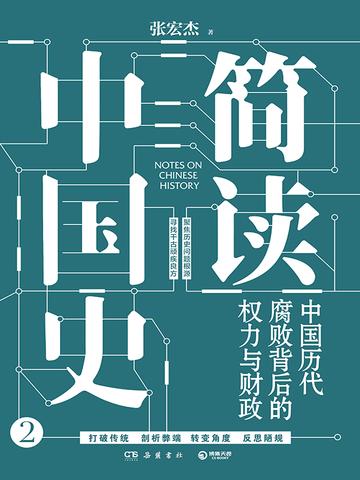
A Brief Reading of Chinese History. the Power and Finance Behind Corruption in China's Past Dynasties
简读中国史.中国历代腐败背后的权力与财政
- Status
- Completed
- Length
- 174k Words
- Genre
- Historical
- Updated
- 4y ago
- Source
- Fanqie
Stats
157Reads
9.1Score
22Chapters
14Listens
59.8kReads · all time
Tags
Synopsis
Reader comments
In booklists 5
Are There Any Teaching Aid Books?
I want to read a book similar to "Half-hour Comic History of China 5". For example, the above
19.3MViews1.2kBooks5dUpdated

A Book Where You Can Learn the Real Skills of Making Money
I want to read a book similar to "Men, Making Money Is Really Skilled (Two Volumes Complete)". If you want to improve your earning power, these books are worth reading.
7.5MViews615Books2dUpdated
Must-Have Books for Kings of Scrolls
2.6MViews1.4kBooks4dUpdated

There Are Not Many Good Books on History! Argue If You Are Not Convinced
Low EQ: I want to read good novels. High EQ: I want to argue if I don't accept it.
1.3MViews363Books10hUpdated


Recommend Books on Skills
I would like to read a book similar to "Word, Excel, and PPT Office Applications from Beginner to Master". I want to learn some skills to make money, but my wallet is a bit tight. I hope you can recommend some free skills learning materials. They are good for everything, including handicrafts and making.
1.2MViews1kBooks4dUpdated
This book uses the history of various periods to directly list all the various corruption methods in China. Although emperors of all generations have more or less wanted to deal with anti-corruption issues, the actual results have not been very satisfactory. As long as you finish reading this book, you will know that the reason why the kings in history failed to achieve effective results was because they failed to solve the fundamental problem. The author also directly analyzes the power and financial issues behind the corruption of Chinese dynasties through real history. The author mainly focuses on the Han, Tang, Song, Yuan, Ming and Qing Dynasties, making vertical comparisons to explore the imperial rule and official history ecology of ancient Chinese society, presenting readers with a clear multi-angle Chinese historical context.
This book uses the history of various periods to directly list all the various corruption methods in China. Although emperors of all generations have more or less wanted to deal with anti-corruption issues, the actual results have not been very satisfactory. As long as you finish reading this book, you will know that the reason why the kings in history failed to achieve effective results was because they failed to solve the fundamental problem. The author also directly analyzes the power and financial issues behind the corruption of Chinese dynasties through real history. The author mainly focuses on the Han, Tang, Song, Yuan, Ming and Qing Dynasties, making vertical comparisons to explore the imperial rule and official history ecology of ancient Chinese society, presenting readers with a clear multi-angle Chinese historical context.
Basically, there is no book that I would read a second time, including Dream of Red Mansions and Tao Te Ching. I have read this book for the first time now, and I am determined to read it at least twice. Because it confirms many fundamental views that I have gained from my independent thinking experience in Chinese society. Television, news, and entertainment online books all fail to tell the truth. This book does not deceive me! Absolutely good book! ! ! I want to make friends with the author.
This book taught me that formulating a system and executing it are two different things. Like many systems in the Qing Empire, most of these seemingly scientific and reasonable regulations did not come off the paper, or they changed soon after they came off the page. So when the emperor wants to fight corruption whenever he wants, those officials in the most lucrative departments become a high-risk profession. Taxation is like the blood of the national economy. The Qing government was on the verge of death. Due to Herder's reforms, it received fresh blood from a large increase in customs tax revenue, which allowed it to extend its life for several decades.
After reading it, the author's words are more logical and he has his own opinions, which can be used to enlighten children. It's a pity that he didn't put forward his own opinions in a targeted way, just analysis.
Corruption in traditional Chinese society is mostly systemic corruption. It is produced for the following reasons. The first reason is the social operating mechanism of "power determines everything". The second basis is that power is not constrained. Third, the low-wage system leads to the worsening of corruption. The fundamental characteristic of the imperial autocratic system is that the emperor does not exist for the country; on the contrary, the country exists for the emperor. In the traditional Chinese era, there was no distinction between the public domain and the private domain. All private domains had a political nature and were all political domains. A person's birth, old age, illness, and death, as well as food, clothing, housing, and transportation, all need to be regulated by power. The strengthening of the monarchy's autocratic system shows two directions. One is the continuous downward extension of imperial power. For example, Zhu Yuanzhang strengthened the Lijia system. Another direction is that with the development of autocratic monarchy, the power of officials is continuously divided, in order for officials to check and balance each other and weaken their challenges to imperial power.
The writing is good, the Ming and Qing Dynasties are the focus, and the information is easy to collect. It was too difficult to collect data in the past. The most evocative part is about the customs. I really didn't know the details before, but now that I understand it, I can only smile bitterly.
When you read history books, do you often see that there are always a few very corrupt eunuchs or courtiers in each dynasty? Every time you read this, you will probably hate them deeply but have no choice but to do anything. Have you ever wondered why such annoying characters appear in every dynasty? This book records this matter in detail. He tells about the power and finance behind corruption in China's past dynasties. This book analyzes this problem from its roots, and the analysis is very thorough and reasonable. I recommend everyone to read this good book.
Looking at the past and knowing the present, the stage has remained the same throughout the dynasties, and only the actors have changed. From the common people at dawn to the nobles, from the red walls and green tiles in the palace to the peddlers and minions on Tian Street, they are all clouds, stories, and jokes for future generations...
Although the details are appropriate, it is said that the Qing Dynasty focused too much on finance than other dynasties, causing other dynasties to lose some authority.
Much better than those bad online novels
I really like this book. The thinking and logic are clear, the arguments are sufficient, and the content of the article is wonderful. The more I read, the more I want to read it [Send heart] [Send heart] [Send heart] [Love] [Love] [Love]
Respect human nature and maintain integrity with adequate salary
As for its content, it can be said that it is quite detailed. It looks at the past and draws lessons from the present, and pays great attention to the Qing Dynasty. In addition, the separation of officials and local officials, the different salaries of officials, and the inequality of salaries between large and small bureaucrats can be said to be very innovative.
Good books and free, Tomato is a truly conscientious company❗
The logic is clear, the arguments are reduced layer by layer, and the path of analysis is clear.
Read, worth reading Understand the wage system and financial policies of various dynasties in history, and learn about the rise and fall of dynasties from a side perspective
The writing is very good, but most of it is about the Qing Dynasty. Unfortunately, I didn't read the history of the Ming and Qing Dynasties.
The meaning is still not exhausted. I admire the author for his solid skills. I hope policymakers can use history as a mirror😮💨.
Qi Ting, look at my deputy deputy director [smile]
Very detailed and well-argued
Good books in social sciences
It feels like it's over before it's finished
The customs part is quite nice, it feels really subtle.
This book is okay, but the use of cases is still insufficient. The argumentation problem is not just a few words, but a complete and sufficient explanation.
I understand a lot of inner truths and the writing is very good.
The book is okay, but it focuses on the Qing Dynasty. It would be better to write more about other dynasties.
A good book, the preface summarizes the main content of the book. Mark it first and see Chapter 3.
Very inspiring and very practical
If you just want to have a brief understanding of ancient corruption, this book may explain it in too detail. It can be explained clearly in a few sentences, and it will be clear at a glance if you ask AI.