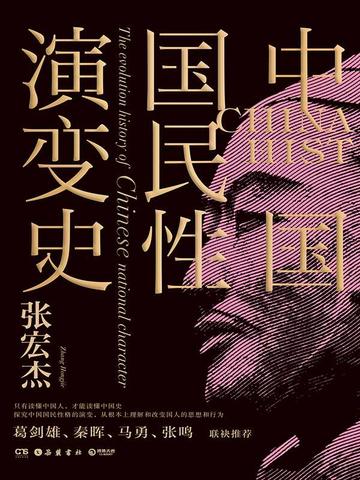
The Evolution of Chinese National Character
中国国民性演变史
- Status
- Completed
- Length
- 186k Words
- Genre
- Historical
- Updated
- 4y ago
- Source
- Fanqie
Stats
385Reads
8.5Score
113Shelves
25Chapters
67Listens
32.6kReads · all time
Tags
Synopsis
Reader comments
In booklists 3



Historical Writing, Be More Realistic
No system, no Qin Shi Mingyue, pure history
14.6MViews245Books2dUpdated



A Book Where You Can Learn the Real Skills of Making Money
I want to read a book similar to "Men, Making Money Is Really Skilled (Two Volumes Complete)". If you want to improve your earning power, these books are worth reading.
7.6MViews168Books3dUpdated



Is There Any Book That Is a Classic Every Sentence?
3.8MViews545Books3dUpdated
First, let's be clear, whether this book is good or bad, I'm just giving my opinion a little bit. This book shocked me greatly. It shattered my view of history and reshaped and revised the path of my dreams. Only by studying history can we know the present, and by appreciating history can we innovate. Use the lessons of the past to create a new trend. My generation, it's just the right time!
The evolution of Chinese national character can be regarded as a general history from another perspective. From Yao, Shun, and Yu to the Qin and Han dynasties, to the prosperous Tang Dynasty and the two Song, Ming, and Qing dynasties. The bad nature of Chinese people is constantly mentioned in this book, which reminds me of many of Mr. Lu Xun's works, such as some descriptions in Xianglin's Wife. Lu Xun said: "I have seen the Revolution of 1911, the Second Revolution, Yuan Shikai proclaimed himself emperor, and Zhang Xun was restored. Every time I looked at it, I became suspicious, so I became very disappointed and depressed." In many of Mr. Lu Xun's works, he criticized the numbness of the people, and I often felt heartbroken and depressed when reading them. In order to enlighten the people's wisdom, Liang Qichao carried out reforms in the late Qing Dynasty, but failed in the end. With Tan Sitong's tragic "I cut my sword across the sword and smiled to the sky", I still feel uncomfortable every time I think about it.
Quoting the author's own words First, this book is not an academic work, but just my Wild Fox Zen-style self-justification. Compared with serious academic works, there may be too much sensibility, too many personal feelings, too many generalizations, and there may be many things that are not rigorous, inaccurate, and muddled. Then make people think and open their minds. But it is really very subjective. Many of the ideas are explained with purpose, and are specifically raised to address the issues. The examples given are particularly partial, subjective judgments, conclusions, and inferences are made. So when I see some chapters and examples, I will be speechless. But there are some chapters where I think it's not unreasonable. Simply put, you can still watch it, and it is recommended that you finish it and add some insights and thoughts. There were definitely a lot of cuts in the book in the end.
Mr. Zhang Hongjie is a well-known contemporary historian in China. His books and public lectures have reached a large audience. This "History of the Evolution of Chinese National Character" is titled "National Character" and believes that although China has made great progress in material living standards with technological evolution and productivity improvements since ancient times, its core has not changed. This book is divided into two parts. The first part discusses the historical evolution of national character, and the second part traces the institutional roots and changes of national character. This book has a broad vision, solid information, unique perspectives and is thought-provoking.
If you listen both, you will be enlightened; if you believe only, you will be dark.
This is a thought-provoking sociological work. Through a comprehensive study of the evolution and change of Chinese national character, the author reveals the changes in the Chinese people's thoughts and behaviors under the historical background. This book not only explores the impact of cultural traditions, social structure, economic development and other factors on national character, but also triggers thinking about the fate of the country and social progress. "National character determines destiny, and evolution shapes the future" stated in the book reminds us that the shaping of national character is of great significance to the development of the country and society.
The writing style of this book is very unique, as if I am chatting with you, and it feels very friendly. The author's writing style is also good, simple and easy to understand. Moreover, he pointed out the impact of the system on national character by comparing ancient and modern times, which inspired me very much. However, I kind of hate the feudal rulers in the book. Their selfishness and ignorance are really infuriating! Overall, this is a very thoughtful book and worth reading.
I learned a lot of knowledge and solved some confusions that I had had for many years. Especially when I met many people and things in society that I didn't understand in the past, I understood them from the perspective of national character and now I know what's going on. Thanks to the author!
Now I am taking a detour
This is a thought-provoking sociological work. Through a comprehensive study of the evolution and change of Chinese national character, the author reveals the changes in the Chinese people's thoughts and behaviors under the historical background. This book not only explores the impact of cultural traditions, social structure, economic development and other factors on national character, but also triggers thinking about the fate of the country and social progress. "National character determines destiny, and evolution shapes the future" stated in the book reminds us that the shaping of national character is of great significance to the development of the country and society.
Looking at the evolution of Chinese people from a new perspective, I feel that the Chinese people have regressed for at least a thousand years in terms of character.
Studying history is to understand the present. In this book, the author Zhang Hongjie explains in simple terms and analyzes in detail, from the aristocratic culture in the Spring and Autumn Period to the gentry culture in the Wei and Jin Dynasties, to the civilian culture in the Song Dynasty, the gangster culture in the Yuan Dynasty, and the slave culture in the Qing Dynasty. With the continuous change of the feudal autocratic system, the national character has gradually changed in the direction of the economic and social trends. It can be said that the national character is closely related to the development of the national system. This book contains detailed historical materials and solid viewpoints and theories. It is a general history book with great historical significance.
Many thanks to the author! Great book! Worth recommending!
Good book, worth recommending and reading
This book is so good!
Although there is a lot of perceptual content, it also opens up new ideas for reading and thinking to a certain extent.
This book is worth reading. Just as listening can lead to enlightenment, partial belief can lead to darkness. Although it is not possible to think from both sides of everything, you can think from both sides yourself, and this book can just be used to improve your thinking. That is to say, this is a book worth reading. Will read it again.
The writing is good, smooth and popular, but too extreme.
Recommend good books
Although the first part is not very acceptable, I recommend readers to read on. The real essence is in the second half.
The writing style is very strong, just write a novel [smile]
A very good book. I learned a lot from it. It is worth collecting and reading.
Pretty good, the perspective is unique This is not the complete book, some chapters are seriously missing.
Thought-provoking content
Somewhat inspiring
Unique insights beyond history books.
Materials come first and are the foundation. The so-called national character is attached to the current living conditions. To talk about national character without living conditions is nonsense.
Reading this book is no less than seeing Cognitive Awakening for the first time. For someone like me who has very little exposure to extracurricular readings, it is simply incomparable.
Learn more about the transformation of national character from ancient times to the present.
The writing is very good, especially in modern times. Some of the ancient ones are not specific enough, which is very inspiring.