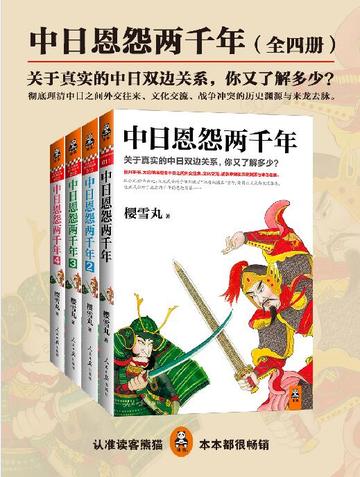
China and Japan**********
中日**********
- Status
- Completed
- Length
- 625k Words
- Genre
- Historical
- Updated
- 4y ago
- Source
- Fanqie
Stats
173Reads
5.8Score
71Chapters
31Listens
26.7kReads · all time
Synopsis
Reader comments
In booklists 3

A Mortal's Story of Cultivation into Immortality
Where is "The Legend of Mortals Cultivation to Immortality"? Why can't I find it? It was made into a movie, but I can't find the original book.
10.6MViews252Books5dUpdated

Are There Any New Historical Videos? I've Watched All the Old Ones! Want New Ones! Beg
4.5MViews466Books4dUpdated

I Want to Take the Books for the High School Entrance Exam!
57.8kViews86Books5moUpdated
Overall it's ok. First of all, Japan is a neighbor of China and has a lot of grudges and resentments with China. It is very necessary to understand its history. This book can roughly explain the history of exchanges between China and Japan, give you a general understanding of various aspects of Japan, find out some of our shortcomings, and learn from others' good points. But at the same time, we can also confidently say that he has been our little brother since ancient times, and now he is just an upstart. There is no need to regard them as too noble, nor do we need to regard ourselves as too humble. We should stick to the self-confidence in our hearts. Generally speaking, we must pay attention to our opponents tactically and strategically, and despise our opponents psychologically. I quite agree with some of the views and opinions of the author of this book, including his understanding of some characters and his unique views on certain historical events. It can all be seen that the author has indeed conducted in-depth research, unlike some people who think they have some knowledge and just spray it on the Internet without considering rationality and objective conditions. But it can also be seen that the author is definitely a pro-Japanese element, and certain emotions may not necessarily have reference value. Based on my understanding of the Japanese, even if you are willing to make friends with them, or even if they show the appearance of making friends with you, they must be defensive behind the scenes and must be hiding something you don't know. This means that you must not underestimate them. Therefore, I don't think there will be any good rewards for Ichimei's friendly attitude. In the final analysis, they are still poisonous snakes. If they don't show their teeth now, it doesn't mean they won't show them in the future. And once they wait for him to show their teeth before being alert, there will be a heavy price. In this regard, we can promise not to engage in tense situations, but we must also be prepared and prepared behind the scenes. This should also be the attitude towards any country.
As neighboring countries, China and Japan have had exchanges with each other in various periods of history. The changes in the relationship between the two also reflect the changes in China's national power to a certain extent. Japan and China had a period of harmonious coexistence during the Tang Dynasty, and there were also invasions by Japanese pirates during the Ming and Qing dynasties, and even more brutal invasions in modern times. China and Japan have been entangled in love and hatred for thousands of years. Our ancestors said that the Japanese people in the East were cunning and fickle and should not be treated as good friends. To a certain extent, this is true. Through the course of history, we have correctly understood the face of Japan and maintained an appropriate diplomatic distance from it.
Due to the close geographical location, Sino-Japanese relations are inevitable. This book tells the story of Sino-Japanese relations that can be traced back to the ancient times two thousand years ago. In the early days, there were mutual cultural exchanges and influences between China and Japan. However, with the passage of time, the relationship between the two countries has gone through many stages, including friendship and cooperation, as well as conflict and war. After the mid-19th century, with the invasion and intervention of Western powers, Sino-Japanese relations became more tense. During this period, Japan adopted Western modernization models, defeated China in the war, and gained control of China. After the end of World War II, Sino-Japanese relations experienced a series of changes. With Japan's defeat and post-war reconstruction, China and Japan began to rebuild and develop bilateral relations.
The book "Two Thousand Years of Grudges between China and Japan" explains the causes and consequences of the grievances between China and Japan. More than 2,000 years ago, China and Japan had a very friendly relationship. Japan sent ships across the sea to China to learn Buddhist thoughts from China, and they had close exchanges. But during the Yuan Dynasty, Japan began to slowly become more proud, and its contacts with China were no longer close. Until the Sino-Japanese War of 1894-1898, the friendly relations between Japan and China broke down. Japan began to invade China, and China began to rise up to resist.
China and Japan are separated by a strip of water and face each other across the sea. For more than two thousand years, in this narrow sea area, countless people with friendship, hatred, curiosity, and admiration have braved the wind and waves, risking being swallowed by the sea, and frequently traveled between the two countries. The book starts from the earliest exchanges between the two countries and introduces the history of Sino-Japanese exchanges from the Qin and Han Dynasties to the late Ming Dynasty. From a historical perspective, the status of the two countries has evolved from the initial feudal society that subordinated the slave society to Japan, to the diplomatic equality in the late Tang Dynasty, and then to Japan's vague diplomatic arrogance during the Yuan and Ming Dynasties. A small country has just completed its diplomatic counterattack.
China and Japan are two neighboring countries geographically, and they also have relatively deep roots in cultural dissemination and national development. This book helps readers understand the historical entanglements, disputes and reconciliation process between China and Japan through in-depth research and detailed narrative. It explores important issues such as the invasion of Japanese pirates in ancient times, trade and exchanges during the Ming and Qing Dynasties, wars and colonial rule in modern times, and cooperation and friction in the modernization process.
Awesome history Just don't take it as official history
This book uses the timeline as an axis to clearly sort out the two thousand years of grievances and resentments between China and Japan. The content is rich and the language is easy to understand, allowing us to have a more comprehensive understanding of the development of Sino-Japanese relations. The book describes the social scene of Japan in various periods very vividly, such as "They also have strange tattoos on their faces and hands. The most eye-catching thing is the short stature of this group of people." With just a few strokes, we seem to have seen the scene at that time. All in all, it's well worth reading!
The analysis is very comprehensive and the insights are very unique. I feel like I am wandering in the sea of history! Is this the end?
Good-looking, good-looking, good-looking So pretty [smile][smile][smile][smile][smile]
Although the writing is mostly ridiculed, it at least allows me to understand the "history of exchanges" between China and Japan since before the Tang Dynasty.
The writing is vivid and interesting, and some parts are too detailed. Please read it as a novel. The later content is too redundant and not concise enough.
A very good book
It is better to believe in books than to have no books at all. Reading can make you wise, and reading history can help you learn from it. I hope everyone can have their own independent thinking when reading the book, and choose the good ones and follow them.
The story is told clearly. It is worth learning from and comparing.