With the end of the Cold War, the confrontation between the United States and the Soviet Union after World War II no longer exists, and with it comes people's optimism about the prospects of major power relations. Many people believe that great power security competition and war in the international system have died out, and that the international community will live in peace and harmony from now on. However, Mearsheimer believes that the world in the 21st century is still full of crises, and proposed the offensive realist international relations theory, hoping to use this book to "break the dream of world peace." In the book, Mearsheimer examines great power relations from the French Revolution and the Napoleonic Wars in 1792 to the late 20th century, explaining why countries compete for power, how great powers have behaved in the past, and how they are likely to act. Mearsheimer reminds people that international politics has always been a cruel and dangerous transaction. In a world without international authority to rule other countries, big countries will benefit themselves at the expense of others, pursue power, and try to protect their own security by becoming dominant countries. In the process, conflicts will inevitably arise between big countries. This is the tragedy of power politics.
Special appendix: An exciting debate between Yan Xuetong, a professor at Tsinghua University and an expert on international relations, and Mearsheimer
Reader comments
I have to admit that there are always some people in the world who seem to have golden fingers for predicting the future and can see much further than others. I searched on Baidu and found that the author John Mearsheimer published the book "The Tragedy of Great Power Politics" in October 2001. China only joined the WTO on December 11, 2001, and its economic strength was still very weak. However, as early as 2001, the author jumped on the prophets and proposed the China threat theory in this book. Looking back at this book in 2023, many of the predictions have come true. The United States now indeed regards China as its most threatening enemy, and continues to suppress China in the fields of technology, economy, politics and other fields. But I don't want the author's prediction of an eventual war between China and the United States to come true. The Chinese nation has always respected Confucian culture and loves peace. I hope we can escape from the tragedy of a great power and find a path of peaceful development.
The tragedy of great power politics, just looking at the name makes me full of curiosity. What does the tragedy of great power politics mean? Why did this tragedy arise? After reading it, I got some answers. Tragedy is just a characteristic. Through a series of in-depth studies of history and reality, the author reveals the dilemmas, challenges and contradictions existing in the politics of great powers, and expresses the complexity and dilemma of great powers' politics. At the same time, politics is interlinked. The decisions and actions of some major countries can have some impact on other countries and regions. The politics of major countries should alleviate the tragedy through rationality and cooperation, so as to achieve win-win and peaceful development.
In the 1990s, the dramatic changes in the Soviet Union and Eastern Europe caused some Western scholars to propose the "end of history theory", believing that a liberal economic system and ideology would become the social construction framework and concept that governs the world. Behind this view lies a metaphor for the world returning to peace. Millstone tells us in this book that history has shown that peace in international relations is temporary after all. The background of international hegemony in modern times is the selfishness and cunning of big powers, and common interests can only maintain short-term peace. From today's perspective, the Sino-US trade war, national public opinion wars and mutual isolation during the COVID-19 epidemic, and regional hot wars all indicate that the peace of the past thirty years has become a thing of the past. History shows Millstone was right.
After the end of the Cold War, the bipolar opposition between the United States and the Soviet Union was broken, and a situation of one superpower and multiple powers was achieved. The world became peaceful and developed became the theme of the times. People are optimistic about the politics of great powers and believe that the world will remain peaceful from now on and there will be no more wars. Through the French Revolution, this book breaks people's illusions and believes that the nature of great powers is to benefit themselves at the expense of others. Without the management of international organizations, great powers will do whatever they want, and peace cannot be guaranteed.
History can be verified, but no one may be sure of the future. Times are progressing, and we still need to work hard.
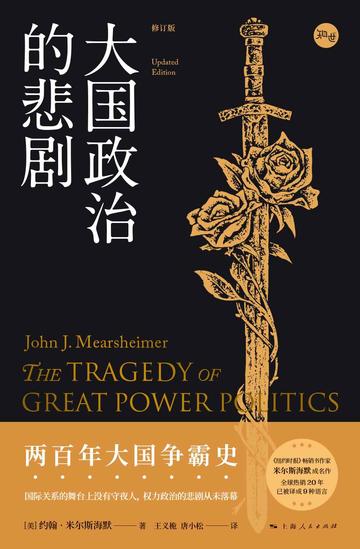


I have to admit that there are always some people in the world who seem to have golden fingers for predicting the future and can see much further than others. I searched on Baidu and found that the author John Mearsheimer published the book "The Tragedy of Great Power Politics" in October 2001. China only joined the WTO on December 11, 2001, and its economic strength was still very weak. However, as early as 2001, the author jumped on the prophets and proposed the China threat theory in this book. Looking back at this book in 2023, many of the predictions have come true. The United States now indeed regards China as its most threatening enemy, and continues to suppress China in the fields of technology, economy, politics and other fields. But I don't want the author's prediction of an eventual war between China and the United States to come true. The Chinese nation has always respected Confucian culture and loves peace. I hope we can escape from the tragedy of a great power and find a path of peaceful development.
The tragedy of great power politics, just looking at the name makes me full of curiosity. What does the tragedy of great power politics mean? Why did this tragedy arise? After reading it, I got some answers. Tragedy is just a characteristic. Through a series of in-depth studies of history and reality, the author reveals the dilemmas, challenges and contradictions existing in the politics of great powers, and expresses the complexity and dilemma of great powers' politics. At the same time, politics is interlinked. The decisions and actions of some major countries can have some impact on other countries and regions. The politics of major countries should alleviate the tragedy through rationality and cooperation, so as to achieve win-win and peaceful development.
In the 1990s, the dramatic changes in the Soviet Union and Eastern Europe caused some Western scholars to propose the "end of history theory", believing that a liberal economic system and ideology would become the social construction framework and concept that governs the world. Behind this view lies a metaphor for the world returning to peace. Millstone tells us in this book that history has shown that peace in international relations is temporary after all. The background of international hegemony in modern times is the selfishness and cunning of big powers, and common interests can only maintain short-term peace. From today's perspective, the Sino-US trade war, national public opinion wars and mutual isolation during the COVID-19 epidemic, and regional hot wars all indicate that the peace of the past thirty years has become a thing of the past. History shows Millstone was right.
After the end of the Cold War, the bipolar opposition between the United States and the Soviet Union was broken, and a situation of one superpower and multiple powers was achieved. The world became peaceful and developed became the theme of the times. People are optimistic about the politics of great powers and believe that the world will remain peaceful from now on and there will be no more wars. Through the French Revolution, this book breaks people's illusions and believes that the nature of great powers is to benefit themselves at the expense of others. Without the management of international organizations, great powers will do whatever they want, and peace cannot be guaranteed.
History can be verified, but no one may be sure of the future. Times are progressing, and we still need to work hard.