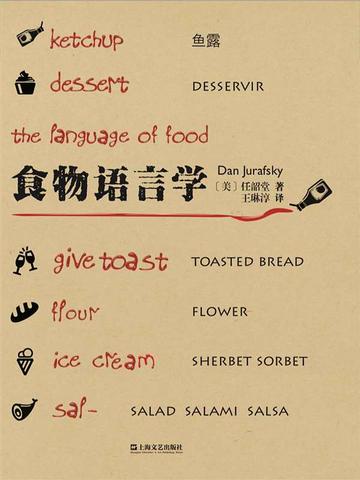
"Food Linguistics" is a very interesting work, starting from ice cream, to potato chips and ketchup, spanning Europe and Asia, and exploring the relationship between food, language and cultural communication.
Some ingredients in daily life can tell their strange origins from their names, such as ketchup, which is commonly used in the West. This weird English word actually comes from the Hokkien word "fish sauce", "chup" is the sound of "sauce" in Hokkien, and "ket" means "kipper". Although the materials are completely different, the language has left traces of history. Why is the turkey that is native to Mexico and often eaten on Thanksgiving named after the country? Who thought of putting fresh milk or juice into wood with ice and salt and stirring it to invent sherbet, and how did sherbet evolve into syrup? Why are Coca-Cola and Pepsi Cola not unrelated to this?
Reader comments
Food is closely related to people's lives, and so is language, but language about food always makes people feel more vivid and involves the perception of multiple senses. The author arranges the entire book into an ordering process through very vivid and humorous language, from how to read the menu to the evaluation and explanation of each dish. While feeling happy, we learned knowledge about the origin of each food noun, such as the difference between macarons and macarons, the origin of potato chips, and the Japanese cultural characteristics behind sushi. Behind the vivid stories circulate the political and economic reasons food embodies. At the end of the book, this foreign friend also discussed the reasons why there are no desserts in China, which was humorous and vivid.
It explores the relationship between food, culture and society from a novel and unique perspective. This is a book that studies the relationship between food and culture. The author reveals the importance of food in society and culture by exploring the symbolic meaning of food and the connection between food and identity. By comparing eating habits and ingredient choices in different cultures, readers can better understand the connection between food and culture. At the same time, the book also touches on topics such as food, identity, and emotions, making the whole book more colorful. This book provides new perspectives and ways of thinking for readers interested in food culture and linguistics.
Like Katie's ketchup question, it made me realize how limited our understanding of common things is. This reminds me of "What is good to eat this year?" ", Also explores culture through food. Moreover, the author's explanation method is very humorous. It feels like chatting with a friend, and people learn a lot of knowledge without knowing it.

Food is closely related to people's lives, and so is language, but language about food always makes people feel more vivid and involves the perception of multiple senses. The author arranges the entire book into an ordering process through very vivid and humorous language, from how to read the menu to the evaluation and explanation of each dish. While feeling happy, we learned knowledge about the origin of each food noun, such as the difference between macarons and macarons, the origin of potato chips, and the Japanese cultural characteristics behind sushi. Behind the vivid stories circulate the political and economic reasons food embodies. At the end of the book, this foreign friend also discussed the reasons why there are no desserts in China, which was humorous and vivid.
It explores the relationship between food, culture and society from a novel and unique perspective. This is a book that studies the relationship between food and culture. The author reveals the importance of food in society and culture by exploring the symbolic meaning of food and the connection between food and identity. By comparing eating habits and ingredient choices in different cultures, readers can better understand the connection between food and culture. At the same time, the book also touches on topics such as food, identity, and emotions, making the whole book more colorful. This book provides new perspectives and ways of thinking for readers interested in food culture and linguistics.
Like Katie's ketchup question, it made me realize how limited our understanding of common things is. This reminds me of "What is good to eat this year?" ", Also explores culture through food. Moreover, the author's explanation method is very humorous. It feels like chatting with a friend, and people learn a lot of knowledge without knowing it.