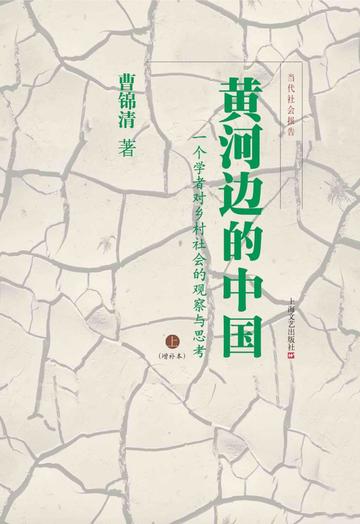
"China by the Yellow River" is a field investigation conducted by scholar Cao Jinqing in Henan from May to November 1996. It is a rare empirical study of contemporary China. "China by the Yellow River" records the transformation of rural society in the Central Plains, involving the changing status quo of the relationship between farmers and land, the market, the kinship network, and local government after the implementation of the land contract responsibility system; it involves many aspects such as rural areas, farmers, agriculture, revenue and expenditure, farmers' burdens, family planning, etc.; It involves the various conflicts caused by the increasingly large and overriding local government and farmers who operate in rural societies and decentralized farmers competing for limited agricultural surplus; it also involves the strong tension between traditional culture as a display of strength and modernization efforts. While trying to describe the social facts of the Central Plains countryside, the author also focuses on reflecting the interests, emotions and attitudes of the small farmer class in the process of social transformation.
"China by the Yellow River", with its huge sense of reality and profound sense of history, has been hailed as "the encyclopedia of rural areas in mainland China". The author's investigation method not only inherits the traditional form of staying in camps and "three relationships" with farmers, but also uses modern sociological case interviews and in-depth communication methods. The author does not hold symposiums from top to bottom, but directly reaches the investigation site-villages, farmhouses, and fields through the "network of relatives and friends". In this kind of field-style interview, the villagers have no doubts and no need to be defensive. Unguarded chatting is the easiest way to obtain social truth, without any artificial packaging, and the content is authentic and credible.
After "China by the Yellow River" was first published in 2000, it aroused strong social response. It was reprinted 13 times in more than ten years, with a cumulative circulation of more than 50,000 copies. It has won the fifth Shanghai Literature and Art Outstanding Achievement Award and the first China Rural Development Research Award. The first edition was limited to the environment of the time, and some content was compressed and deleted. In order to fully present this highly valuable social investigation, the 2013 new edition restored all the deleted content in the past, with a total of more than 100,000 words, accounting for about 20% of the total length. It appears as an unprecedented complete and complete book, with a new significance.
Reader comments
It leads people into the depths of the Central Plains - from the changes in food, clothing and warmth to the stagnation of nostalgia and customs, from the gradual changes in housing and transportation to the cooling of the relationship between cadres and the masses, from administrative directives to raise funds and loans to the almost complete bankruptcy of rural enterprises, from the detailed accounts of farmers' income and expenditure to the formal content of the heavier burden on farmers, from the evolution of clan and family concepts to the confusion of rural democratic construction. The content covers dozens of villages and towns, and provides a detailed and comprehensive record of all aspects of the social life and social psychology of farmers and cadres along the Yellow River in the mid-1990s.
The Yellow River is the mother river of China. China's economic development and civilization inheritance are closely related to the Yellow River. The author shows the unique features and rich culture of the Yellow River Basin region through words and pictures. It uses the Yellow River as a clue to explore the geography, history, humanities and natural environment of the area. We saw the magnificent scenery of the Yellow River, the rich cultural heritage and the lives of local residents, gained a deeper understanding of the Yellow River Basin, and understood the important role of the Yellow River in China's socio-economic development.
"Take the readers from village to house along the Yellow River and have heart-to-heart conversations with all kinds of people." Professor Cao answered various questions and confusion about agriculture, rural areas and farmers, and believed that the complexity of China's rural issues should be treated with caution. Looking at the industrial structure and tax structure, China is already an industrialized country. However, from the perspective of employment structure, China has not yet gotten rid of the basic characteristics of an agricultural society. This kind of employment structure lags behind the industrial structure, which is generally said to be that urbanization lags behind industrialization. The specific manifestation is that nearly 200 million migrant workers are wandering between urban and rural areas, as if they can neither go back nor come in, which is quite embarrassing. Therefore, the issue of migrant workers has become a very important research topic in the current "three rural" research.
The Yellow River is the mother river of China. It gave birth to Chinese civilization. This book records the author's experience of living and working in a rural area in Henan Province, China. It depicts a Chinese rural society where modernization and traditional culture coexist. It involves multiple counties, township-level units and families in Henan Province. Fei Xiaotong put forward a series of important views and theories through in-depth research on farmers' production methods, social structure, cultural traditions and other aspects. Friends who are interested in this kind of field research can come and read it.
I think this book is very real! It is like a documentary about rural China, allowing me to see the lives of farmers and the problems they face. I like the real cases and interviews in the book, which gave me a deeper understanding of rural China. This reminds me of "Rural China", both of which conducted in-depth research on China's rural society. I will recommend this book to my friends so that they can understand the real situation in rural China.
Can someone please analyze and discuss this book? I can't understand it without commenting.

It leads people into the depths of the Central Plains - from the changes in food, clothing and warmth to the stagnation of nostalgia and customs, from the gradual changes in housing and transportation to the cooling of the relationship between cadres and the masses, from administrative directives to raise funds and loans to the almost complete bankruptcy of rural enterprises, from the detailed accounts of farmers' income and expenditure to the formal content of the heavier burden on farmers, from the evolution of clan and family concepts to the confusion of rural democratic construction. The content covers dozens of villages and towns, and provides a detailed and comprehensive record of all aspects of the social life and social psychology of farmers and cadres along the Yellow River in the mid-1990s.
The Yellow River is the mother river of China. China's economic development and civilization inheritance are closely related to the Yellow River. The author shows the unique features and rich culture of the Yellow River Basin region through words and pictures. It uses the Yellow River as a clue to explore the geography, history, humanities and natural environment of the area. We saw the magnificent scenery of the Yellow River, the rich cultural heritage and the lives of local residents, gained a deeper understanding of the Yellow River Basin, and understood the important role of the Yellow River in China's socio-economic development.
"Take the readers from village to house along the Yellow River and have heart-to-heart conversations with all kinds of people." Professor Cao answered various questions and confusion about agriculture, rural areas and farmers, and believed that the complexity of China's rural issues should be treated with caution. Looking at the industrial structure and tax structure, China is already an industrialized country. However, from the perspective of employment structure, China has not yet gotten rid of the basic characteristics of an agricultural society. This kind of employment structure lags behind the industrial structure, which is generally said to be that urbanization lags behind industrialization. The specific manifestation is that nearly 200 million migrant workers are wandering between urban and rural areas, as if they can neither go back nor come in, which is quite embarrassing. Therefore, the issue of migrant workers has become a very important research topic in the current "three rural" research.
The Yellow River is the mother river of China. It gave birth to Chinese civilization. This book records the author's experience of living and working in a rural area in Henan Province, China. It depicts a Chinese rural society where modernization and traditional culture coexist. It involves multiple counties, township-level units and families in Henan Province. Fei Xiaotong put forward a series of important views and theories through in-depth research on farmers' production methods, social structure, cultural traditions and other aspects. Friends who are interested in this kind of field research can come and read it.
I think this book is very real! It is like a documentary about rural China, allowing me to see the lives of farmers and the problems they face. I like the real cases and interviews in the book, which gave me a deeper understanding of rural China. This reminds me of "Rural China", both of which conducted in-depth research on China's rural society. I will recommend this book to my friends so that they can understand the real situation in rural China.
Can someone please analyze and discuss this book? I can't understand it without commenting.
A basic sociology book, interesting