[Editor's Recommendation]
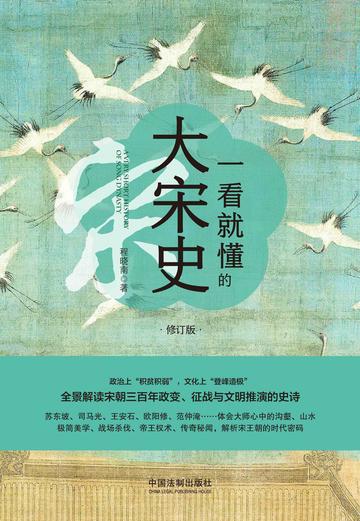
Politically "impoverished and weak," culturally "at its peak"
An epic panorama of three centuries of coups, wars, and civilizational evolution in the Song Dynasty
Su Dongpo, Sima Guang, Wang Anshi, Ouyang Xiu, Fan Zhongyan... Explore the depths of the masters' minds and their visions of mountains and rivers
Minimalist aesthetics, bloody battlefields, imperial machinations, and legendary secrets: Decoding the secrets of the Song Dynasty
[Synopsis]
The Northern Song period is considered one of the most economically and culturally prosperous eras in ancient Chinese history, and many Western historians have called it China's Renaissance. During this time, Confucianism was revived, and the Northern Song literary scene was filled with brilliant stars, including Su Xun, Su Shi, Su Zhe, Ouyang Xiu, Wang Anshi, Zeng Gong, Yan Shu, Yan Jidao, Fan Zhongyan, Liu Yong, Huang Tingjian, and Zhou Bangyan... Little wonder that someone once said, "Since the Qin, no age has seen literature flourish as it did under the Song." Why did this happen? It was probably thanks to Zhao Kuangyin's national policy of "prioritizing civil officials and suppressing the military." But this policy had a major drawback: the military was weak, and the Northern Song was at a constant disadvantage against the Liao and Western Xia in the north. The Treaty of Chanyuan merely eased the pressure on the Northern Song in this regard, while military complacency ultimately led directly to the Jingkang Humiliation. The Jin captured Bianliang, and both Emperor Huizong and Emperor Qinzong of Song were taken prisoner. The Song court had no choice but to move south and establish its capital in Hangzhou, bringing the Northern Song to an end.
[About the Author]
Cheng Xiaonan was born in 1981 in Haiyang, Yantai, Shandong. He graduated from the History Department of Shandong Normal University and currently teaches at Binzhou No. 1 Middle School in Shandong Province, where he is a senior middle school teacher. He has received numerous honors, including being named an outstanding educator and an excellent homeroom teacher in Binzhou. He has published several papers, including "Using Current Affairs to Enrich History Teaching," "The Importance of Reading Methods for Effective High School History Teaching Under the New Curriculum Reform," and "Methods for Implementing Character Education in High School History Education Under the New Curriculum Reform."
The writing style of this book is interesting and the content is easy to understand, as if the author is chatting with you. And the writing style is also good, explaining complex history in a simple and clear way. I especially liked the interpretation of Song Dynasty culture in the book, which gave me a deeper understanding of that era. It feels like traveling back to the Song Dynasty and witnessing that glorious era. It is recommended that you also read it, you will definitely gain something different.