[Editor's Recommendation]
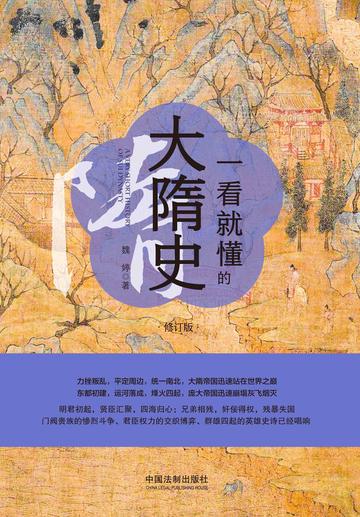
A wise ruler rises and gathers worthy ministers, winning the hearts of the realm; brothers turn against one another, treacherous favorites seize power, and tyranny brings a nation to ruin. The fierce struggles of aristocratic clans, the tangled contests for power between ruler and ministers, and the heroic saga of warlords rising across the land have begun.
[Synopsis]
Yang Jian, born into the Hongnong Yang clan, rose from being the father-in-law of a Northern Zhou emperor to become the founding emperor of the Sui dynasty. Along the way, he carefully evaded the covert attacks of Northern Zhou powerbroker Yuwen Hu and cautiously avoided the suspicions of Emperor Wu of Northern Zhou, Yuwen Yong.
After the incompetent Emperor Xuan took the throne, Yang Jian finally got his chance. He changed the dynasty and founded Sui. Through diligence and vigorous governance, he eventually ushered in the “Reign of Kaihuang.”
But, urged on by Empress Dugu, Yang Jian deposed the crown prince and installed Yang Guang, making a grave mistake. After becoming emperor, Yang Guang did make some contributions to the country. Yet his stubborn, arrogant nature ultimately led him down a path of militaristic expansion and disregard for human life. In the end, warlords rose up across the land, and the Sui dynasty fell...
[About the Author]
Wei Ting, from Laiwu, Shandong, holds a master's degree from the Department of History at Shandong Normal University and is currently a graduate student at the School of Marxism at Wuhan University. She has published nearly ten papers in Theory Study, Anhui Daily, and other publications. She has participated in one Shandong provincial social science project and co-written a history study guide for senior high school students in Shandong.


This book is rich in content and easy to understand, giving me a more comprehensive understanding of the history of the Sui Dynasty. The book also quotes wonderful descriptions such as "Even if the body is wrapped in horse leather, the seven-foot body of a man is not in vain." It made me feel that era when heroes emerged in large numbers. At the same time, the author's evaluation of Emperor Wen of the Sui Dynasty is very objective, allowing me to see a real Emperor Wen of the Sui Dynasty. He ended the war, established a new order, and was excellent in both civil and military skills. All in all, this is a history book worth reading.