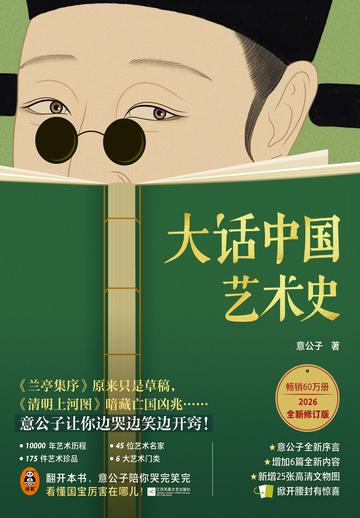
What is the beauty of Chinese aesthetics? What's so great about the national treasure? Mr. Yi will make you cry, laugh and gain enlightenment at the same time!
Yi Gongzi has written a new preface, revealing new aesthetic thinking in the AI era for the first time: 6 new important contents (lacquerware, porcelain, Tang Sancai, etc.), 25 High-definition pictures of cultural relics, the content has been fully expanded, and the true sense of "Chinese art history" has been constructed.
"A History of Chinese Art" starts with primitive pottery and spans the Qin, Han, Tang, Song, Yuan, Ming and Qing dynasties to modern times, covering pottery, jade, bronze, calligraphy, landscape painting, meticulous painting and other unique Chinese art forms.
Using time as the context, Yi Gongzi connects the magnificent art history of more than 10,000 years with familiar art treasures, coupled with vivid language and exquisite pictures, leading readers to re-understand the development context and spiritual connotation of Chinese art, and feel the unique artistic color of this land.
Reader comments
Good-looking, simple and easy to understand, just like Mr. Yi said that Chinese art is a familiar stranger to us. We have heard of it but don't understand it. For an art novice, it is a very happy thing to be able to clearly understand the development process of Chinese art and the human history behind it after reading it. I was lucky enough to meet Mr. Yi. When I saw the end, not only Mr. Yi cried, but I also had tears, but they didn't come out due to the environment. Thank you Mr. Yi for being willing to build a road to accompany us to see the scenery in art along the way. Grateful
The moment I opened the book, I started an artistic journey through thousands of years! The books tell me one by one about the pottery, jade, bronze, and paintings that I have never had an in-depth understanding of, what they have experienced, and what touching stories they are walking through. This is my cultural journey alone!
This book is really good! Yi Gongzi's perspective is very unique and his language is very humorous, making it easy for me, a person who doesn't know much about art, to understand it easily. I especially like the parts about pottery and landscape paintings. I feel that Chinese art is really charming! And this book reminds me of Jiang Xun's "History of Chinese Art for Everyone". They both tell the history of Chinese art in an easy-to-understand way, which is very beneficial to people. I think this book is like a treasure trove of art, and I can gain something new every time I read it.
Indeed, as the author said, there are many categories of ancient Chinese art. The main line of Western art history is not as clear as that of Western art history, so more collection and accumulation are needed. However, in any case, art ultimately expresses people's emotions. Good works will definitely arouse people's resonance.
The language is natural, easy to understand, combined with the language of the times, humorous and true to heart. It is a rare art popularization book. I like it very much. Thank you to the entire team for their hard work. I look forward to more and better works from you!
"The History of Chinese Art" is written by Yi Gongzi. She uses a unique narrative method to transform the eight thousand years of Chinese art development into an easy-to-understand story of civilization, making this book a popular art popularization book in recent years.
Eight thousand years of Chinese art
• Primitive art: budding visual expression: Neolithic pottery and jades bear witness to ancestors' exploration of beauty. The "square on the outside and round on the inside" shape of the Hongshan Culture jade cong contains the ancients' understanding of the order of heaven and earth. The "eggshell thin body" craft of Longshan black pottery reflects a breakthrough in technology and aesthetics. These artifacts are carriers of primitive religion and spiritual beliefs.
• The Bronze Age: Rituals and technological progress: Shang and Zhou bronzes were important sacrificial vessels and models of art. The stepmother Wu tripod is majestic and the Zenghou Yi chime has a precise melody, showing superb casting technology. The Sanxingdui bronze mask has a mysterious shape. Compared with the bronzes from the Central Plains, it reveals the "diversity and unity" characteristics of Chinese civilization. The patterns on the bronzes contain social hierarchy and religious concepts.
• Qin and Han Dynasties to Sui and Tang Dynasties: Art in the prosperous times: the terracotta warriors and horses in Qinling Mausoleum show the majesty of the empire, and the T-shaped silk paintings in Mawangdui reflect the view of life and death. The Dunhuang murals of the Sui and Tang dynasties and Yan Liben's "Moving Chariot Picture" reflect the openness and tolerance of the prosperous times. Art has become a mirror image of social life, such as "Along the River During the Qingming Festival" which delicately depicts the marketplace in the Northern Song Dynasty.
• Song, Yuan, Ming and Qing Dynasties: Literati Spirituality and Secularity: Literary paintings of the Song and Yuan Dynasties marked a shift in the focus of art. Fan Kuan's "Travel in Streams and Mountains" and Su Shi's "Huangzhou Cold Food Post" reflected the literati's observation of nature and the inner world. The individual expressions in the works of Xu Wei and Bada Shanren in the Ming and Qing Dynasties broke through tradition, and Castiglione's painting style showed a fusion of Chinese and foreign paintings. At this stage, art continues the tradition of "integrating poetry, calligraphy and painting" and integrates secular aesthetics.
• Modern transformation: fusion of tradition and modernity: When Western learning spread to the East, Xu Beihong integrated Western realism techniques into Chinese painting, Qi Baishi drew inspiration from folk art, and Pan Yuliang used Fauvist techniques to create self-portraits. The exploration of modern art is the process of Chinese culture finding new expressions in the fission of the times.
Use interesting words to create innovative narratives
• "Life stage" metaphor: The whole book uses "exploration in infancy - glory in adulthood - reflection in old age" as a metaphor for the development of art history. For example, primitive art is the ignorant exploration in "infancy", the art of the Tang and Song Dynasties is the self-confidence and publicity in "the prime of life", and the art of the Ming and Qing Dynasties is the precipitation and reflection in "twilight years". It helps readers remember the historical context and reveals the logic and spiritual characteristics of artistic development.
• Story-based interpretation: Yi Gongzi restored the works of art to life scenes, such as describing the birth of Wang Xizhi's "Preface to the Orchid Pavilion Collection" as a "literati gathering party" and Gu Hongzhong's "Han Xizai's Night Banquet" as an "ancient spy war", allowing cultural relics and paintings to become carriers of historical emotions, allowing readers to understand the connection between art and the times.
• Visual narrative: The high-definition pictures of cultural relics in the book are combined with the text's analysis of colors, materials, and techniques to form an immersive experience of "co-reading with pictures and text." For example, through the layered diagram of T-shaped silk paintings, we can understand the concept of funeral in the Han Dynasty, and through the analysis of the composition of Dunhuang murals, we can reveal the cultural integration of the Tang Dynasty.
•Popular language: The author abandons obscure terminology and uses popular and interesting language to narrate. For example, he calls the etiquette aesthetics of Zhou Dynasty bronze eating utensils "eating habits" and jokingly calls breakthroughs in bronze casting technology "ancient black technology", which lowers the reading threshold.
My understanding of "big words"
• The "big art history" view: This book adopts the "big art history" view and brings various art forms into the field of vision. It not only emphasizes the mystery of Sanxingdui civilization, but also reveals its value as a branch of Chinese civilization. The analysis of Tang Bohu's secular figure paintings shows the phenomenon of secularization of the aesthetics of artistic works.
• The literati philosophy of integrating poetry, calligraphy and painting: The book explains the "integration of poetry, calligraphy and painting" characteristics of Chinese art. Wang Xizhi's "Preface to the Orchid Pavilion Collection", Zheng Banqiao's Bamboo and Stone Pictures, Su Shi's "Huangzhou Cold Food Post" and other works reflect the natural integration of calligraphy, painting and poetry. The literati spirit carried by Chinese art, such as the idea of "unity of man and nature", and the painter's attitude towards reality, is its charm.
• The coexistence of individual destiny and the times: Art works bear the imprint of the times. Wang Ximeng's "A Thousand Miles of Rivers and Mountains" contains the political ideals of Emperor Huizong of the Song Dynasty. Xu Beihong's "Galloping Horse" and Qi Baishi's "Shrimp" embody modern China's survival and cultural confidence. The interpretation of art paintings, artists and historical backgrounds makes art history a part of the development history of historical civilization.
The value of "Talk about Chinese Art History"
The narrative and structure of this book are innovative. It avoids the accumulation of professional terms and uses popular language to explain the origin of art and creative mood. The linear narrative structure is clear, using keywords to summarize the artistic characteristics of the era, and using the metaphor of "life stages" to make the historical context clear. At the same time, the author captures the common emotions of ancient and modern times and enhances the sense of immersion in reading. "The History of Chinese Art" is both popular and ideological. Through innovative narrative, Yi Gongzi allows ordinary readers to perceive the aesthetic genes of Chinese civilization and appreciate the beauty of Chinese art.
The writing is really good, and it brings each artist in history to life. It turns out that they also had youthful frivolity, bumpy fate, and wasted life, as well as the awe-inspiring righteousness of serving the country and the people, and the pleasure and grudges of going their own way... It seems that I have made a lot of artist friends. We all have different lives, but at this moment we are sympathetic.
It is very well written. I seem to be looking at a historical figure standing in front of me vividly. It is not a straight-forward text. It contains high-definition works and touching stories, which attract me to keep reading. I not only want to read it once, but I want to read it three or four times countless times. It is well-founded, clear, vivid and interesting. Thank you very much to the author!
The content is very compact and the knowledge points are very coherent.
This book is really well written. It makes boring history very humorous and easy to understand. In the process of listening to the story, I learned a lot of historical knowledge. It is a very good book.
An in-depth and simple explanation of the art of Chinese painting, each artist vividly appears before our eyes. This book is great [Like][Like][Like]
Explains the profound things in a simple way, is not impatient or impatient, and talks without leaving the book bag. It is a great work [like][like]
The greatest function of art is to soothe people's hearts
A great book, sorted out in a chronological context, to enhance art novices' concepts of classical art
Love art, love life, love yourself
The language is plain and sincere,
The true meaning of Chinese art is artistic conception
I always thought that art was unattainable, but through the author's guidance I discovered that art has never been separated from life. All works of art are realistic representations of life and explorations of life.
I learned a lot and understood a lot. Grateful!
If you know the history, you can check it out, it's pretty good.
It is well written, rich and informative yet interesting. It compares the history of Chinese art to a person's life, making it more vivid and three-dimensional. The language is full of humanistic feelings. It is an excellent book for studying the history of Chinese art.
It's very beautiful, the writing context is very clear, and the tone is easy-going, like a famous writer telling the history of art in a story-telling tone.
Super cool. Deeply impressed by the author's knowledge and talent.
Good-looking, simple and easy to understand, just like Mr. Yi said that Chinese art is a familiar stranger to us. We have heard of it but don't understand it. For an art novice, it is a very happy thing to be able to clearly understand the development process of Chinese art and the human history behind it after reading it. I was lucky enough to meet Mr. Yi. When I saw the end, not only Mr. Yi cried, but I also had tears, but they didn't come out due to the environment. Thank you Mr. Yi for being willing to build a road to accompany us to see the scenery in art along the way. Grateful
The moment I opened the book, I started an artistic journey through thousands of years! The books tell me one by one about the pottery, jade, bronze, and paintings that I have never had an in-depth understanding of, what they have experienced, and what touching stories they are walking through. This is my cultural journey alone!
This book is really good! Yi Gongzi's perspective is very unique and his language is very humorous, making it easy for me, a person who doesn't know much about art, to understand it easily. I especially like the parts about pottery and landscape paintings. I feel that Chinese art is really charming! And this book reminds me of Jiang Xun's "History of Chinese Art for Everyone". They both tell the history of Chinese art in an easy-to-understand way, which is very beneficial to people. I think this book is like a treasure trove of art, and I can gain something new every time I read it.
Indeed, as the author said, there are many categories of ancient Chinese art. The main line of Western art history is not as clear as that of Western art history, so more collection and accumulation are needed. However, in any case, art ultimately expresses people's emotions. Good works will definitely arouse people's resonance.
The language is natural, easy to understand, combined with the language of the times, humorous and true to heart. It is a rare art popularization book. I like it very much. Thank you to the entire team for their hard work. I look forward to more and better works from you!
"The History of Chinese Art" is written by Yi Gongzi. She uses a unique narrative method to transform the eight thousand years of Chinese art development into an easy-to-understand story of civilization, making this book a popular art popularization book in recent years. Eight thousand years of Chinese art • Primitive art: budding visual expression: Neolithic pottery and jades bear witness to ancestors' exploration of beauty. The "square on the outside and round on the inside" shape of the Hongshan Culture jade cong contains the ancients' understanding of the order of heaven and earth. The "eggshell thin body" craft of Longshan black pottery reflects a breakthrough in technology and aesthetics. These artifacts are carriers of primitive religion and spiritual beliefs. • The Bronze Age: Rituals and technological progress: Shang and Zhou bronzes were important sacrificial vessels and models of art. The stepmother Wu tripod is majestic and the Zenghou Yi chime has a precise melody, showing superb casting technology. The Sanxingdui bronze mask has a mysterious shape. Compared with the bronzes from the Central Plains, it reveals the "diversity and unity" characteristics of Chinese civilization. The patterns on the bronzes contain social hierarchy and religious concepts. • Qin and Han Dynasties to Sui and Tang Dynasties: Art in the prosperous times: the terracotta warriors and horses in Qinling Mausoleum show the majesty of the empire, and the T-shaped silk paintings in Mawangdui reflect the view of life and death. The Dunhuang murals of the Sui and Tang dynasties and Yan Liben's "Moving Chariot Picture" reflect the openness and tolerance of the prosperous times. Art has become a mirror image of social life, such as "Along the River During the Qingming Festival" which delicately depicts the marketplace in the Northern Song Dynasty. • Song, Yuan, Ming and Qing Dynasties: Literati Spirituality and Secularity: Literary paintings of the Song and Yuan Dynasties marked a shift in the focus of art. Fan Kuan's "Travel in Streams and Mountains" and Su Shi's "Huangzhou Cold Food Post" reflected the literati's observation of nature and the inner world. The individual expressions in the works of Xu Wei and Bada Shanren in the Ming and Qing Dynasties broke through tradition, and Castiglione's painting style showed a fusion of Chinese and foreign paintings. At this stage, art continues the tradition of "integrating poetry, calligraphy and painting" and integrates secular aesthetics. • Modern transformation: fusion of tradition and modernity: When Western learning spread to the East, Xu Beihong integrated Western realism techniques into Chinese painting, Qi Baishi drew inspiration from folk art, and Pan Yuliang used Fauvist techniques to create self-portraits. The exploration of modern art is the process of Chinese culture finding new expressions in the fission of the times. Use interesting words to create innovative narratives • "Life stage" metaphor: The whole book uses "exploration in infancy - glory in adulthood - reflection in old age" as a metaphor for the development of art history. For example, primitive art is the ignorant exploration in "infancy", the art of the Tang and Song Dynasties is the self-confidence and publicity in "the prime of life", and the art of the Ming and Qing Dynasties is the precipitation and reflection in "twilight years". It helps readers remember the historical context and reveals the logic and spiritual characteristics of artistic development. • Story-based interpretation: Yi Gongzi restored the works of art to life scenes, such as describing the birth of Wang Xizhi's "Preface to the Orchid Pavilion Collection" as a "literati gathering party" and Gu Hongzhong's "Han Xizai's Night Banquet" as an "ancient spy war", allowing cultural relics and paintings to become carriers of historical emotions, allowing readers to understand the connection between art and the times. • Visual narrative: The high-definition pictures of cultural relics in the book are combined with the text's analysis of colors, materials, and techniques to form an immersive experience of "co-reading with pictures and text." For example, through the layered diagram of T-shaped silk paintings, we can understand the concept of funeral in the Han Dynasty, and through the analysis of the composition of Dunhuang murals, we can reveal the cultural integration of the Tang Dynasty. •Popular language: The author abandons obscure terminology and uses popular and interesting language to narrate. For example, he calls the etiquette aesthetics of Zhou Dynasty bronze eating utensils "eating habits" and jokingly calls breakthroughs in bronze casting technology "ancient black technology", which lowers the reading threshold. My understanding of "big words" • The "big art history" view: This book adopts the "big art history" view and brings various art forms into the field of vision. It not only emphasizes the mystery of Sanxingdui civilization, but also reveals its value as a branch of Chinese civilization. The analysis of Tang Bohu's secular figure paintings shows the phenomenon of secularization of the aesthetics of artistic works. • The literati philosophy of integrating poetry, calligraphy and painting: The book explains the "integration of poetry, calligraphy and painting" characteristics of Chinese art. Wang Xizhi's "Preface to the Orchid Pavilion Collection", Zheng Banqiao's Bamboo and Stone Pictures, Su Shi's "Huangzhou Cold Food Post" and other works reflect the natural integration of calligraphy, painting and poetry. The literati spirit carried by Chinese art, such as the idea of "unity of man and nature", and the painter's attitude towards reality, is its charm. • The coexistence of individual destiny and the times: Art works bear the imprint of the times. Wang Ximeng's "A Thousand Miles of Rivers and Mountains" contains the political ideals of Emperor Huizong of the Song Dynasty. Xu Beihong's "Galloping Horse" and Qi Baishi's "Shrimp" embody modern China's survival and cultural confidence. The interpretation of art paintings, artists and historical backgrounds makes art history a part of the development history of historical civilization. The value of "Talk about Chinese Art History" The narrative and structure of this book are innovative. It avoids the accumulation of professional terms and uses popular language to explain the origin of art and creative mood. The linear narrative structure is clear, using keywords to summarize the artistic characteristics of the era, and using the metaphor of "life stages" to make the historical context clear. At the same time, the author captures the common emotions of ancient and modern times and enhances the sense of immersion in reading. "The History of Chinese Art" is both popular and ideological. Through innovative narrative, Yi Gongzi allows ordinary readers to perceive the aesthetic genes of Chinese civilization and appreciate the beauty of Chinese art.
The writing is really good, and it brings each artist in history to life. It turns out that they also had youthful frivolity, bumpy fate, and wasted life, as well as the awe-inspiring righteousness of serving the country and the people, and the pleasure and grudges of going their own way... It seems that I have made a lot of artist friends. We all have different lives, but at this moment we are sympathetic.
It is very well written. I seem to be looking at a historical figure standing in front of me vividly. It is not a straight-forward text. It contains high-definition works and touching stories, which attract me to keep reading. I not only want to read it once, but I want to read it three or four times countless times. It is well-founded, clear, vivid and interesting. Thank you very much to the author!
The content is very compact and the knowledge points are very coherent.
This book is really well written. It makes boring history very humorous and easy to understand. In the process of listening to the story, I learned a lot of historical knowledge. It is a very good book.
An in-depth and simple explanation of the art of Chinese painting, each artist vividly appears before our eyes. This book is great [Like][Like][Like] Explains the profound things in a simple way, is not impatient or impatient, and talks without leaving the book bag. It is a great work [like][like]
The greatest function of art is to soothe people's hearts
A great book, sorted out in a chronological context, to enhance art novices' concepts of classical art Love art, love life, love yourself
The language is plain and sincere,
The true meaning of Chinese art is artistic conception I always thought that art was unattainable, but through the author's guidance I discovered that art has never been separated from life. All works of art are realistic representations of life and explorations of life.
I learned a lot and understood a lot. Grateful!
If you know the history, you can check it out, it's pretty good.
It is well written, rich and informative yet interesting. It compares the history of Chinese art to a person's life, making it more vivid and three-dimensional. The language is full of humanistic feelings. It is an excellent book for studying the history of Chinese art.
It's very beautiful, the writing context is very clear, and the tone is easy-going, like a famous writer telling the history of art in a story-telling tone.
Super cool. Deeply impressed by the author's knowledge and talent.