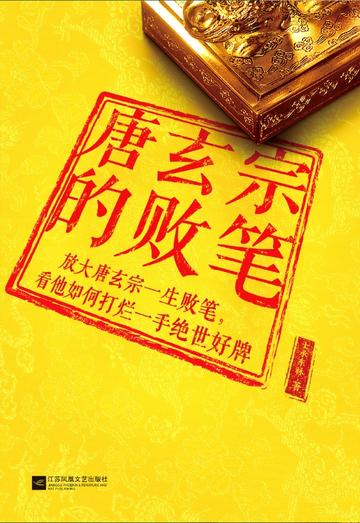
Li Longji, Emperor Xuanzong of the Tang Dynasty, created the "Kaiyuan Dynasty" in the first half of his life. In the court, there were Yao Chong, Song Jing, and Zhang Jiuling in the literary field, and Gao Xianzhi and Ge Shuhan in the martial arts. They opened up territories and expanded the territory, and were invincible in battles. Their literary, political, and martial arts were comparable to those of Emperor Taizong of the Tang Dynasty. Sitting on such a pair of unparalleled cards, but in just 14 years, it failed one after another, and a prosperous generation was destroyed by the Anshi Rebellion...
Failure 1: Indulging in pleasure, causing traitorous ministers to monopolize power and harm the country
Emperor Xuanzong of the Tang Dynasty was satisfied with the appearance of a prosperous age, indulged in pleasure, and had no interest in political affairs. He allowed two treacherous officials, Li Linfu and Yang Guozhong, to control the government. Especially Yang Guozhong, the brother of Concubine Yang, relied on nepotism to become domineering and unrivaled in power, resulting in corruption and chaos within the entire court.
Failure 2: The implementation of the military recruitment system in the border town resulted in the Jieduzhi having great power.
With the disintegration of the equal land system, the military system, which was the basis of the economy, also collapsed. Faced with the depletion of military resources, Emperor Xuanzong of the Tang Dynasty began to implement a recruitment system, which resulted in the military power being controlled by Jiedushi, and a large number of "private soldiers" who only recognized the generals and not the emperor were gathered in the border towns, resulting in a military situation in which external emphasis was placed on the outside and internal affairs were neglected.
Failure Three: Superstition in the imperial checks and balances, leading to conflicts.
Tang Xuanzong supported multiple forces to engage in factional struggles at the same time. He believed that this kind of check and balance relationship was more conducive to the monarchy. Yang Guozhong held great power in the court, so An Lushan, who was at odds with Yang Guozhong, was reused in the army. The conflict between the general and the prime minister deepened day by day. In the end, An Lushan used the excuse of "crusade against Yang Guozhong" to rebel.
…………
Open this book and see how Emperor Xuanzong of the Tang Dynasty failed one after another and destroyed the prosperous Tang Dynasty!
Reader comments
The short book is not long, but it describes Tang Xuanzong and Li Longji with flesh and blood, truly reproducing the key figures in history who can control the destiny of the people and the power of life and death in the country. Reading history will make people clear, reading history will teach people, and reading history will increase wisdom.
Very very good
The writing style of this book is very clear and the writing style is good. The author has done a deep research on the history of Tang Xuanzong period. By listing various failures of Emperor Xuanzong of the Tang Dynasty, the author vividly presents that period of history in front of us, allowing us to see more clearly the reasons for the decline of the prosperous Tang Dynasty. I think this book is worth reading, especially for those who are interested in history.

The short book is not long, but it describes Tang Xuanzong and Li Longji with flesh and blood, truly reproducing the key figures in history who can control the destiny of the people and the power of life and death in the country. Reading history will make people clear, reading history will teach people, and reading history will increase wisdom.
Very very good
The writing style of this book is very clear and the writing style is good. The author has done a deep research on the history of Tang Xuanzong period. By listing various failures of Emperor Xuanzong of the Tang Dynasty, the author vividly presents that period of history in front of us, allowing us to see more clearly the reasons for the decline of the prosperous Tang Dynasty. I think this book is worth reading, especially for those who are interested in history.