Editor's recommendation
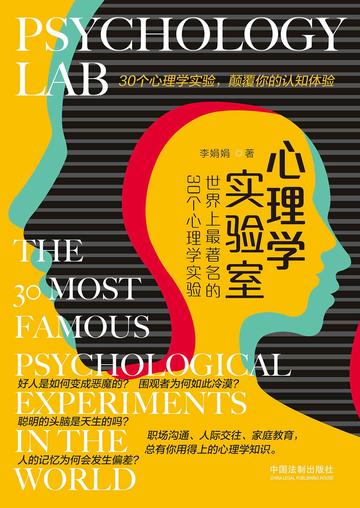
30 psychology experiments that will subvert your cognitive experience
How do good people become evil? Why are the onlookers so indifferent?
Are smart minds innate? Why does human memory go awry?
There is always psychological knowledge that you can use in workplace communication, interpersonal interactions, and family education.
Introduction
This book introduces 30 famous psychological experiments that were controversial and caused a stir in the history of psychology. Some of them violated professional ethics and were too cruel, causing pain to the participants, such as the Stanford Prison Experiment and Milgram's electric shock experiment. Some challenge the basic beliefs of mankind and impact the deep-rooted values of mankind. For example, Judy Harris's research on genes and upbringing weakens the influence of parents on their children, which is difficult for us who believe that "parents are their children's first teachers" to accept. Other experiments have caused great suffering to animals that also have the right to life and dignity, such as the dog in the learned helplessness experiment that was shocked in a cage but had nowhere to escape and could only whine helplessly. All in all, these psychological experiments are a bit "perverted", but they are thought-provoking.
[About the author]
Li Juanjuan is a well-known psychological writer. Her representative works include "The Psychology of Micro-Reactions", "The Psychology of Micro-Expressions", "Psychology and Executive Power", "Psychology and Emotional Control", "Psychology and Negotiation Power", "Psychology and Business", etc.
Reader comments
This book is very interesting! Through some famous psychological experiments, it allows us to see the complexity of human nature and the impact of the environment on people. I particularly liked the Stanford Prison Experiment in the book, which taught me that the environment can change a person's behavior and attitude. The knowledge in this book is useful in interpersonal communication and family education, and it is worth reading.
This book is very interesting! Through some famous psychological experiments, it allows us to see the complexity of human nature and the impact of the environment on people. I particularly liked the Stanford Prison Experiment in the book, which taught me that the environment can change a person's behavior and attitude. The knowledge in this book is useful in interpersonal communication and family education, and it is worth reading.