In ancient times, in ordinary people's minds, there were all kinds of magnificent and moving myths and legends, such as Pangu created the world, Nuwa skillfully mended the sky, Fuxi created the Eight Trigrams, Shen Nong tasted hundreds of herbs, Yao and Shun abdicated, Dayu controlled the floods, etc. For thousands of years, these legends have been regarded as trustworthy history and influenced generations of people. What is the situation close to reality?
In the Xia, Shang and Zhou dynasties, apart from the stories of Xia Qi seizing the throne, Shang Tang destroying Jie, King Wen conquering Zhou, and stories of kings, saints, and ministers such as Bigan gouging out his heart, Jiang Shang fishing, and Duke Zhou spitting out food, as well as the specious characterization of a "slave society," there seems to be no other deep imprint in the memory. Is this period of history that lasts almost two thousand years really nothing more than that?
It is said that there were many assassins during the Spring and Autumn Period. For example, in 712 BC, Minister Yu Fu of the State of Lu sent an assassin to stab Duke Yin of Lu to death; in 611 BC, Mrs. Xiang sent an assassin to stab to death her grandson Duke Zhao of Song; in 607 BC, members of the powerful minister Zhao Dun of Jin stabbed Duke Ling of Jin to death; however, why were similar scenes of regicide frequently staged during the Spring and Autumn Period? …
It is said that the Song Dynasty was extremely prosperous and powerful, but why was it always suppressed by foreigners? From Zhao Kuangyin, who gave up his military power over a glass of wine and exhausted all his agencies, to Aguda, who started a rebellion with two thousand people and conquered thousands of miles, from Abaoji, who unified eight tribes and destroyed everything, to Temujin, who conquered the east and west and made the world surrender. How did the Song, Liao, Xia, Jin and Yuan take turns to conquer the world? What are the similarities and differences in their rise, growth and decline? Why did the struggle for survival among China's various ethnic groups reach a climax in these three hundred years? …
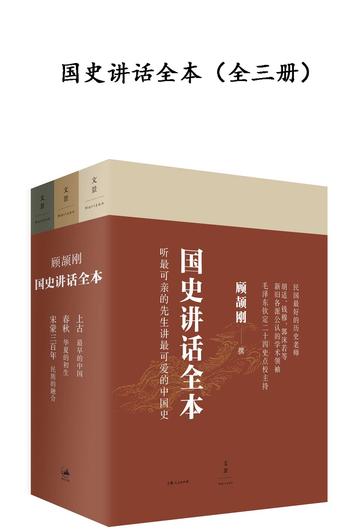
Qian Mu's Bole, teacher of masters of history such as Tan Qixiang, Tong Shuye, Yang Xiangkui, Bai Shouyi, and historian Gu Jiegang, who has long held the top position in the field of ancient history in the Republic of China, started his lectures with sincerity and relaxed, telling the truth and falsehood of ancient legends, the division and convergence of the Spring and Autumn Period, and the fierce conquests of Song and Mongolia.
Reader comments
This book is like a kind teacher, telling the history from ancient times to the Song and Yuan Dynasties in an easy-to-understand way. Mr. Gu Jiegang commented on various historical legends and stories, which gave me a deeper understanding of history. The characters' experiences and personalities are also very vivid. The frequent scenes of regicide made me see the chaos of the Spring and Autumn Period. Moreover, this book also made me think about history, which is really great!

This book is like a kind teacher, telling the history from ancient times to the Song and Yuan Dynasties in an easy-to-understand way. Mr. Gu Jiegang commented on various historical legends and stories, which gave me a deeper understanding of history. The characters' experiences and personalities are also very vivid. The frequent scenes of regicide made me see the chaos of the Spring and Autumn Period. Moreover, this book also made me think about history, which is really great!