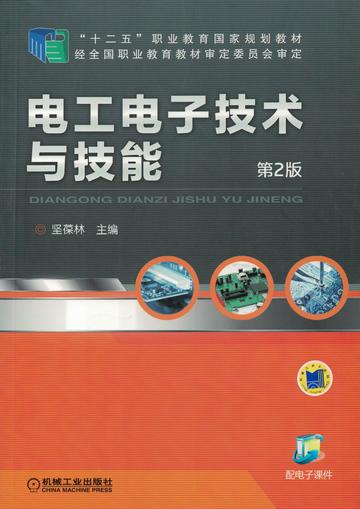
This book is a new nationally planned textbook for secondary vocational education curriculum reform. It is compiled based on the "Secondary Vocational School Electrical and Electronic Technology Basics and Skills Teaching Syllabus" released by the Ministry of Education in 2009.
This book integrates theoretical courses, experimental courses and practical training courses, and the electrical and electronic technology courses are divided into 4 parts with 15 chapters: the first part is circuit basics (understanding the electrician training room and safe use of electricity, DC circuits, capacitance and inductance, magnetic field and electromagnetic induction, single-phase sinusoidal AC circuit, three-phase sinusoidal AC circuit); the second part is electrical technology (electrical technology, Commonly used electrical appliances, basic control circuits of three-phase asynchronous motors); the third part is analog electronic technology (understanding electronic training room and basic skills training, commonly used semiconductor devices, rectification, filtering and voltage stabilizing circuits, amplification circuits and integrated operational amplifiers); the fourth part is digital electronic technology (basics of digital electronic technology, combinational logic circuits and sequential logic circuits).
This book is written based on the principles of "broadness, simplicity, practicality, and novelty". The content is close to the reality of production and life. The form of expression is mainly charts and graphs. It strives to be lively and suitable for the characteristics of secondary vocational students.
Reader comments
The content of this book is very practical, combining theory and practice, and is rich in diagrams and easy to understand. The basic knowledge of electrical and electronic technology is explained very clearly, which is very suitable for fresh graduates like me. It feels similar to the book "Basics of Electronic Technology", both of which explain the basic knowledge of electrical and electronic technology. The author Jian Baolin must be an experienced teacher. The contents in the book are very close to reality and are very helpful for learning!


The content of this book is very practical, combining theory and practice, and is rich in diagrams and easy to understand. The basic knowledge of electrical and electronic technology is explained very clearly, which is very suitable for fresh graduates like me. It feels similar to the book "Basics of Electronic Technology", both of which explain the basic knowledge of electrical and electronic technology. The author Jian Baolin must be an experienced teacher. The contents in the book are very close to reality and are very helpful for learning!