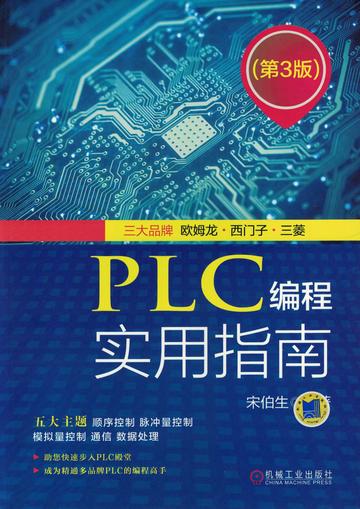
"Practical Guide to PLC Programming (3rd Edition)" focuses on the five major themes of PLC for sequence control, pulse control, analog control, communication and data processing. It analyzes the resources and functions of Omron, Siemens, Mitsubishi and some Hollysys (including ABB), AB, Schneider, and GE PLCs. Taking the application design of these five major themes as examples, it systematically introduces the theory, algorithm and skills of PLC application design, with theoretical integrity and practical operability. This book has complete content, clear concepts, practical algorithms, originality and innovation, wide coverage, and a large amount of information. It is a practical guide to PLC programming. It can help you enter the PLC programming palace as soon as possible, and then become a master of multi-brand PLC programming technology.
Reader comments
This book is very practical! It is complete in content and covers PLC programming technology of various brands. The concept is clear and the definition and characteristics of PLC are explained thoroughly. Through this book, we can understand the important role of PLC in industrial control, and also learn the theories and techniques of various application design. As the book says, "The main difference between it and ordinary computers is that it does not have a keyboard and is replaced by input contacts or modules." This sentence simply and clearly points out one of the characteristics of PLC. In short, this is a very good guide to PLC programming.




This book is very practical! It is complete in content and covers PLC programming technology of various brands. The concept is clear and the definition and characteristics of PLC are explained thoroughly. Through this book, we can understand the important role of PLC in industrial control, and also learn the theories and techniques of various application design. As the book says, "The main difference between it and ordinary computers is that it does not have a keyboard and is replaced by input contacts or modules." This sentence simply and clearly points out one of the characteristics of PLC. In short, this is a very good guide to PLC programming.