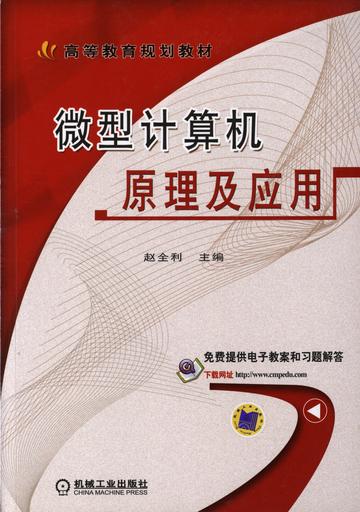
"Microcomputer Principles and Applications" combines three parts: microprocessor structural principles, assembly language programming and interface application technology. First, after an overview of basic computer knowledge and the composition of microcomputer systems, based on the 8086 CPU, the hardware structure, working principle, instruction system, assembly language programming and EMU8086 simulation software application examples of the 80x86 microprocessor are introduced in detail. Then, the microcomputer memory system and interface design, input/output interface, bus and interrupt application technology are described in detail. The following chapters focus on commonly used integrated programmable chips, with application technology as the core, focusing on serial communication, parallel communication, timer/counter, D-A and A-D conversion and interface circuit software and hardware design, and simulate and debug application examples through Proteus circuit principle design. "Microcomputer Principles and Applications" is easy to understand, has clear concepts, and parallels application and virtual simulation. Through a large number of examples and simulation environment debugging, it guides readers to gradually understand, become familiar with, and master microcomputer application technology.
Reader comments
This book is detailed, easy to understand, and very helpful for learning the principles and applications of microcomputers. The examples and simulation debugging in the book can help us better understand and master the knowledge points. Among them, "The application of microcomputers has been widely used in scientific computing, information processing, transaction management, system control, instrumentation, and various fields of human learning and life." This sentence made me deeply realize the importance of microcomputers. I think this book is a must-have for studying computer-related majors.

This book is detailed, easy to understand, and very helpful for learning the principles and applications of microcomputers. The examples and simulation debugging in the book can help us better understand and master the knowledge points. Among them, "The application of microcomputers has been widely used in scientific computing, information processing, transaction management, system control, instrumentation, and various fields of human learning and life." This sentence made me deeply realize the importance of microcomputers. I think this book is a must-have for studying computer-related majors.