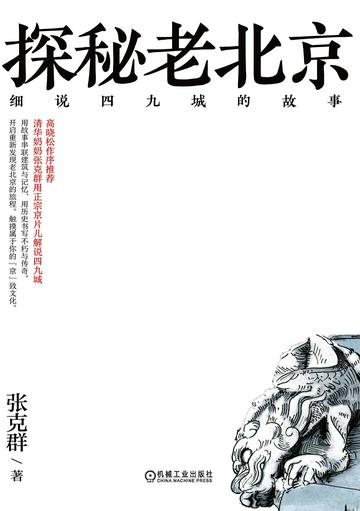
Explore Old Beijing and Tell the Story of the Forty-Nine Cities in Detail
探秘老北京 细说四九城的故事
- Status
- Completed
- Length
- 71k Words
- Updated
- 4y ago
- Source
- Fanqie
Stats
31Reads
8.5Score
10Chapters
15Listens
16.7kReads · all time
Tags
Synopsis
Reader comments
In booklists 3


Knowledge books
10.9MViews642Books8dUpdated

Is There Any Old Shanghai or Old Beijing Literature?
It's the kind that has dialects in it and is more realistic, such as Liang Chen Mei Mei.
5.9MViews201Books3dUpdated
Looking for Literate Books
I want to read a book like "About the Prince of the Southern Dynasties I Impersonated".
3.9kViews117Books11moUpdated
Forty-Nine City is a subdivision on the city wall of Beijing and one of the most distinctive places in old Beijing. In the past, Sijiucheng was famous for its unique cultural atmosphere, architectural style and social lifestyle. It was built in the Yuan Dynasty and was originally a fortification outside the imperial city. It began to be expanded in the Ming Dynasty and became a bustling commercial district in the Qing Dynasty, including many teahouses, restaurants, theaters, etc. There are many typical Beijing hutongs in Sijiucheng, such as Banjie Hutong, Caochong Hutong, Pedestrian Hutong, etc. These hutongs are important cultural heritage left over from old Beijing, reflecting the people's lifestyle and social conditions at that time.
From the natural conditions of Beijing to the Yan Kingdom and the Five Dynasties and Ten Kingdoms, from the capital of Nanjing in the Liao Dynasty to the capital of Jin, from the capital of the Yuan Dynasty to the Beijing city of the Ming Dynasty and then to the Beijing city of the Qing Dynasty, from inside to outside the city, from the imperial city to the alleys, the history, culture and architecture of Beijing are interpreted, allowing readers to appreciate the unique charm and rich historical and cultural connotations of Beijing. This book explains the development process, urban pattern and architectural features of Beijing through clear explanations and vivid and humorous language. This book includes four parts: establishing an archive of Beijing, detailing the four-nine cities, the streets and alleys, and the bustling life outside the city.
This book covers everything from ancient times to the present, from line to point, and is a popular science book on Beijing's architectural history that is suitable for all ages. The text of this book is concise and smooth, and the arrangement is reasonable. It not only introduces the history of Beijing city, but also tells many interesting stories about old Beijing, truly reproducing the historical development process of Beijing city. During the interpretation process, the language is easy to understand and humorous, telling readers historical stories such as the distribution of the four nine cities and eight banners in the Qing Dynasty, the difference and disappearance of the archways and archways in Beijing, and also accompanied by corresponding pictures, both pictures and texts, to facilitate readers' understanding.
Beijing is the city with the most flavor that can be found in China. Its taste has existed since the birth of the city of Beijing and continues to this day. By studying various aspects of Beijing, the book perfectly presents the imperial city of Beijing to readers. My language is very witty and humorous. With unique and charming language, readers can appreciate the unique charm and rich cultural heritage of Beijing. Learn about the story of Four Nine Cities.
If we build archives for Beijing, we have to mention the hutongs and the Four Nine Cities. From the roots of the imperial city to the Summer Palace, this geomantic treasure land not only has superior natural conditions, but also contains profound humanistic accumulation and cultural heritage. Most of the plans and place names we are familiar with in Beijing during the Ming and Qing Dynasties are still preserved, such as the various ancient bridges and the tombs of princes, princesses, etc., All telling long-standing stories and the prosperity of each dynasty. Although Beijing has an ancient history, its humanities are getting more and more modern. Today, this old city is attracting the attention of countless Chinese young people as a global metropolis.
I especially like the streets and alleys mentioned in the book. I feel like I am traveling through the city of Beijing. However, I hate that little gangster who always bullies others, he is really bad! My favorite character is the old storyteller. He knows a lot of interesting historical and cultural knowledge. This book made me study harder and I will definitely visit Beijing if I have the opportunity in the future!