I'm Looking for High-Quality Historical Articles, Not Mindless and Cool Articles, and Don't Come Here If You Want to Bring Down Your Wits.
I want high-quality historical articles that are good-looking, not intellectually subdued, and not brainless. They can be enjoyable, but don't treat readers as fools. The food officer who deceived Cao Cao at the beginning, and the literary protagonist who always possesses the power of a king, should not be here. They have no new ideas and no brains...
377Books7.8MViews2dUpdated
From a broad perspective, since the "Seven Kingdoms Rebellion" under Emperor Jing of the Han Dynasty, there has been no large-scale civil strife for about 150 years, which can be called a long period of peace; externally, the Xiongnu problem that has troubled the Han Dynasty for many years has also been eased. From the time when Emperor Wu of the Han Dynasty sent Wei Qing and Huo Qubing to chase the North and Emperor Yuan of the Han Dynasty sent "Zhaojun out of the fortress", the Han Dynasty and the Xiongnu have coexisted peacefully for more than 30 years. Speaking of the Xiongnu and their relatives, the situation in the Western Regions is also very stable. Although the wealth of ordinary people living in the Western Han Dynasty at this time should not be exaggerated, it is by no means as bleak as the world was in chaos: the cessation of wars and social stability brought about economic growth, and the population reached its peak.
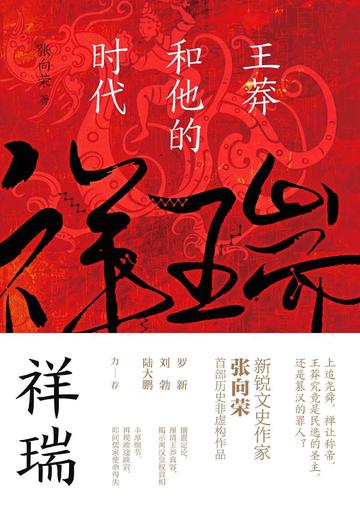
Traditional historiography relegated Xin Mang to a leap position, and made this important moment in the late classical period look grotesque and absurd. Zhang Xiangrong allows readers to see a transitional era full of vitality and possibility with his in-depth and detailed writing. It is very well written. The first chapter is a brief introduction to the history of Han Dynasty. It integrates various cutting-edge results and has a huge amount of information. Regarding the part about Wang Mang specifically, the existing research itself is weak and there are few results to rely on. The writing is based on basic historical materials, slow and careful, and contains common sense and insight.
It tells the story of Wang Mang, who was born in the late Western Han Dynasty. He lost his father when he was young, worked hard on his own, and combined with his smooth conduct as a person, finally transformed from a Confucian scholar to a well-known rising star. He returned to the court with the auspicious words, and he rose step by step from then on, and finally legally established a new court. But later, under very unbelievable circumstances, in just fifteen years, he went from a victor who returned to the world to a usurper spurned by heaven and man. Just like the author Zhang Xiangrong said about dancing with shackles, the author made this comparison. Without a detailed understanding, it would be difficult to understand Wang Mang's life. This is a good piece of historical literature.
Wang Mang, who was evaluated by Hu Shi as "China's first socialist", was an earth-shattering presence in the feudal Confucian society at that time. As the first practitioner of "land to the tiller" in feudal history, he worked hard to govern. Although he was called an "unorthodox" emperor by later generations, he did leave a strong mark on the historical picture. From the perspective of "auspiciousness", this book reproduces Wang Mang's life amid the competition between various forces in the Han Dynasty.
Wang Mang is a controversial person in history. Some of the policies he established and the incidents he encountered have been rumored to be magical. Wang Mangye has always been suspected of being a "time traveler". In ancient times, historians believed that Wang Mang was a "traitor" who usurped the throne based on the "orthodox" concept. However, in modern times, many historians praised him as "the first social reformer in Chinese history." This book tells the history from Emperor Xuan of the Han Dynasty to the period of the new Wang Mang, and restores Wang Mang's true character from the events that are said to be miraculous.
Wang Mang is a very complicated person. Some of his actions and policies seemed very advanced, but in the end they made a mess. However, it also makes us think about the complexity of history. I think this book is very helpful for understanding the history of the late Western Han Dynasty and is worth reading.
Thorough logic and clear thinking
Nice. The structure is clear, the examples are detailed, and the conclusions are well-founded.
Awesome, it restores the true history [Like]
The portrayal of Wang Mang's character is relatively good, and it also raises historical questions about Confucianism.
The author's writing style is humorous, and the objective narrative and subjective ideas are integrated, allowing people to understand the historical truth while also understanding the laws of historical development and cultivating life wisdom. It is a good book that cannot be missed.