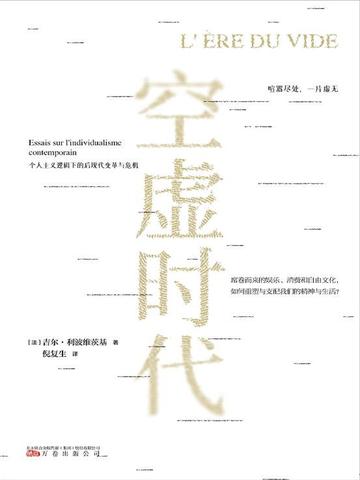
After entering the post-modern society, the grand narrative of collectivism is gradually deconstructed by individualism. As privatization continues to expand and consumerism deepens, new liberal ideologies collide with traditional moral concepts. After overthrowing authority and regulation, the trend of individualization replaced obligations with a culture of pleasure, and replaced the history of heroism with "desire machines." We lose interest in great ideals and the distant future. We only live in the present and focus only on ourselves. Our minds inevitably fall into nothingness.
The famous French sociologist and philosopher Gilles Lipovitzki tried to clarify the many problems faced by individual spirit, culture, life and future in modern society from the chaotic and complex phenomena, and find answers to "where will we go?"
The book starts from a series of elements such as narcissism, indifference, temptation, emptiness, humor, violence, etc., And combines theoretical research on different levels such as class, gender, generation, etc., To outline a panoramic view of today's system and culture with diversity and individualization as the evolutionary context. At the same time, it adopts the perspective of big history, puts the modern society full of changes into the overall civilization process, and reconstructs mankind's expectations for the future.
As a classic work on contemporary philosophical research, this book is not only a mirror of today's social development, but also brings intellectual inspiration and spiritual baptism to every modern person who wants to see the world clearly and escape emptiness.
Wonderful points:
Temptation: A prosperous consumer society means abundant "choices", and desire, happiness, and communication have become the "values". The trouble of modern people is not what they choose, but what they lose because of their choices.
Indifference: The flood of information and the rapid rotation of news. Once an event is known, it is quickly forgotten because it has to make way for a more sensational event. A kind of indifference arises due to excess, due to over-motivation. What else is surprising or sensationalizing these days?
Narcissism: Being obsessed with oneself is not unrealistic. It strives to achieve the great goal of self-liberation and individual independence. If you give up love, the reason is "I don't need other people, just to love myself more, so that I can make myself happy."
Violence: Under the tide of personalization, the principle of establishing authority through muscles has abdicated. People yearn for autonomous control, spiritual dialogue and unrestrained life, and the ancient law of dividing gender by violence no longer exists.
Expression: The opportunity and desire to express is what matters, the substance of the "information" is insignificant. Communicate for the sake of communication, express for the sake of expression, and have no other purpose except to win a few responses.
Reader comments
[This is an unprecedented democratization of speech. Everyone is inspired to call the hotline. Everyone wants to say something based on their inner feelings. Everyone can become a listener and announcer. In this era of information explosion, although we and the author are in different times, our needs are similar. Do we all want to be announcers when we post on WeChat Moments, shoot on Douyin, and post on Weibo? Are the Moments we scroll through, the Douyin hotspots with over a million likes, and the melon-eating people on Weibo hot searches all audiences? No matter the media is radio, television or mobile phones and computers in contemporary society. We are all in the midst of an unprecedented development.
"In the past, cars and horses were very slow, and letters were far away. There is only enough time to love one person in a lifetime." Mu Xin wrote in "Once Upon a Time Slow". What now? There is an overflow of information and rapid news rotation. If you fail to catch up with the hot spot in the last second, it will be covered by the next hot spot in the next second. People who appear in the next second may not know what happened in the previous second. A kind of indifference generated by the information explosion emerged. I can't help but think deeply, have modern people become indifferent? It seems not. Has the times turned cold? We can still see news that brings tears to our eyes. Is this rapid process something that should attract our attention? The author's views in the 1980s are still applicable today. Has society progressed?
A sociological work that reflects on modern society. Please allow me to express my immature opinions after limited reading. While we are celebrating the fact that modernity has shattered all the outdated cultural traditions and systems of the old era, allowing individuals to have the rights to free expression, free movement, and free life, a emptiness caused by extreme individualism is also sweeping across the entire society. New concepts represented by various trends of consumerism and extreme individualism collide with traditional morality in many fields. While people seek liberation, they also fall into infinite emptiness. This book is worth reading by many fans of current extreme ideological trends. I believe that from this reading, they will be able to reflect on some profound issues and reconstruct the broken social order in front of them.
"Empty Age" is a concept that describes the characteristics of contemporary society. It refers to a state of inner emptiness, lack of meaning and sense of purpose that people in modern society generally feel. This concept emphasizes the material abundance but spiritual emptiness of modern society. The emergence of the Empty Age is closely related to factors such as modernization, industrialization, technological development, and social change. With the advancement of science and technology and the improvement of material living standards, people's material needs have been met, but they are facing new challenges at the spiritual level.
In the boom of individualism, we have more freedom to choose our own lives: we can choose our own style, choose our own marriage partner, choose our own way of being alone, choose the style of our residence. When these choices become the freedom of the masses, it is actually the popularity of a fashion trend. It is no longer a personal proposition, but the shape of the entire society (there are more and more mavericks). What are the consequences of too much freedom and individuals for us and the entire society? Because of the fear of disappointment and the fear of being unable to control emotions, these fears subjectively confirm what Kerry Rush calls "emotional avoidance... Respect" and "coldness" "Cool" X and free relationships, while condemning jealousy and strong possessiveness, people become more and more restrained, avoiding strong emotions and possible harm, but people cannot truly escape from this emotional need, which leads to worse consequences - the expectation of love becomes increasingly difficult to truly realize, vaguely seeking love and the feeling of being loved, being dominated by emptiness, seeking comfort, and being dominated by greater emptiness again. This book analyzes elements such as temptation, indifference, narcissism, emptiness, humor, and violence. While pursuing individual independence, various life patterns make people feel increasingly spiritually empty and boring.
Being unable to endure all this and having no way to change it is the living condition of most people, and this is also the reason why most people are unhappy.
As mentioned in the book, on the one hand, the commercial industry hopes that workers will work more, earn less, and enjoy it later. In a word, workers should be like cogs in a machine. On the other hand, the business industry should encourage entertainment, leisure and relaxation, that is, people should work hard during the day and indulge in fun at night
It's difficult. It's not just difficult, it's very difficult. You must have a deep philosophical foundation, otherwise you won't be able to understand it.
I haven't finished reading it yet.
This book is very interesting! It explores some of the important issues of our time, such as narcissism, emptiness, temptation and violence. I think it is a bit similar to "Amusing Ourselves to Death", both of which made me think more deeply about modern society. The "replacing coercion with communication" mentioned in the book also reminded me of some plots in "1984". I especially like the author's analysis of temptation, which allows me to see the essence behind many phenomena in our daily lives. All in all, this is a very inspiring book and I recommend it to you!
Very good talk. I only read a little bit. Contemporary nihilism is neither active nor passive, neither sentimental nor destructive. It is a kind of incompleteness, showing only indifference.
Philosophy and psychology, sociology and human nature, this book is very good. There are not many examples, but mostly theories. I don't think it's suitable for reading. The brain needs to memorize and understand at the same time. It's suitable for reading and understanding while listening to a book.
I have listened to all the books. I personally agree with some of the theories and disagree with others. Most of them seem to be about the study of events in 1970 and before. If you want to briefly check whether it is suitable, you can just read the postscript and compare the chapters to find what you like. After all, choosing a book that suits you is sometimes better than not reading and doing other meaningful things.
In fact, it is the contradiction between identity and struggle. In the extreme struggle, modern society has lost its identity and has therefore fallen into loneliness and emptiness.
I don't know how serious it is. But like it very much
Why was this book blocked?
It's too long. I hope I'll get a headache if I separate it.



[This is an unprecedented democratization of speech. Everyone is inspired to call the hotline. Everyone wants to say something based on their inner feelings. Everyone can become a listener and announcer. In this era of information explosion, although we and the author are in different times, our needs are similar. Do we all want to be announcers when we post on WeChat Moments, shoot on Douyin, and post on Weibo? Are the Moments we scroll through, the Douyin hotspots with over a million likes, and the melon-eating people on Weibo hot searches all audiences? No matter the media is radio, television or mobile phones and computers in contemporary society. We are all in the midst of an unprecedented development.
"In the past, cars and horses were very slow, and letters were far away. There is only enough time to love one person in a lifetime." Mu Xin wrote in "Once Upon a Time Slow". What now? There is an overflow of information and rapid news rotation. If you fail to catch up with the hot spot in the last second, it will be covered by the next hot spot in the next second. People who appear in the next second may not know what happened in the previous second. A kind of indifference generated by the information explosion emerged. I can't help but think deeply, have modern people become indifferent? It seems not. Has the times turned cold? We can still see news that brings tears to our eyes. Is this rapid process something that should attract our attention? The author's views in the 1980s are still applicable today. Has society progressed?
A sociological work that reflects on modern society. Please allow me to express my immature opinions after limited reading. While we are celebrating the fact that modernity has shattered all the outdated cultural traditions and systems of the old era, allowing individuals to have the rights to free expression, free movement, and free life, a emptiness caused by extreme individualism is also sweeping across the entire society. New concepts represented by various trends of consumerism and extreme individualism collide with traditional morality in many fields. While people seek liberation, they also fall into infinite emptiness. This book is worth reading by many fans of current extreme ideological trends. I believe that from this reading, they will be able to reflect on some profound issues and reconstruct the broken social order in front of them.
"Empty Age" is a concept that describes the characteristics of contemporary society. It refers to a state of inner emptiness, lack of meaning and sense of purpose that people in modern society generally feel. This concept emphasizes the material abundance but spiritual emptiness of modern society. The emergence of the Empty Age is closely related to factors such as modernization, industrialization, technological development, and social change. With the advancement of science and technology and the improvement of material living standards, people's material needs have been met, but they are facing new challenges at the spiritual level.
In the boom of individualism, we have more freedom to choose our own lives: we can choose our own style, choose our own marriage partner, choose our own way of being alone, choose the style of our residence. When these choices become the freedom of the masses, it is actually the popularity of a fashion trend. It is no longer a personal proposition, but the shape of the entire society (there are more and more mavericks). What are the consequences of too much freedom and individuals for us and the entire society? Because of the fear of disappointment and the fear of being unable to control emotions, these fears subjectively confirm what Kerry Rush calls "emotional avoidance... Respect" and "coldness" "Cool" X and free relationships, while condemning jealousy and strong possessiveness, people become more and more restrained, avoiding strong emotions and possible harm, but people cannot truly escape from this emotional need, which leads to worse consequences - the expectation of love becomes increasingly difficult to truly realize, vaguely seeking love and the feeling of being loved, being dominated by emptiness, seeking comfort, and being dominated by greater emptiness again. This book analyzes elements such as temptation, indifference, narcissism, emptiness, humor, and violence. While pursuing individual independence, various life patterns make people feel increasingly spiritually empty and boring.
Being unable to endure all this and having no way to change it is the living condition of most people, and this is also the reason why most people are unhappy. As mentioned in the book, on the one hand, the commercial industry hopes that workers will work more, earn less, and enjoy it later. In a word, workers should be like cogs in a machine. On the other hand, the business industry should encourage entertainment, leisure and relaxation, that is, people should work hard during the day and indulge in fun at night
It's difficult. It's not just difficult, it's very difficult. You must have a deep philosophical foundation, otherwise you won't be able to understand it. I haven't finished reading it yet.
This book is very interesting! It explores some of the important issues of our time, such as narcissism, emptiness, temptation and violence. I think it is a bit similar to "Amusing Ourselves to Death", both of which made me think more deeply about modern society. The "replacing coercion with communication" mentioned in the book also reminded me of some plots in "1984". I especially like the author's analysis of temptation, which allows me to see the essence behind many phenomena in our daily lives. All in all, this is a very inspiring book and I recommend it to you!
Very good talk. I only read a little bit. Contemporary nihilism is neither active nor passive, neither sentimental nor destructive. It is a kind of incompleteness, showing only indifference.
Philosophy and psychology, sociology and human nature, this book is very good. There are not many examples, but mostly theories. I don't think it's suitable for reading. The brain needs to memorize and understand at the same time. It's suitable for reading and understanding while listening to a book. I have listened to all the books. I personally agree with some of the theories and disagree with others. Most of them seem to be about the study of events in 1970 and before. If you want to briefly check whether it is suitable, you can just read the postscript and compare the chapters to find what you like. After all, choosing a book that suits you is sometimes better than not reading and doing other meaningful things.
In fact, it is the contradiction between identity and struggle. In the extreme struggle, modern society has lost its identity and has therefore fallen into loneliness and emptiness.
I don't know how serious it is. But like it very much
Why was this book blocked?
It's too long. I hope I'll get a headache if I separate it.