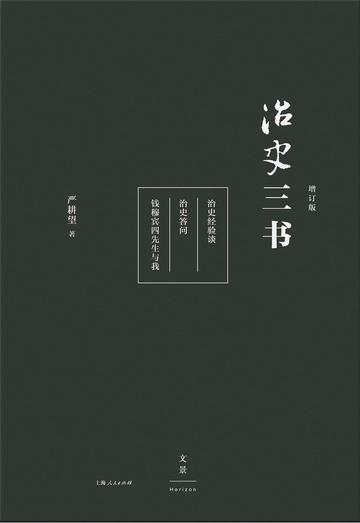
"Three Books on History" is a historical methodology work written by the historian Yan Gengwang based on his personal academic experience and integrating the historical experience of several generations of historians such as Liang Qichao, Chen Yinke, Fu Sinian, Qian Mu, etc. It is considered to be an introductory book to academic studies that "golden needles can measure people", and the content involves history It covers the basic methods of scientific research, specific rules, topic selection, writing standards, paper style, citation and annotation methods, paper writing and revision, as well as efforts and life cultivation and many other issues. The language is simple and fluent, sincere and friendly, and practical.
Reader comments
Among the experiences in studying history mentioned in this book, the one that impressed me the most is "Don't start with philosophy when studying history." He believes that history from a philosophical perspective is mostly based on subjective ideas and lacks reality. He believes: "The traditional method of studying history is empty without any preconception, and it is completely based on scattered fragmentary materials with no direction. A framework forms a system of its own. You must establish your own set of views from the collection of historical materials and research on historical events, rather than following a certain established theory as a guiding principle to deduce historical events. "The article explains many truths, and the author put everything he has learned and thought into this book.
Governing history is a long process. Once you choose history, you must be mentally prepared for a lifetime. Mr. Yan Wang told us that governing history requires lofty ambition and diligence, perseverance, courage, prudence, love, and harmony. After choosing history and establishing the direction of the future, we need to make rigorous plans. Talking without doing anything will only make you a giant of words and a dwarf of action. Persistence has become what we must. The eclectic nature of history requires us to read widely and read regularly every day to broaden our horizons and knowledge.
Based on his own understanding of historical learning methods and the historical experience of generations of historians such as Liang Qichao, Chen Yinke, Fu Sinian, Qian Mu, etc., The historian Mr. Yan Gengwang discussed and summarized the methods and principles of historical research, and combined them into this historical work. The development and evolution of historical methodology is a process of continuous exploration and innovation. With the development of history and social changes, different schools and scholars may have different method preferences and research tendencies. This book written by the author is worth reading.
This book is dedicated to historical methods. The author achieves success through his own learning and then teaches it to others. However, the author Yan Gengwangqian said that he "doesn't pay much attention to methodology" and believes that "Three Books on History" "cannot be said to be a historical methodology. At best, it can only be said to be my personal experience and personal method." He only understood "Three Books on the History of Governance" through his own experience, so that this book will not be too rigid like ordinary historical works, which will inevitably make the content in the book appear rigid. Instead, this book gently shows us a charming historical story.
"Three Books on History" is a work on historical methodology written by the historian Yan Gengwang based on his personal academic experience and integrating the historical experience of several generations of historians such as Liang Qichao, Chen Yinke, Fu Sinian, Qian Mu, etc. It is considered an introductory book on academic scholarship for "golden needles to measure people". The content of this book covers the basic methods, specific rules, topic selection, essay standards, essay style, citing materials and annotation methods, essay writing and revision, as well as efforts and life cultivation and many other issues in historical research. The author uses his own experience to remove the rigidity that is common in history books, leaving behind refined and pragmatic story content.
Mr. Yan Gengwang also quoted the experience of previous historians, which was of great benefit to people. There is a sentence in the book that impressed me deeply: "You need to be specialized, but you also need to be broad." This is the true meaning of governing history! Whether you are a beginner in history or an experienced scholar, you can be inspired by this book.
Among the experiences in studying history mentioned in this book, the one that impressed me the most is "Don't start with philosophy when studying history." He believes that history from a philosophical perspective is mostly based on subjective ideas and lacks reality. He believes: "The traditional method of studying history is empty without any preconception, and it is completely based on scattered fragmentary materials with no direction. A framework forms a system of its own. You must establish your own set of views from the collection of historical materials and research on historical events, rather than following a certain established theory as a guiding principle to deduce historical events. "The article explains many truths, and the author put everything he has learned and thought into this book.
Governing history is a long process. Once you choose history, you must be mentally prepared for a lifetime. Mr. Yan Wang told us that governing history requires lofty ambition and diligence, perseverance, courage, prudence, love, and harmony. After choosing history and establishing the direction of the future, we need to make rigorous plans. Talking without doing anything will only make you a giant of words and a dwarf of action. Persistence has become what we must. The eclectic nature of history requires us to read widely and read regularly every day to broaden our horizons and knowledge.
Based on his own understanding of historical learning methods and the historical experience of generations of historians such as Liang Qichao, Chen Yinke, Fu Sinian, Qian Mu, etc., The historian Mr. Yan Gengwang discussed and summarized the methods and principles of historical research, and combined them into this historical work. The development and evolution of historical methodology is a process of continuous exploration and innovation. With the development of history and social changes, different schools and scholars may have different method preferences and research tendencies. This book written by the author is worth reading.
This book is dedicated to historical methods. The author achieves success through his own learning and then teaches it to others. However, the author Yan Gengwangqian said that he "doesn't pay much attention to methodology" and believes that "Three Books on History" "cannot be said to be a historical methodology. At best, it can only be said to be my personal experience and personal method." He only understood "Three Books on the History of Governance" through his own experience, so that this book will not be too rigid like ordinary historical works, which will inevitably make the content in the book appear rigid. Instead, this book gently shows us a charming historical story.
"Three Books on History" is a work on historical methodology written by the historian Yan Gengwang based on his personal academic experience and integrating the historical experience of several generations of historians such as Liang Qichao, Chen Yinke, Fu Sinian, Qian Mu, etc. It is considered an introductory book on academic scholarship for "golden needles to measure people". The content of this book covers the basic methods, specific rules, topic selection, essay standards, essay style, citing materials and annotation methods, essay writing and revision, as well as efforts and life cultivation and many other issues in historical research. The author uses his own experience to remove the rigidity that is common in history books, leaving behind refined and pragmatic story content.
Mr. Yan Gengwang also quoted the experience of previous historians, which was of great benefit to people. There is a sentence in the book that impressed me deeply: "You need to be specialized, but you also need to be broad." This is the true meaning of governing history! Whether you are a beginner in history or an experienced scholar, you can be inspired by this book.
Nice, introductory history book
Not bad, very helpful for history students.