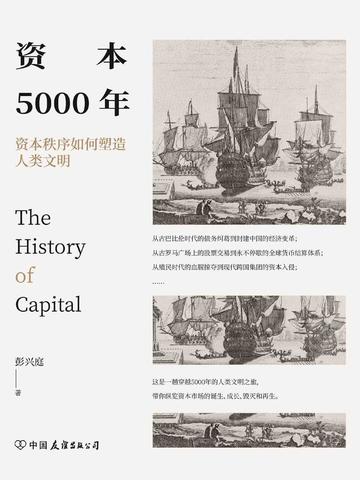
5000 Years of Capital: How the Capital Order Shapes Human Civilization
资本5000年:资本秩序如何塑造人类文明
- Status
- Completed
- Length
- 277k Words
- Updated
- 4y ago
- Source
- Fanqie
Stats
35Reads
8.4Score
26Chapters
5Listens
1.2kReads · all time
Tags
Synopsis
Reader comments
In booklists 3




I Want a Suffocating Love
If you want a male and female protagonist or two female protagonists, you want a yandere with a strong sense of suffocation, not a brainless or illogical one.
8.9MViews258Books14hUpdated




A Book to Improve Your Emotional Intelligence and Perspective
I am very worried about these two items and need help urgently.
6.3MViews322Books4dUpdated



Books That Provide Exposure to Different Professional Knowledge
Not only reading novels, but also wanting to learn a lot about daily medicine, sleep life, agricultural planting, technological transformation, and literary creation are also the best choices for entertainment.
4.6MViews533Books2dUpdated
This book mainly discusses the origin, development and evolution of capital, as well as the formation and evolution of the capitalist economic system from an economic perspective. Through the interpretation of historical events and economic phenomena, the author reveals how the power of capital has shaped the evolution of human society, from the agricultural revolution to the industrial revolution to the modern technological revolution. It explores the impact of capital on social organization, technological progress, wealth distribution, social classes, etc., Thus providing an in-depth analysis of the advantages and disadvantages of the capitalist economic system. At the same time, the author also puts forward thoughts and prospects for future social and economic development.
How is the social system of capital established? Learn slowly and find the answer here. "The growing British industrial production capacity required a broader market, and the monopoly privileges enjoyed by chartered companies became a restriction on the expansion of British industrial capital. The same was true for the policy of mercantilism - British capital was already too strong to need its protection. Smith proposed a global trade strategy: free trade. He believed that although Britain could maintain its commercial monopoly through trade protection and conquest by force, Britain could make more money by choosing free trade. Only by making other countries richer could they buy more British products."
This book is very rich in content. It tells how capital affects human civilization. Through various historical events and cases, I have a clear understanding of the formation process of capital and its impact on society. The viewpoints in the book are also very novel and gave me a deeper understanding of capital. I think this book is well worth reading, especially for those interested in economics and history.