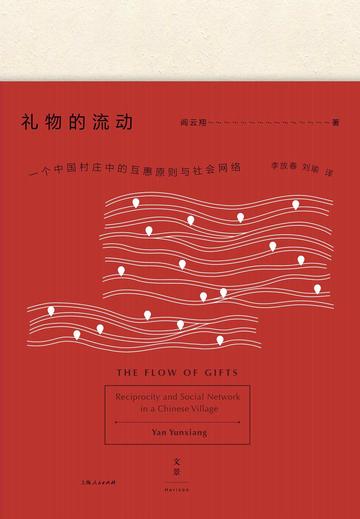
"The Flow of Gifts" is a monograph adapted by Yan Yunxiang based on his doctoral thesis. It mainly focuses on a very classic research issue in the field of anthropology, namely gift exchange. The author lived in a rural village in Heilongjiang Province for seven years and visited it twice to write this book. Through anthropological methods such as participant observation and in-depth description, we pay attention to the villagers' gift exchange in daily life and its cultural significance. While Yan Yunxiang updated the classic explanation theory of traditional anthropology on this issue, he also revealed the "non-institutionalization" characteristics of traditional Chinese society and discussed the social structure of rural society.
Reader comments
Gifts are a classic topic in anthropological research. Different from the formal understanding of market economic activities in economics, anthropologists since Mauss and Sahlins hope to see the substantive part of the economy from the gift exchange in ancient societies. Yan Yunxiang's ethnographic research on the flow of gifts in a village in Northeast China demonstrated the social relationship structure of the village through gift exchange in a civilized society. It showed that economic exchanges are still deeply embedded in society and advanced the research of early anthropologists.
It turns out that in rural areas, the flow of gifts is so complicated, and it can also reflect interpersonal relationships and social structure! What I like most about the plot in the book is about villagers giving gifts to each other. It feels very humane. The author's research method is also very interesting, using field surveys to understand rural society, which made me very interested in anthropology. I think this book is not only suitable for adults, but also suitable for us primary school students to understand different cultures.
Characteristics of the Chinese gift exchange system and its significance for the ongoing discussion of gifts in anthropology; the complexity of personal network (guanxi) and moral rules of interpersonal behavior (renqing) in Chinese culture; the relationship between the gift economy and larger-scale social changes. As a social phenomenon, gift giving occurs all over the world. However, the form it takes varies according to the cultural matrix. The significance of this study lies in its outline and interpretation of the position of Chinese culture in the world of gifts.
Anthropologist Yan Yunxiang this time focuses on Chinese villages, which retain a relatively primitive state. The author uses an image of "the flow of gifts" to explain the rural lifestyle. In traditional Chinese culture, gift exchange has an important principle of reciprocity. This reciprocity is not only reflected in material aspects, but also includes emotional, relational and social aspects. It was deeply discussed that gift exchange is not only a material exchange, but also involves cultural, historical, psychological and emotional factors. Chinese culture and society can be better understood through an in-depth study of gift exchange.
Traditional Chinese society has left behind many interesting and meaningful customs. This book looks at the flow of gifts from a very interesting perspective. Gift exchange is something that all of us come into contact with. The author wrote this book through many visits to rural people during his seven years in rural Heilongjiang. Through this book, I analyze the significance of this custom and analyze anthropological issues. The social structure of rural China is discussed.


Gifts are a classic topic in anthropological research. Different from the formal understanding of market economic activities in economics, anthropologists since Mauss and Sahlins hope to see the substantive part of the economy from the gift exchange in ancient societies. Yan Yunxiang's ethnographic research on the flow of gifts in a village in Northeast China demonstrated the social relationship structure of the village through gift exchange in a civilized society. It showed that economic exchanges are still deeply embedded in society and advanced the research of early anthropologists.
It turns out that in rural areas, the flow of gifts is so complicated, and it can also reflect interpersonal relationships and social structure! What I like most about the plot in the book is about villagers giving gifts to each other. It feels very humane. The author's research method is also very interesting, using field surveys to understand rural society, which made me very interested in anthropology. I think this book is not only suitable for adults, but also suitable for us primary school students to understand different cultures.
Characteristics of the Chinese gift exchange system and its significance for the ongoing discussion of gifts in anthropology; the complexity of personal network (guanxi) and moral rules of interpersonal behavior (renqing) in Chinese culture; the relationship between the gift economy and larger-scale social changes. As a social phenomenon, gift giving occurs all over the world. However, the form it takes varies according to the cultural matrix. The significance of this study lies in its outline and interpretation of the position of Chinese culture in the world of gifts.
Anthropologist Yan Yunxiang this time focuses on Chinese villages, which retain a relatively primitive state. The author uses an image of "the flow of gifts" to explain the rural lifestyle. In traditional Chinese culture, gift exchange has an important principle of reciprocity. This reciprocity is not only reflected in material aspects, but also includes emotional, relational and social aspects. It was deeply discussed that gift exchange is not only a material exchange, but also involves cultural, historical, psychological and emotional factors. Chinese culture and society can be better understood through an in-depth study of gift exchange.
Traditional Chinese society has left behind many interesting and meaningful customs. This book looks at the flow of gifts from a very interesting perspective. Gift exchange is something that all of us come into contact with. The author wrote this book through many visits to rural people during his seven years in rural Heilongjiang. Through this book, I analyze the significance of this custom and analyze anthropological issues. The social structure of rural China is discussed.