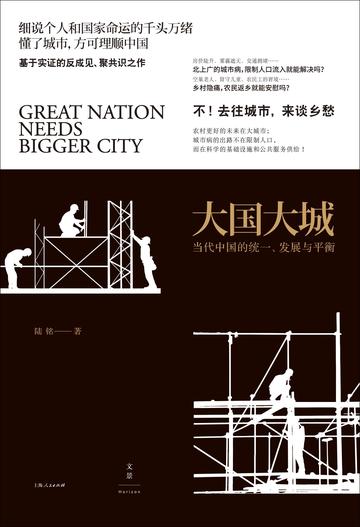
Economist Professor Lu Ming's "Big Country, Big City" focuses on the practical problems that exist in China's current urban and rural economic development. Housing prices are rising sharply, smog covers the sky, and traffic is congested; the plight of empty-nesters, left-behind children, and migrant workers... China has just passed the halfway point of its urbanization process, but the symptoms of big cities and the hidden pain in rural areas have become the focus of people's attention. Can the problem be solved by restricting the inflow of people from big cities and allowing migrant workers to return to their hometowns? No! Go to the city and talk about nostalgia. The author compares global experiences, bases himself on the local current situation, and advocates the importance of developing large cities in China based on evidence. Social problems should be sparse rather than blocked. Only by allowing the market itself to fully exert its regulatory role on production factors, including labor, can current thorny social problems be fundamentally solved. The function of the government is not to compete with the market, but to lay out scientific infrastructure and provide public services with a long-term perspective in places where the market is speechless. "Big Powers and Big Cities" will tell you that only in agglomeration can economic development achieve balance. Only by pursuing a balance of per capita GDP instead of pursuing a balance of regional GDP can the national competitiveness of a big country be fully unleashed and the public interests of all people enhanced.
Reader comments
This book is of great practical significance and explores the issues in China's urbanization process. By comparing global experience, Professor Lu Ming pointed out the importance of the development of large cities for economic balance and solving social problems. Some of the views in the book impressed me deeply, such as "Social problems should be neglected rather than blocked. Only by allowing the market itself to fully exert its regulatory role in the factors of production can the problem be fundamentally solved." This book provided a new perspective and allowed me to think more deeply about China's urbanization.
As a person who is not completely familiar with economics, reading it really overturned my inherent knowledge, and it is easy to understand. I hope this book will be read by more people. The Chinese people are a community of interests.
Thanks for answering a lot of my previous confusions
This book was recommended by the teacher. It is more interesting than I expected, relatively easy to understand, and focuses on China's current real problems.
Profound insight, prophet of the future, we need to deepen our understanding of the nearby and recent times. This book's explanation of the national situation is very beneficial.
It looks good. I understand the current national policies better. I wish our country's reform will get better and better, continue to improve the system, and improve innovation competitiveness.
This book was written in 2013, and I only read it at the end of 2024. There is a difference of 11 years. After reading this book, I now understand more and more about national policies, such as supply-side reform, elimination of overcapacity, coordinated regional development, abolition of the household registration system, economic scale, agricultural industrialization, national unified market, free movement of population, comprehensive deepening of reform, improvement of systems, etc., So reform It is not easy, because all reforms involve the interests of certain people, which requires a lot of courage. I hope that in 20 or 30 years, we can realize that the rich first will drive the rich later, and achieve common prosperity. Even if everyone cannot be equally rich, we still hope that public services can benefit everyone. I believe it will be achieved, because our country is working in the right direction and in the right way.
Real and objective, very good
I originally took a look, but ended up watching it, fried chicken sticks!





This book is of great practical significance and explores the issues in China's urbanization process. By comparing global experience, Professor Lu Ming pointed out the importance of the development of large cities for economic balance and solving social problems. Some of the views in the book impressed me deeply, such as "Social problems should be neglected rather than blocked. Only by allowing the market itself to fully exert its regulatory role in the factors of production can the problem be fundamentally solved." This book provided a new perspective and allowed me to think more deeply about China's urbanization.
As a person who is not completely familiar with economics, reading it really overturned my inherent knowledge, and it is easy to understand. I hope this book will be read by more people. The Chinese people are a community of interests.
Thanks for answering a lot of my previous confusions
This book was recommended by the teacher. It is more interesting than I expected, relatively easy to understand, and focuses on China's current real problems.
Profound insight, prophet of the future, we need to deepen our understanding of the nearby and recent times. This book's explanation of the national situation is very beneficial.
It looks good. I understand the current national policies better. I wish our country's reform will get better and better, continue to improve the system, and improve innovation competitiveness. This book was written in 2013, and I only read it at the end of 2024. There is a difference of 11 years. After reading this book, I now understand more and more about national policies, such as supply-side reform, elimination of overcapacity, coordinated regional development, abolition of the household registration system, economic scale, agricultural industrialization, national unified market, free movement of population, comprehensive deepening of reform, improvement of systems, etc., So reform It is not easy, because all reforms involve the interests of certain people, which requires a lot of courage. I hope that in 20 or 30 years, we can realize that the rich first will drive the rich later, and achieve common prosperity. Even if everyone cannot be equally rich, we still hope that public services can benefit everyone. I believe it will be achieved, because our country is working in the right direction and in the right way.
Real and objective, very good
I originally took a look, but ended up watching it, fried chicken sticks!
I can't believe this book was written in 2016