At the end of the Qing Dynasty and the beginning of the Republic of China, that is, at the beginning of China's modern transformation, China had crises at both the community and individual levels regarding the issue of "identity," which manifested themselves as a crisis of political order and a crisis of spiritual order respectively.
Over the past 100 years, the Chinese intellectual community's imagination of "China" has not been monolithic. It has changed with movements and ideological trends. It has swayed and struggled between the European and American family world. The state machine itself has been constantly adjusting to gain legitimacy for its rule. The understanding of "China" by intellectuals and the state machine also affects our ordinary people's identification with the country and individuals.
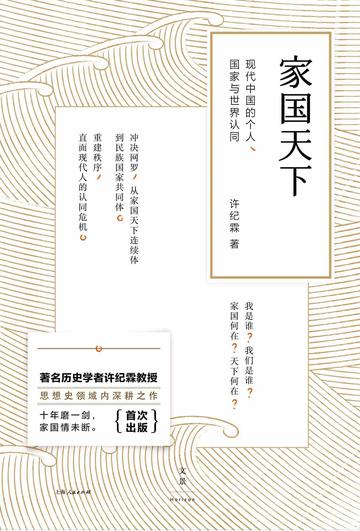
The purpose of "Family, Country, World" is to explore the impact and transformation of China's modern national identity in the history of thought. Starting from the impact of modernity on the traditional "conception of the world", the author discusses Confucianism, the late Qing constitutionalists and revolutionaries, the late Qing's local identity and personal identity, the "cosmopolitanism" of the May Fourth Movement, the competition between civilization and wealth, nationalism and other attempts in China's modern ideological revolution. Finally, the author designs the identity model of "New Tianxiaism" to solve the unresolved issue of national identity.
Reader comments
The writing style of this book is simple and easy to understand, with smooth writing style and accurate wording. The author explores the issue of national identity by sorting out the history of modern Chinese thought, with unique and thought-provoking views. It reminds me of Fei Xiaotong's "Russian China". Both books provide in-depth analysis of China's traditional concepts and social structure. "Family, Country, World" can help us better understand China's past and present, as well as China's development direction in the context of globalization.

The writing style of this book is simple and easy to understand, with smooth writing style and accurate wording. The author explores the issue of national identity by sorting out the history of modern Chinese thought, with unique and thought-provoking views. It reminds me of Fei Xiaotong's "Russian China". Both books provide in-depth analysis of China's traditional concepts and social structure. "Family, Country, World" can help us better understand China's past and present, as well as China's development direction in the context of globalization.