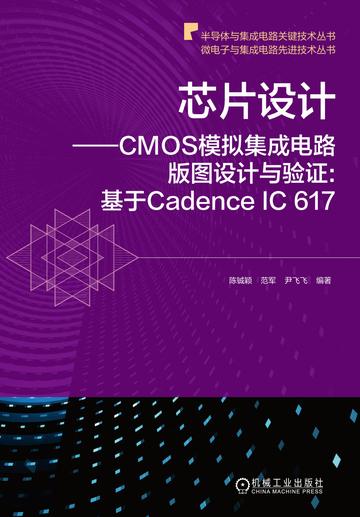
This book mainly relies on the Cadence IC 617 layout design tool and Mentor Caliber layout verification tool. On the basis of introducing the basic principles of new CMOS devices and layout, combined with layout design practice, it adopts a step-by-step approach to discuss the basic knowledge and methods of using Cadence IC 617 and Mentor Caliber for CMOS analog integrated circuit layout design and verification. The content covers nano-scale CMOS devices, CMOS analog integrated circuit layout basics, Cadence IC The basic overview, operation interface and usage of 617 and Mentor Caliber, and the complete process of CMOS analog integrated circuits from design to exporting data for tape-out.
At the same time, the basic method of using the Cadence IC 617 layout design tool to design basic analog circuit layouts such as operational amplifiers, bandgap reference sources, and low-dropout linear regulators is introduced in chapters. Finally, typical error cases of Mentor Caliber in LVS verification are analyzed. By combining device knowledge, circuit theory and layout design practice, this book gives readers a deep understanding of the rules, processes and basic methods of CMOS circuit layout design and verification. It will be helpful to senior undergraduates, masters and doctoral students studying CMOS analog integrated circuits, as well as engineers engaged in integrated circuit layout design and verification.
Reader comments
This book is very useful for people like me who want to understand chip design! It is rich in content, covering all aspects from device knowledge to layout design practice, and is explained in detail and easy to understand. The case studies in the book are also very helpful, allowing people to better grasp the design and verification methods. The authors are certainly experts in the field and their experience and knowledge are reflected in the book. I think this book is a good helper for learning CMOS analog integrated circuits, and I recommend it to friends who are interested in chip design!
Good book, worth reading!
For professional books, I still prefer physical books. Physical books are much more convenient than e-books for annotation and other aspects. Unless they are made into PDFs, paperless learning can be achieved [Send Heart]









This book is very useful for people like me who want to understand chip design! It is rich in content, covering all aspects from device knowledge to layout design practice, and is explained in detail and easy to understand. The case studies in the book are also very helpful, allowing people to better grasp the design and verification methods. The authors are certainly experts in the field and their experience and knowledge are reflected in the book. I think this book is a good helper for learning CMOS analog integrated circuits, and I recommend it to friends who are interested in chip design!
Good book, worth reading!
For professional books, I still prefer physical books. Physical books are much more convenient than e-books for annotation and other aspects. Unless they are made into PDFs, paperless learning can be achieved [Send Heart]