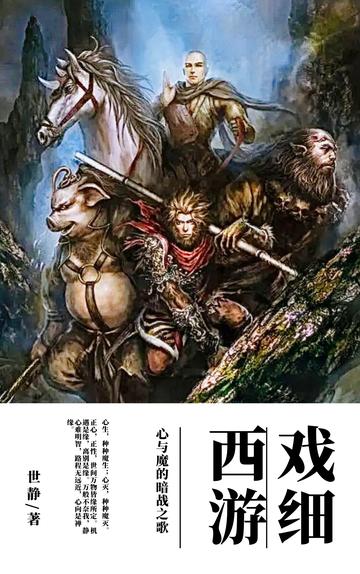
“When the mind arises, all kinds of demons arise; when the mind fades, all kinds of demons fade.”
I have always believed that the novel Journey to the West is an exposition of this idea. As the saying goes, appearances arise from the mind; the Buddha is within one's own nature, not outside oneself. Buddha-nature is inherent in all things: the mind itself is the Buddha. But Journey to the West is by no means only about how to attain Buddhahood. It speaks of human relationships and worldly affairs, and reflects social realities. I quote this saying because I want to point out that wherever there is a mind, wherever there are people, Buddhas and demons coexist in the world.
My love for Journey to the West has reached the point of obsession. Combined with my social circle and personality, this led me to express my understanding of Journey to the West in a rather unusual way. This is also a way of giving myself some closure. If I have fallen short, I hope readers will be understanding.
There are far too many mysteries in Journey to the West, and countless details have gone unnoticed by the general public. Many people have never read the original novel and instead learned about it from television adaptations, which differ greatly from the source. So I will go through the chapters one by one, weaving my own interpretations into the story in the hope that readers will come away with a different understanding of Journey to the West.
I hereby declare that everything I write is purely my personal interpretation. After all, every reader will see a novel differently. I am a Buddhist, and I also have great respect for Taoism. What I say in this book is simply my personal understanding of the novel Journey to the West. I mean no disrespect to Buddhism or Taoism, nor to any historical figures.