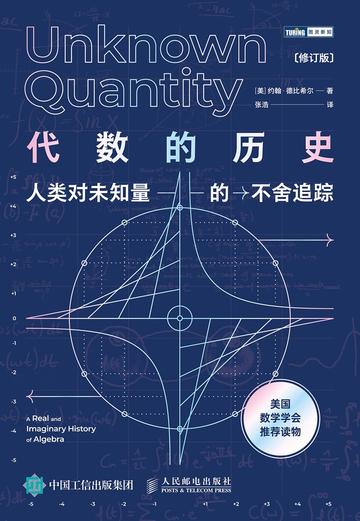
The History of Algebra: Man's Perseverance in Tracking the Unknown (Revised Edition)
代数的历史:人类对未知量的不舍追踪(修订版)
- Status
- Completed
- Source
- Fanqie
Stats
8.9Score
27Chapters
Tags
Synopsis
Reader comments
In booklists 3




Good Books on Mathematics
I just want some fun stuff! Thank you all
3.4MViews227Books3dUpdated
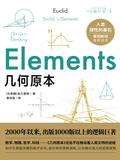



Looking for Mathematics and Physics Books
I want to read a book similar to "Elements of Geometry". I personally major in mathematics, chemistry and biology and don't care much about it.
1.8MViews314Books2dUpdated


Books About Mathematics, More Hardcore
Recently I read Stickman Learning Mathematics on Station B. I was wondering if there are any similar books like this?
254.7kViews85Books2moUpdated
I had a good impression of the author's "The Love of Prime Numbers" before, and I wanted to know a little bit more about cryptography, so I read this book. There is nothing to pick in terms of popular science, but there seems to be a gender cognitive disorder. The abstract "ring" is called Ms., And the great Ms. Noether is called Mr. (I haven't read the original work, so I'm not sure if it's the translator's fault)... It is clearly stated in the article that Noether was called Der Noether by the academic circles at the time because of the disapproval of her female identity. How could it still be such a stereotype?
"Every science, when we regard it not as an instrument of power and domination, but as an adventure in knowledge that we humans have pursued through generations, is nothing else than a harmony, more or less, vast and rich from one period to another: in different ages and centuries, for Different themes appear one after another, and it shows us subtle and precise correspondences, as if coming from the void. "The adventure is over! Full of sense of accomplishment! Full of rewards. I want to get closer to the kingdom of mathematics, from admiring its luxurious appearance to entering inside, exploring its structure, construction, and wondering how I can contribute to it!"
This book is especially suitable for readers interested in algebra and its history. The book mainly talks about the content of three major sections: The first section: From ancient times to about 1600 AD, the alphabetic symbol system (that is, using letters to represent numbers) was widely used. Section 2: The first glorious achievements of alphabetic symbolism in mathematics, and the slow separation of symbols from traditional arithmetic and geometric concepts that ultimately led to the discovery of new mathematical objects. The third section: modern algebra - placing new mathematical objects on a solid logical foundation, with a higher level of abstraction. You will read the entire book to gain a better understanding of the development of algebra.
A very interesting mathematical book, this book is very helpful for readers to understand algebra itself. The article relatively completely combs the development history of algebra, clarifies the emergence, evolution and development of key concepts of algebra, and has a very clear expression of the concept of algebra itself. Algebra is an important branch of mathematics, which can be commonly understood as arithmetic, but its actual coverage is very broad. It plays a huge role in areas that ordinary people have no access to. At the same time, it also integrates with other disciplines and branches of mathematics to promote each other.
This book is really interesting! It tells the history of algebra in an easy-to-understand way that I, a junior high school graduate, can understand. The author is great. He tells the development of algebra like a story and introduces important concepts and characters. I think this book is not only suitable for people who are interested in algebra, but also for people like me who want to understand mathematics. After reading it, I gained a new understanding of algebra and became more interested in mathematics. Recommended!
Algebra is a basic branch of mathematics. Its history can be traced back to around 2,000 BC, when the ancient Babylonians began to use algebra to solve equation problems. However, algebra in the true sense began to develop during the Islamic Golden Age (8th to 13th centuries AD). In Europe, the rapid development of algebra began during the Renaissance. European mathematicians such as Leonhard Euler, Joseph Louis Lagrange, and Pierre-Simon Laplace all made important contributions to algebra. They developed new algebraic expressions, equation-solving methods, and algebraic theory, including fundamental concepts in modern algebra such as group theory, field theory, and vector spaces.
Why does it feel like the comment area is filled with humans and machines, like AI comments, and the average reading time per person does not exceed 30 minutes?