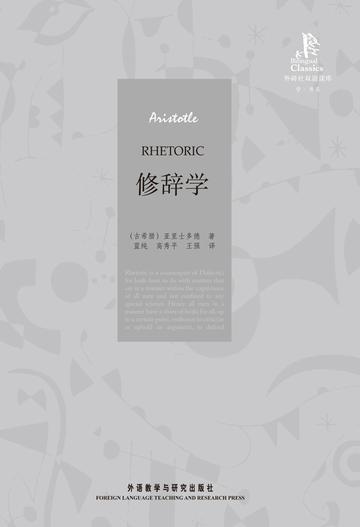
"Rhetoric" is one of Aristotle's most important extant literary and artistic theoretical works, and it is also the first systematic rhetorical theoretical work in the history of European literary and artistic theory. In this book, Aristotle defined the nature, definition and significance of rhetoric, summarized the development history and research results of rhetoric in the past, analyzed the emotions that can be used in speeches, rhetorical themes, methods of persuasion, and discussed the form (style and arrangement) of speeches. This book pioneered a scientific rhetoric system and has important theoretical significance and academic value for future generations to study and study Western rhetoric.
Aristotle (384 BC - 322 BC), an ancient sage, an ancient Greek, one of the great philosophers, scientists and educators in the ancient history of the world, can be called the master of Greek philosophy. He was a student of Plato and teacher of Alexander.
In 335 BC, he founded a school called Lyceum in Athens, which was called the Peripatetic School. Marx once called Aristotle the most knowledgeable figure among ancient Greek philosophers, and Engels called him "the ancient Hegel."
An encyclopedic scientist, he contributed to nearly every discipline. He wrote on ethics, metaphysics, psychology, economics, theology, politics, rhetoric, natural science, education, poetry, customs, and Athenian law. Aristotle's writings formed the first extensive system of Western philosophy, encompassing ethics, aesthetics, logic and science, politics and metaphysics.
Reader comments
This book is very interesting! It is the first systematic rhetorical theory work in Europe. It feels like Aristotle is chatting with us and passing on his thoughts to us. I particularly enjoyed his analysis of rhetoric, which made me think of times when I had to persuade others at work. Sometimes when you meet someone you hate, you can use the methods in the book. In short, this book is not only theoretical, but also very practical!
It explains some of the emotions in our daily life very thoroughly. Unexpectedly, people in the city-state of Athens learned how to use personality charm, people's emotions and rational speech to win support so many years ago. It is very suitable for us modern people to learn when giving speeches or trying to persuade certain people.





This book is very interesting! It is the first systematic rhetorical theory work in Europe. It feels like Aristotle is chatting with us and passing on his thoughts to us. I particularly enjoyed his analysis of rhetoric, which made me think of times when I had to persuade others at work. Sometimes when you meet someone you hate, you can use the methods in the book. In short, this book is not only theoretical, but also very practical!
It explains some of the emotions in our daily life very thoroughly. Unexpectedly, people in the city-state of Athens learned how to use personality charm, people's emotions and rational speech to win support so many years ago. It is very suitable for us modern people to learn when giving speeches or trying to persuade certain people.