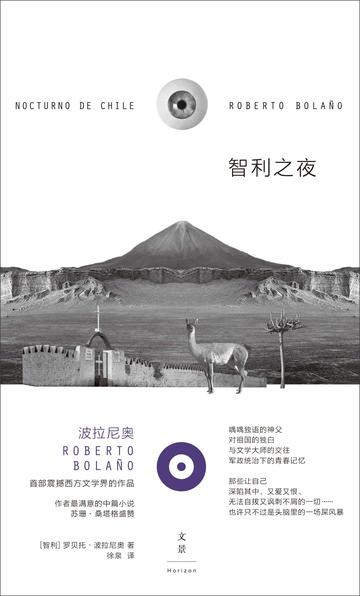
"Chile Nights" tells the story: Sebastian Urrutia Lacroix, a priest and literary critic with a high fever, a mediocre poet, and a member of Opus Dei, thought he was going to die. On his deathbed, he reviewed the important moments in his life in one night. The following characters and plots appeared in sequence:
His association with Fairwell, the godfather of Chilean literary criticism, made him gradually aware of his homosexuality; Ernst Junger, and the Guatemalan painter who allowed himself to die of malnutrition in Paris, the latter scorned all well-intentioned help; two clients with ambiguous identities, a project to travel around Europe in search of An invitation to travel to find ways to preserve church buildings, an unrequited invitation to secretly teach Marxism courses to General Pinochet; and a mysterious woman who gathered prominent figures in Chilean literature in her suburban mansion, while in its basement there were horrific events comparable to horror movies...
Reader comments
It's my favorite type, and I happen to be at the stage where I question reading and literati, especially literati who have no "spine". Maybe being a literati is just a profession. Some people do excellent work, have character, and enlighten their minds; some people just follow the trend and are eventually forgotten. Against the background of political turmoil, the protagonist, as a clergyman, has a love for poetry, but he is unable to briefly burn for his ideals and beliefs with great vigor, and can only live in a dull and dull way for a long time. When life comes to an end, you should repent for not living according to your inner thoughts. At that time, you should be burning passionately for your ideals!
"Chile Nights" is a judgment book on the conscience of Latin American history and cultural intellectuals. It uses a drowsy and urgent monologue to reveal the silent complicity and inner tearing.
In fact, at the beginning of reading this book, I gave up many times because of the obscure metaphors and the writing method of stream of consciousness. However, as the story from the perspective of the protagonist deepened, I became more and more immersed.
Soldero, the aging young man, the black sun, the released falcon... What are they? Can we really understand Bolaño? Or does Bolaño want us to know? We have no way of knowing. But perhaps we have unknowingly become that "aging young man", fighting endlessly against history and power, dedicating our true self to literature, and rebirth this eulogy, this thought, and this enthusiasm.
The plot of this book is so exciting! On his deathbed, the priest looked back on his life, and various characters and plots appeared one after another, allowing me to see a rich and colorful world. I especially loved the mysterious lady and her mansion, and the horrific events taking place in the basement, it was so creepy! However, I also quite dislike the painter who scorns all kind help. Bolaño's writing is charming and enjoyable to read. This book is well worth reading!
The author has the magic ability to extend the content expressed almost like music, and the feeling of reading it is like an abyss. Coupled with the fact that we understand less about Chile, reading becomes even more mysterious and fascinating.
I love reading it. It is written in a stream-of-consciousness style but reads very smoothly and silkily. It is suitable for reading in one sitting in the evening.
The writing is very good and I enjoyed reading it. The whole book can be described as beautiful.



It's my favorite type, and I happen to be at the stage where I question reading and literati, especially literati who have no "spine". Maybe being a literati is just a profession. Some people do excellent work, have character, and enlighten their minds; some people just follow the trend and are eventually forgotten. Against the background of political turmoil, the protagonist, as a clergyman, has a love for poetry, but he is unable to briefly burn for his ideals and beliefs with great vigor, and can only live in a dull and dull way for a long time. When life comes to an end, you should repent for not living according to your inner thoughts. At that time, you should be burning passionately for your ideals! "Chile Nights" is a judgment book on the conscience of Latin American history and cultural intellectuals. It uses a drowsy and urgent monologue to reveal the silent complicity and inner tearing.
In fact, at the beginning of reading this book, I gave up many times because of the obscure metaphors and the writing method of stream of consciousness. However, as the story from the perspective of the protagonist deepened, I became more and more immersed. Soldero, the aging young man, the black sun, the released falcon... What are they? Can we really understand Bolaño? Or does Bolaño want us to know? We have no way of knowing. But perhaps we have unknowingly become that "aging young man", fighting endlessly against history and power, dedicating our true self to literature, and rebirth this eulogy, this thought, and this enthusiasm.
The plot of this book is so exciting! On his deathbed, the priest looked back on his life, and various characters and plots appeared one after another, allowing me to see a rich and colorful world. I especially loved the mysterious lady and her mansion, and the horrific events taking place in the basement, it was so creepy! However, I also quite dislike the painter who scorns all kind help. Bolaño's writing is charming and enjoyable to read. This book is well worth reading!
The author has the magic ability to extend the content expressed almost like music, and the feeling of reading it is like an abyss. Coupled with the fact that we understand less about Chile, reading becomes even more mysterious and fascinating.
I love reading it. It is written in a stream-of-consciousness style but reads very smoothly and silkily. It is suitable for reading in one sitting in the evening. The writing is very good and I enjoyed reading it. The whole book can be described as beautiful.