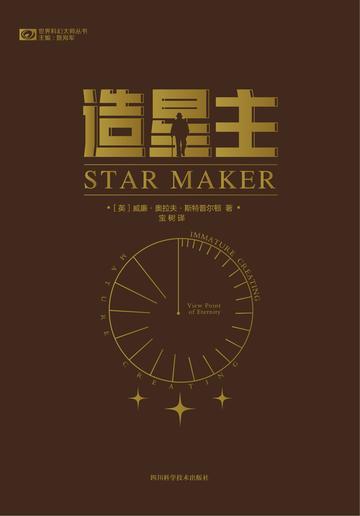
"Star Maker" was published in 1937. It is a work with extremely strange form and content.
The book describes the history of life in the universe, and its time scale far exceeds the two billion years of human history in its predecessor, "The First and the Last Man."
"Star Maker" explores many philosophical propositions such as the nature of life, birth, decline and death, and explores the relationship between the Creator and creation.
Throughout the book, there is a process of gradual unification within and between different civilizations.
Some of the elements and themes briefly discussed in it predicted genetic engineering and alien life forms often mentioned in later science fiction novels.
Reader comments
The postscript is a very good book review, and it should be written as it should.
The time of writing was 1937, and humans had not even entered space yet. The description of leaving the earth and roaming in the universe in the book is a well-founded imagination. It is written in a relatively detailed way and describes the content of the civilizations in different galaxies. It has the feeling of a divine comedy.
However, I didn't use too many subjective feelings mixed with strong emotions into the narrative, because the issues of the times can also be seen in many reflections of reality. Almost all the races in the galaxy I wrote about encountered mental problems, and almost all of them were destroyed due to mental breakdown. As for races with higher minds than humans, the description is somewhat reserved.
So when I later demonstrated the existence of the Star Creator, I started to be idealistic, thinking that the Star Creator is the absolute spirit (ask Hegel). It seems cliché to think that living things will eventually approach this absolute spirit.
Although this book is broad and not in-depth, many ideas can be seen in subsequent science fiction works, which is quite strange.
In this book, the future of the universe is dark, not despair.
This book explores the nature of life and the evolution of the universe from a very unique perspective. The author's imagination opened my eyes, especially the descriptions of different civilizations, which are really wonderful! A sentence in the book impressed me deeply: "Life is like stars, twinkling in the endless universe." This sentence perfectly explains the wonder and endless possibility of life. I recommend you read it, I believe you will have a different perception.
Suitable for looking up at the stars in your mind
It's a bit esoteric, but it's pretty imaginative, and there's something worth learning from.


The postscript is a very good book review, and it should be written as it should. The time of writing was 1937, and humans had not even entered space yet. The description of leaving the earth and roaming in the universe in the book is a well-founded imagination. It is written in a relatively detailed way and describes the content of the civilizations in different galaxies. It has the feeling of a divine comedy. However, I didn't use too many subjective feelings mixed with strong emotions into the narrative, because the issues of the times can also be seen in many reflections of reality. Almost all the races in the galaxy I wrote about encountered mental problems, and almost all of them were destroyed due to mental breakdown. As for races with higher minds than humans, the description is somewhat reserved. So when I later demonstrated the existence of the Star Creator, I started to be idealistic, thinking that the Star Creator is the absolute spirit (ask Hegel). It seems cliché to think that living things will eventually approach this absolute spirit. Although this book is broad and not in-depth, many ideas can be seen in subsequent science fiction works, which is quite strange. In this book, the future of the universe is dark, not despair.
This book explores the nature of life and the evolution of the universe from a very unique perspective. The author's imagination opened my eyes, especially the descriptions of different civilizations, which are really wonderful! A sentence in the book impressed me deeply: "Life is like stars, twinkling in the endless universe." This sentence perfectly explains the wonder and endless possibility of life. I recommend you read it, I believe you will have a different perception.
Suitable for looking up at the stars in your mind
It's a bit esoteric, but it's pretty imaginative, and there's something worth learning from.