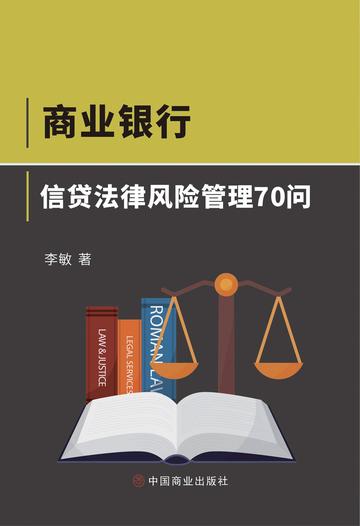
70 Questions on Credit Legal Risk Management of Commercial Banks
商业银行信贷法律风险管理70问
- Status
- Completed
- Length
- 220k Words
- Updated
- 4y ago
- Source
- Fanqie
Stats
9Reads
8.5Score
12Chapters
4.1kReads · all time
Tags
Synopsis
Reader comments
In booklists 6





National Ability + College Life (Ability University) + System
102MViews419Books2dUpdated





I Signed in the City for Many Years and Was Later Exposed.
Divine type, all-round type, invincible type
21.5MViews332Books2moUpdated





The Protagonist Obtains a System in the City and Obtains Urban Culture with Various Abilities.
The protagonist obtains a system in the city and obtains urban culture with various abilities.
17.2MViews139Books2dUpdated





Seeking Rebirth in the Stock Market, Financial Giants, Establishing a World-Class Fortune, If Not the Holy Mother, Kill
16.5MViews234Books10dUpdated





Transform into a Stunning Beauty Through Online Games
6.1MViews318Books1moUpdated





Are There Any Books About Law?
As long as it's about the law, you can interpret the law or the law itself, as long as it's not that kind of novel.
8kViews34Books10moUpdated
It can be seen that the author Li Min has rich experience in bank credit work, especially in the field of credit legal risk management, and has unique insights. This book takes 70 common legal issues that bank credit practitioners face at work as an entry point, and answers the questions in an easy-to-understand way. The author provides a large number of cases, templates and techniques; using case teaching and action learning methods, readers can easily understand and comprehensively master the knowledge and skills of the entire credit process risk management. These contents have high reference value for commercial banks and related staff, and can be directly applied to credit business management through imitation, grafting and innovation methods.
This book is so practical! It uses common legal issues as an entry point, answers them in an easy-to-understand way, and is equipped with real cases, which is very helpful to bank credit practitioners and legal staff. I think it is very similar to the "Banking Legal Practice" I have read before. It is based on practical problems and provides practical suggestions. Moreover, the credit management advice in the book reminded me of my own experience managing finances in life, which was really inspiring! I recommend everyone to read this book.
The constituent elements of the crime of illegally granting loans include: The subject of this crime is a special subject, that is, a staff member of a bank or other financial institution, and an entity can also constitute this crime. If a crime is committed in the name of a unit's branch or internal agency or department, and the illegal proceeds belong to the branch or internal agency or department, it shall be deemed a unit crime. Just because the unit's branches or internal agencies or departments do not have the property to carry out fines, it cannot be regarded as a unit crime and treated as an individual crime. The subjective aspect of this crime is manifested as intentionality or negligence. What needs special attention here is: for crimes with huge amounts, it is generally expressed as intentional, that is, hoping that the consequences of illegal lending will occur.
Bank credit is an activity full of risks. As early as Adam Smith's "The Wealth of Nations", he mentioned that market information problems will cause trouble when banks carry out lending. Subsequently, a large number of economists have studied issues such as the contract design of credit activities. This book summarizes common legal issues that bank credit staff may be involved in and their answers from a practical perspective. It helps staff understand the risks in the work process and deepens their understanding of business regulations, which is very helpful in mitigating the risks of credit activities.
Credit from commercial banks implies a lot of legal background knowledge. If you don't know clearly, please read this book carefully. The book covers legal points in credit risk management, legal risk assessment, legal compliance and other aspects, and provides a wealth of cases and analysis in the form of questions and answers to help readers understand and respond to legal risks in the credit field of commercial banks. This book is suitable for practitioners engaged in commercial bank credit business, legal professionals, and readers interested in commercial bank credit legal risk management.