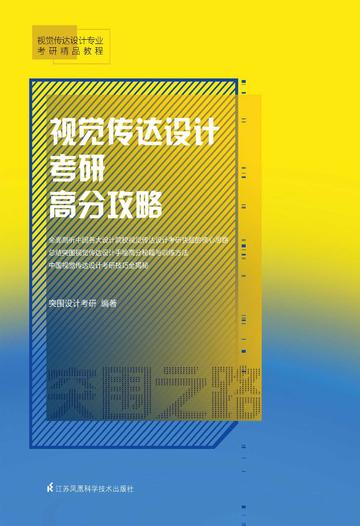
This book is a guide for postgraduate entrance examinations in visual communication design. It took about two years from project establishment to final completion. During this period, the compilation work has been carried out intermittently. It was not until this year that there was a breakthrough and it was completed in one go. There are many reasons for this. One of the obstacles is that in recent years, there has been no unified guidance standard for the postgraduate entrance examination of visual communication design across the country. Every institution has The visual communication design major has different requirements for candidates taking the design postgraduate entrance examination. Some colleges focus on decorative paintings, some colleges focus on font layout, and some colleges use thematic quick-question design as the core of the exam, etc. These all cause great trouble to the unified arrangement of this book. At the same time, in order to find commonalities in the postgraduate entrance examination of visual communication design as soon as possible and ensure the universality of the views, the author of this book visited major target colleges and universities across the country, collected and organized core materials for the postgraduate entrance examination of visual design in many target colleges through various channels, and purposefully interviewed professors and associate professors from some well-known visual communication design colleges, gradually establishing the concepts and purposes described in this book.
Reader comments
The visual communication design postgraduate entrance examination is a highly professional examination. When preparing, you must first understand the examination subjects, question types, key contents and scoring standards in detail. This will help you clarify the direction and focus of your review. Systematically study the basic theories and methods of visual communication design, including design principles, composition, color theory, typography, etc. Establishing a solid knowledge base is crucial to solving both theoretical and applied questions. Improve test-taking skills and time management skills through problem solving and mock exams. Find appropriate teaching materials and simulation test questions, conduct targeted exercises, and summarize and correct mistakes in a timely manner.
It took about two years to finally compile a guide book for postgraduate entrance examinations in visual communication design. It was not easy to complete this book, which filled a gap for the postgraduate entrance examination of visual communication design, which has never had a unified guiding standard across the country. As an increasingly popular subject, visual communication is of great significance to the development of modern industry, industry, and various industries. The author explains the test points in chapters, with clear views and concise language, which is very suitable for candidates to read.
It's a very professional book. I stopped reading it halfway through, but that doesn't mean it's not a good book. It's just that it's too professional and not suitable for ordinary people like me. If you are students who are learning these professional knowledge, or professional staff who are engaged in these jobs, reading this book will definitely be a process of great benefit. Therefore, this book is worthy of careful reading by college students studying majors!
The content in the book is very comprehensive, including not only theoretical knowledge, but also practical case analysis, which gave me a clearer understanding of the postgraduate entrance examination for visual communication design. Moreover, the author also visited many colleges and universities and collected a lot of core information, which made me feel very reliable. I think this book is very similar to "Guidelines for High Scores in Hand-drawn Design Postgraduate Entrance Examination". They are both very practical guide books for the postgraduate entrance examination. I hope I can pass the exam smoothly like the classmates in the book!
The postgraduate entrance examination for the visual communication design major is a process that requires comprehensive preparation and systematic review. This high-score test guide can help us review the basic knowledge of visual communication design more systematically. The review content in the book includes design principles, design history, color theory, composition rules, etc. Different forms such as fill-in-the-blank questions, short-answer questions, and quiz questions are chosen to explain these contents to help us focus on understanding and memorizing important concepts and theories.





The visual communication design postgraduate entrance examination is a highly professional examination. When preparing, you must first understand the examination subjects, question types, key contents and scoring standards in detail. This will help you clarify the direction and focus of your review. Systematically study the basic theories and methods of visual communication design, including design principles, composition, color theory, typography, etc. Establishing a solid knowledge base is crucial to solving both theoretical and applied questions. Improve test-taking skills and time management skills through problem solving and mock exams. Find appropriate teaching materials and simulation test questions, conduct targeted exercises, and summarize and correct mistakes in a timely manner.
It took about two years to finally compile a guide book for postgraduate entrance examinations in visual communication design. It was not easy to complete this book, which filled a gap for the postgraduate entrance examination of visual communication design, which has never had a unified guiding standard across the country. As an increasingly popular subject, visual communication is of great significance to the development of modern industry, industry, and various industries. The author explains the test points in chapters, with clear views and concise language, which is very suitable for candidates to read.
It's a very professional book. I stopped reading it halfway through, but that doesn't mean it's not a good book. It's just that it's too professional and not suitable for ordinary people like me. If you are students who are learning these professional knowledge, or professional staff who are engaged in these jobs, reading this book will definitely be a process of great benefit. Therefore, this book is worthy of careful reading by college students studying majors!
The content in the book is very comprehensive, including not only theoretical knowledge, but also practical case analysis, which gave me a clearer understanding of the postgraduate entrance examination for visual communication design. Moreover, the author also visited many colleges and universities and collected a lot of core information, which made me feel very reliable. I think this book is very similar to "Guidelines for High Scores in Hand-drawn Design Postgraduate Entrance Examination". They are both very practical guide books for the postgraduate entrance examination. I hope I can pass the exam smoothly like the classmates in the book!
The postgraduate entrance examination for the visual communication design major is a process that requires comprehensive preparation and systematic review. This high-score test guide can help us review the basic knowledge of visual communication design more systematically. The review content in the book includes design principles, design history, color theory, composition rules, etc. Different forms such as fill-in-the-blank questions, short-answer questions, and quiz questions are chosen to explain these contents to help us focus on understanding and memorizing important concepts and theories.