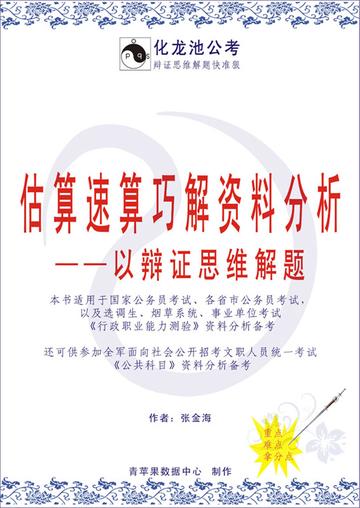
Estimates, Quick Calculations and Clever Data Analysis - Solving Problems with Dialectical Thinking (Solving Problems with Dialectical Thinking • Series 13 of Public Examination Tutorials)
This book is suitable for data analysis and preparation for the National Civil Service Examination, the Civil Service Examination of various provinces and cities, as well as the "Administrative Professional Ability Test" for selected students, tobacco systems, and public institutions. It can also be used to analyze and prepare for the "Public Subjects" information for the military's open recruitment of civilian personnel to the public. Contents of this book: The first chapter of this book describes the guiding ideology of data analysis and problem-solving and the key points of review. Chapter 2 comprehensively and systematically describes the basic formulas, statistical concepts, and professional terminology involved in the analysis of public examination administrative professional ability test data in the past ten years. Chapter 3 comprehensively describes problem-solving methods: quick calculation algorithm, direct data search and comparison, elimination method, qualitative analysis method, rounding estimation method, head-pinch estimation method, insertion standard numerical comparison method, multiplication and division conversion method, hypothesis substitution method, Zhang's law of equalization, assignment method, mantissa method, and experience in dealing with the fifth question of data analysis (comprehensive analysis question). These methods have been tested in actual combat. Chapter 4, analysis of real test questions, explains in detail six sets of real test questions on national examination and joint examination data analysis, and demonstrates the thinking method of estimating and calculating quickly to determine the answer. The characteristic of this book lies in the use of dialectical thinking to solve problems: ① Combining qualitative analysis with quantitative analysis; ② Combining forward problem solving (analyzing or calculating the answer based on the given data of the question) and reverse problem solving (trying to use substitution and elimination methods to lock the answer); ③ More analysis, less calculation - try to make assumptions but not solve them, list equations and formulas but try not to solve equations or formulas; ④ Estimate more and calculate less carefully; ⑤ Do more mental calculations and less written calculations.
Reader comments
The quick estimation methods in the book are very clever and have been tested in actual combat. Especially the feature of "combination of qualitative analysis and quantitative analysis" made me more comfortable in solving problems. I think this book is not only suitable for exam preparation, but also for data analysis in daily work and life. I have already recommended it to my friends who are preparing to take the public exam. Let's work together!




The quick estimation methods in the book are very clever and have been tested in actual combat. Especially the feature of "combination of qualitative analysis and quantitative analysis" made me more comfortable in solving problems. I think this book is not only suitable for exam preparation, but also for data analysis in daily work and life. I have already recommended it to my friends who are preparing to take the public exam. Let's work together!