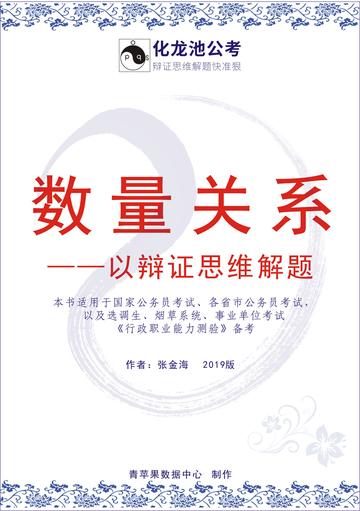
Quantitative Relationships - Using Dialectical Thinking to Solve Problems (2019) (Using Dialectical Thinking to Solve Problems · Series of Public Examination Tutorials No. 12)
It is suitable for preparation for the national examination, joint examination, various local public examinations, as well as administrative professional ability test preparation for selected students, tobacco system, and public institution examinations.
Contents of this book: Comprehensive and systematic explanation of commonly used methods and common test question types: quick calculation algorithm, substitution and elimination method, numerical property method, assignment method, proportion method, equation method, cross method, experimental method, recursive induction method, overall thinking method; permutation and combination, drawer principle, probability, inclusion-exclusion principle, cow eating grass problem, indefinite equation problem, economic problem, itinerary problem, Age problems, engineering problems, solution concentration problems, tree planting problems, square matrix problems, hens and rabbits in the same cage problem, page number problems, average problems, geometry problems, clock problems, calendar and time calculation problems, common divisors and common multiples problems, coordination problems, deductive reasoning problems, reduction problems using the abduction method or abduction method; combination of numbers and shapes, congruence problems.
Features of this book: the original hypothesis introduction method, the cross method, two set-type inclusion-exclusion problems, three set-type inclusion-exclusion problems, the basic thinking model of the cow eating grass problem, drawing a dragon diagram to quickly solve inclusion-exclusion problems, and strategies for solving overall planning problems.
Reader comments
This book is very practical! It is comprehensive and systematic in content, covering various question types and solving methods, and also has some original problem-solving techniques, such as the hypothesis introduction method and the drawing of a dragon. The writing style is also very concise and easy to understand. I feel it will be of great help in improving test scores.






This book is very practical! It is comprehensive and systematic in content, covering various question types and solving methods, and also has some original problem-solving techniques, such as the hypothesis introduction method and the drawing of a dragon. The writing style is also very concise and easy to understand. I feel it will be of great help in improving test scores.