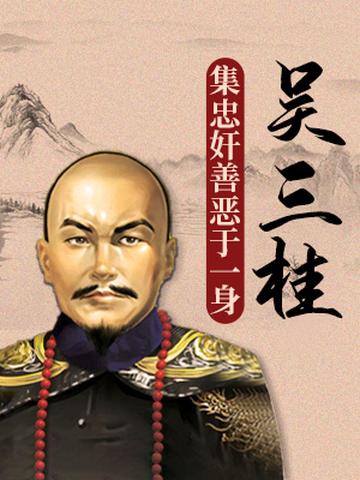
Wu Sangui (1612-1678), a native of Gaoyou, Jiangnan, originally from Liaodong, had the courtesy name Changbo. He was born in martial arts and served as the chief soldier in the late Ming Dynasty. His courtesy name was Ningyuan. He participated in the Battle of Songshan, defeated Xibo, and led the army to garrison Shanhaiguan. Li Zicheng led the rebel army to occupy Beijing. Wu Sangui asked Prince Dorgon of Qingrui for troops, defeated Li Zicheng, and was named King of Pingxi by the Qing Dynasty. In the 14th year of Shunzhi, he was awarded the title of General Pingxi. Together with Doni and others, he captured the Yunnan-Guizhou region of the Southern Ming Dynasty and killed Zhu Youlang, the king of Gui Dynasty in the Ming Dynasty. The Jin Dynasty was granted the title of Prince, and he was in charge of Yunnan and Guizhou, and he had heavy troops. In the twelfth year of Kangxi's reign (1673), he launched a rebellion in Yunnan. He claimed to be the king of Zhou and the marshal of the army. In the seventeenth year of Kangxi's reign (1678), he proclaimed himself emperor in Hengzhou, changed the Yuan Dynasty to Zhaowu, and made Hengzhou the Dingtian Mansion. He died suddenly shortly after. His grandson Shipan Jili changed the Yuan Dynasty to Honghua. In the 20th year of Kangxi (1681), the Qing army besieged Kunming in three directions. Shipan committed suicide and Yunnan and Guizhou were peaceful.
Reader comments
The biographies of people in the history of the Ming Dynasty are clear and vivid. It is a top-notch book. I have listened to it twice! There is an aftertaste! Encourage the author, thank you very much, I am listening to it for the third time...
The biographies of people in the history of the Ming Dynasty are clear and vivid. It is a top-notch book. I have listened to it twice! There is an aftertaste! Encourage the author, thank you very much, I am listening to it for the third time...