Stats
5.8Score
Synopsis
No synopsis yet.
We haven’t got an English blurb for this one. It appears once the source description has been translated.
We haven’t got an English blurb for this one. It appears once the source description has been translated.
In the era of Li Bai and Du Fu, poetry was almost a habit in the life of literati. Poems at the time were very similar to popular songs today. Many poems by Li Bai and Du Fu contain the word "" in their titles, such as "The Journey of Changgan", "The Journey of Military Chariots", "The Journey of Beautiful People", etc. "Xing" is inherited from the Yuefu poetry of the Han Dynasty, which is the tune of the song. New lyrics can be put into a tune. "Changganxing" was a singable song at that time, and it still retained a very obvious ballad form. Changgan is a place name. In today's Jiangsu, "Changgan Xing" is the tune of a popular song in this place. The poet used this widely circulated folk tune to write out his inner feelings and compile a new pop song.
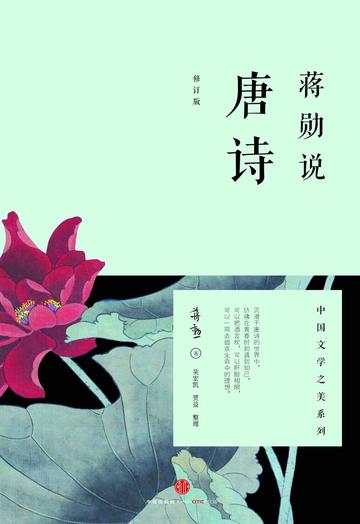
If Tang poetry is like a garden, with a sea of graceful flowers and vast expanse. Then Teacher Jiang is like the bee, understanding every flower and knowing the honey of every flower. Under the leadership of teacher Jiang Xun, experience the original and pure beauty of Tang Dynasty poetry. Teacher Jiang Xun's language is like pearls, explaining everything about Tang poetry implicitly. The Tang poems are stripped of their cocoons and displayed in the hands of readers bit by bit. Follow Teacher Jiang Xun's words, step by step, continue to delve deeper into the Tang Dynasty and understand everything about the Tang Dynasty.
We will like different words, poems, and feelings at different stages of life. Just like Jiang Xun said: "I told many friends that the Paris I introduced to you is not objective, because I studied in Paris when I was twenty-five years old. The "Paris" I introduced actually refers to my twenty-five years old, not Paris." When I read this Tang poetry written by Jiang Xun this year, when I was young, I often thought that poetry should be very beautiful. After experiencing some things in life, I feel that the most difficult thing to write about in life is probably these details. And we are living in these details, pursuing the dream of being thirty.
We will like different words, poems, and feelings at different stages of life. Just like Jiang Xun said: "I told many friends that the Paris I introduced to you is not objective, because I studied in Paris when I was twenty-five years old. The "Paris" I introduced is actually my twenty-five years old, not Paris." When we read Tang poetry and literature at any age, their beauty is not the narrowing of life, but the process of broadening life. Jiang Xun believes that the greatest characteristic of poets in the Tang Dynasty is almost "wandering", which is a romantic knight-errant behavior. In the Tang Dynasty, the pattern became larger. The poet is always in dialogue with the moon, the sun, and the mountains and rivers. The entire consciousness of life is magnified into the huge space, and he will feel proud and tragic, and he will have the consciousness of the universe. At the same time, he feels that there are not many lives in such a vast space, so there is a huge sense of desolation. He presents the representative poets of the Tang Dynasty and their representative works, from the prosperous Tang Dynasty to the late Tang Dynasty, from Wang Wei, to Li Bai and Du Fu, to Bai Juyi and Li Shangyin, allowing us to see the growth of Tang poetry.
This book is like a dear friend, telling the story of Tang poetry in my ears. Mr. Jiang Xun's interpretation of Tang poetry was profound and vivid, making me feel like I was in that prosperous Tang Dynasty. His analysis of the poets' characters and experiences gave me a deeper understanding of these poets, and also reminded me of my relatives and friends. Aren't their stories and experiences also so rich and colorful? This book not only allowed me to appreciate the beauty of Tang poetry, but also made me feel the various aspects of life.
It is different from ordinary works explaining poetry. On the ninth day of the lunar month, I just choose poems I like and poets I like. Combining aesthetics to explore and tell these Tang poems. Therefore, when reading, we can easily integrate ourselves into the beauty of Tang poetry. The poetry of the Tang Dynasty can be said to be the most prosperous period of development in China. It left countless treasures to future generations. During the process of reading Tang poetry, relatives and friends could still be immersed in the free artistic conception of Tang poetry.
Legend has it that at night when the moon is full, the clam shells will be opened one by one, allowing their pearls to absorb the essence of the moon. This is a very beautiful image. You will feel that on a full moon night, all the clam shells in the ocean are opened, and there is a relationship between the round pearls and the bright moon in the sky. "Returning to flight" is what Li Shangyin wants to talk about: how to rectify oneself and how to find the experience of one's own life body, instead of chasing outwards.
After reading this book, I fell in love with Li Shangyin.
This book narrates some of the most representative poets and their works of Tang poetry. The profound artistic conception of the poets and the beauty of the poems are clearly visible, allowing people to be more deeply integrated into the artistic conception of Tang poetry, and the allusions in the poems are even more refreshing.
From an aesthetic point of view, appreciating Tang poetry and Song lyrics is like walking on a historical and cultural mountain valley, with mountains and rivers, spring flowers and autumn moons, and you'll be dazzled by them, with pearls of witty sayings everywhere you look! A classic!
After reading, your teeth and cheeks will be fragrant
A good book about reading Tang poetry, easy to understand!
I have read several books written by Jiang Xun, commenting on Tang poetry, Song poetry, Hong Hu Meng, The Book of Songs, Zhuangzi, and Su Shi. They are very profound and full of Chinese implicit beauty.
I read them all in one go, they are all great poets that I like, thank you! ! !
Light and appropriate, poetic and picturesque
It's a good book, but there are a lot of words.
Mr. Jiang Xun explained it so well. I feel like I finally understand Tang poetry.
Everyone's explanations are indeed very helpful.
It's a good book, written very emotionally. I really like Jiang Xun's in-depth analysis.
It's a very good talk about poetry from the perspective of literary aesthetics.