Stats
Synopsis
No synopsis yet.
We haven’t got an English blurb for this one. It appears once the source description has been translated.
Reader comments
In booklists 12
Literary Masterpiece, (ㆁωㆁ)



Metamorphosis, the Protagonist Is a Rural Child, His Quality Can Defeat the Wealthy
Can anyone write a book like this?

Are There Any Lobotomy Companies That Have Traveled to Other Anime Worlds?

I Want to See the Monthly Meter! I Want to See the Monthly Meter!
I want to read a book similar to "Yueji Sichen brought some strange things".

Does Tomato Have Any Philosophy Books?
I have become more interested in philosophy recently. Are there any high-quality introductory books on philosophy? : D



Transformation Writing, Abuse Writing
It's best to be the kind that hurts the heart of the person who uses the knife.


Is There Any Book About Border Bus?
I want to read a book like "I Have a Border Prison Personality System When I Travel Through the City". There are still too few books on monthly calculations


Ah Ah, Is There Any Book About the Moon Plan? It's Best to Travel to Other Worlds.
I want to read a book like "Lobotomy: Increasingly Outrageous Employees".
Literature Books, I Want Literature Books! ! !
Family members, I want to read literature books, books that can improve my writing skills or increase my knowledge. Beg on your knees!
No Need to Push Anymore, I Have Already Withdrawn from the Circle (Please Read the Book About Border Prison Bus)
The protagonist group only needs Twelve Sinners + Dante (at most + Vergil + Charon, not Sinner No. 14, Sinner No. 0), No moon meter system, no works about MiHoYo (such as Genshin Impact, Bent Iron, etc.), No moon meter OC, you can do it without a library.
Are There Any... Foreign Masterpieces... Chinese Masterpieces?

There Are Really Few Articles About Monthly Calculations, and Few People Read Them?
I would like to read a book like "City: The Legendary Experience of a Color Finisher". Sometimes I really want to find a place where no one cares about me, and then go crazy, yelling and dancing in all kinds of ways. So meaningless!
It's a rotten apple in the fruit basket It's a broken string It's the bright red seal on the bill is everything ever useful Things that are now obsolete "I think he should die willingly!"
The first thing the protagonist thinks about after turning into a beetle is how to go to work. Everyone only cares about whether he can continue to work. It is like a machine. It only needs to keep running to be a good machine. There is a sense of alienation in this (?) People are the sum of all social relationships. When a person loses When his labor ability loses the ability to create value, his relationship bound by interests also disappears, but the family relationship is like this, which makes me... Especially before the protagonist turns into a beetle, he goes to work alone and raises three "beetles". In the end, he will be cast aside, and his family will only think that he is a burden. . In reality, the mainstay of the family will not suddenly turn into a beetle, but he may lose the ability to work due to an accident and become a "beetle"
I briefly learned about Kafka's life, and then searched for information on his own, about his emotions and his school deeds. I feel that Kafka has a very sensitive sadness. His experience also gave me a deeper understanding of the importance of children's education. And a person is influenced by his family of origin throughout his life. There is a feeling of being poor and unable to work. I suspect that the kind of person who is completely happy and has no pain may not become a good writer. There are works that are surrounded by love, but they are very few. Without painful experiences and hesitation, it would be difficult to break away from the happy real life and get into writing. Writing is a process of spiritual catharsis and self-comfort. Many profound works record heart-rending pain. Of course, it's not necessarily about writing about one's own pain and growing up happily, but it seems that those who have high empathy for the pain of others, are not numb to the world, and want to speak out and make their voices heard are more likely to become writers, or to devote themselves to writing (?). It's not easy to be happy if you think too much. It seems hard to be happy when thinking about heavy problems.
Gregor, who turned into an insect, still retained his human thoughts, the narrow sofa, the sheets tightly wrapped around him, the self-blame when his mother fainted from fright, and the joy when he heard his sister playing the piano. Gregor, who has spent his whole life thinking about his family, failed to get love in return. The death of Gregor, who had lost his usefulness, was decided.
I read this book after playing Border Bus and wanting to see the true character of the characters. But it is different from what is shown in the game: the "forced war hero" in the game gives people a character with a reliable tragic color (sometimes it is embarrassing, and sometimes it is very funny), and here it can be regarded as a relatively restored character in Yueji. Of course, it is a pity that the plot in this article is not used in several of the plots of Yueji. Coming back to this article, I personally think that this article can only be read as two kinds of articles: one is as an allusion to some of the not-so-good aspects of reality (such as changes in people's attitudes between money and family affection or the decision-making between support and resistance in social survival), and the other is a fairy tale (or fantasy work) with realism. Finally, please let me share some thoughts after reading this: A person's life lasts only a hundred years, and it is difficult to live as you are, but don't forget who you are, and at least try hard to "when death comes, I can say without hesitation: I am worthy of this life" (Paul's words in "How Steel Was Tempered").
The bond that maintains Gregor and his family turns out to be not the family love that blood is thicker than water, as he thought, but the private interests hidden under the shared property relationship. The rotten apple eventually accompanied him to the end of his life.
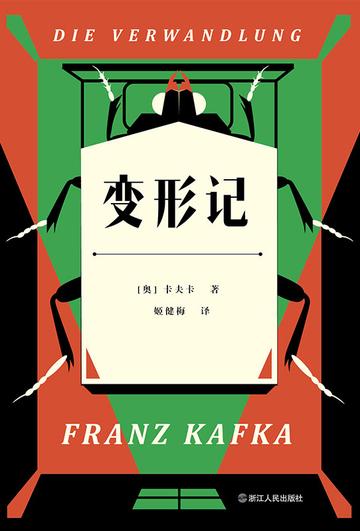
The hard backbone of the beetle transformed by Gregor after alienation symbolizes slowness and clumsiness, as well as self-protection. The tiny legs and feet represent his weakness and ridiculousness, and his overall image is that of being small and humble, ignored and despised. The door is also a very interesting image. Gregor can neither go out nor not go out, which symbolizes the confused state of man's dilemma in survival. Not going out: protecting yourself, resisting the outside world, but blocking communication and creating gaps. Going out: breaking the deadlock, connecting with others, but not being recognized by others. There are three aspects of Gregor's alienation: 1. Work - a means of making a living and creating value Turned into indifferent, profit-oriented oppression 2. Family love - a warm harbor and a strong backing Become a frightened, doubtful, hostile stranger 3. Self--self-esteem, freedom, people who pursue happiness Become a despicable, depressed "pest" And "alienation" is the subject's splitting off its own opposite and becoming an external alien force [get it][get it]
The absurd plot is full of real and devastated human nature. When the pillar of a family becomes completely uncontributable, the family's attitude towards him will take a sharp turn, and in the end they even want to abandon him, without any affection at all. . . I feel sorry for Gregor. A life of irony and tragedy.
It was very sad after reading it. Gregor was thinking about his sister's music school and family until the end. He went to work in such pain every day, and his only confidence was the happiness of his family. Even after turning into a bug, he still thought about work. What a disgusting manager. He has worked hard every day for five years, but just one absence is like Gregor's disaster. What the author wants to show is the alienation of people caused by modernization, which has reshaped family relationships. Family relationships are no longer linked by family ties, but by interests. Once upon a time, home was a home, a place where people could breathe briefly and warmly. Today, home is like a small country, where everyone is trying their best to get what they want and care about every detail🥺
The best ending for Gregor is to die at the feet of his first father
The deformation not only changes the body of the protagonist Gregor, but also the relatives around him. After the protagonist deforms, his family undergoes emotional changes of shock, fear, dissatisfaction and relief. Kafka later mentioned not to describe the insect that Gregor transformed into in detail, but to make the insect abstract. It is conceivable what the author wanted to express through this, but I was too shallow to see it. In summary, this book is meticulously depicted and fluently written. It is an excellent work worth reading.
It is actually very despairing to assume the perspective of the younger sister. The younger sister has actually tried her best. She suppressed her fear in the early stage and worked hard to take care of her. Don't persuade others to be good without others' suffering. Who can not be afraid of such a big beetle, even if it was once your brother...
In the face of interests, human nature is very fragile. Gregor changes from the family's breadwinner and guardian to a "pest" who has lost his human status and needs to be cleaned up. When Gregor cannot bring benefits, family ties are as thin as paper.
I can't summarize anything about this book from a professional perspective or rationally. I think capable people have already studied it, so I don't need to talk about my understanding here. So let's talk about real feelings. I read this book in great pain. My mental state has become so bad that I have broken my promises to myself many times, the number of all-nighters has accumulated again and again, I can't stop crying, retching, fear (not just falling asleep), I still consume my body even though I know I should sleep and eat well, countless headaches, heartache, but still. When I read this book, my spirit was in chaos. After reading it, I just felt so painful. It truly pains me. I always believe that human nature is self-interested and selfish, so I can understand selfishness and relief. I just suffer from a "blood bag" that has been squeezed out of everything and is willing to die in the end. If human nature is like this for all "worthlessness", then if human nature is so indestructible, how can we still live? How to hypnotize yourself into being happy. Maybe my mental state is really bad, and such negative thoughts cannot be used as a book review. But thanks to the Internet, and thanks to me being an ordinary person, I can express what cannot be said in reality, and then maintain dignity in reality.
After reading the novel, I felt a lot in my heart. The ruthlessness of the family dealt a heavy blow to the life of the protagonist Gregor. Gregor's death made everyone in the family feel that the future was bright. Before Gregor was transformed, he was the mainstay of his family and felt that he was loved by his family. In fact, this was not the case. What his family only loved was the money he got back. I have always been curious about why Gregor's father in "The Metamorphosis" was so unfeeling. It wasn't until I read Kafka's biography that I realized that his father had left a lifelong shadow on Kafka. Recommend everyone to read it
After reading "The Metamorphosis", I still didn't quite understand the protagonist's feelings and the meaning of the writer's writing. After reading the following biography, I deeply admired the writer's pain and struggle of being oppressed.
The rotten apple on his back and the inflamed area covered with soft dust around it were almost invisible. He thought of his family with a heart filled with emotion and love, even more convinced than his sister that he should disappear.
Reading this book always feels like watching a cartoon. Frame after frame, the pictures are coherent, vivid, three-dimensional and vivid... You will always be infected by the deep sadness and sorrow contained in the author's delicate and light writing style, and you will reflect sadly, for that worm, for that sister, for that father, for...
The suffocating sense of substitution in Kafka's Metamorphosis I read Kafka's Metamorphosis today and was deeply touched by the sensitive, humorous and self-destructive tragic and sharp writing style of this Prague writer. As Kafka said, "Only the kind of books that bite you and sting you should be read. If reading a book can't give us a wake-up call, why bother reading it?" In the beginning, Gergoff turns into a bug and worries about catching the train and missing work. It is really darkly humorous and absurd. The further reading is about facing the reality of human nature after "alienation", self-destruction after spiritual desires are incompatible with society, and finally ushering in the liberation of the family and the beginning of a new life. How ironic! Kafka's metamorphosis is like a mirror, projecting his own reality.
Try to read his other works. As far as this book is concerned, the ending of the male protagonist in his works seems to be death in the end. As he himself said, good works should give people a wake-up call, and he has always implemented this.
When I saw the ending, it felt like it ended abruptly, but it seemed to be expected. Love is a verb that will change qualitatively with time and environment. When Gregor transforms, time is like a reminder, peeling away the emotional ties between him and his parents and sister, and the truth will eventually be revealed. No one will suddenly stop loving you, it's just that you suddenly know it. Loving ourselves is the best choice in our lives and the cornerstone of getting along with others. There is always a banquet in the world, and many unexpected partings are caused by differences of opinion. Just like how can the paths of insects and humans be the same? Let go of your unwillingness, don't look back when it's time to say goodbye, and move forward boldly.
The content of the article is extremely absurd and depressing. The protagonist's tragedy is caused by his family's selfishness and indifference, and is also a microcosm of the objectification of people by society at that time. Finally, "Good night, Gregor! May you find your own peace in heaven!"
The protagonist was really gone, and I realized that I was a little naive. It was a human life, and it was their relatives. I thought the worst ending was just being abandoned. It turned out that the protagonist's life and death after turning into a bug had long been meaningless. To them, the protagonist had long since died of illness. I have been unable to make any money for a long time and was killed by π_π. Alas, my previous concern was just a bit of emotion (have you really experienced it before?). In addition, I also have hopes for whether the protagonist will recover, and suddenly I think of other works. In a tragic era, living people will always be vulnerable to death. They were all alive! Want to stay alive! But it can only become a tragedy of mistakes in a bad world.
I am very interested in Kafka's writings and his people. They are probably somewhat similar but not exactly the same. This book ranks in the top six in my own mind.
Ironically, Gregor's first reaction when he turned into a bug was to go to work instead of thinking about his situation. When the family realized that Gregor could no longer create wealth, they gradually changed from indifference to disgust. Finally, facing Gregor's death, they did not feel sad, but felt relaxed.
Although reading it felt very depressing, sad, and not happy at all. But the storyline is so shocking that you can't help but keep reading. While feeling sad and aggrieved for the protagonist, I also had to seriously reflect on my own destiny!
Well worth watching. You can write good-looking books by yourself. We should read these books about life and death, which can affect our own great compassion, to witness the misfortune of others, to understand others, and to become a being of great kindness.
I heard about Samsa written with the particle p. The particle p was already desperate enough, but after reading the original work, it was like an invisible darkness... Apples, screams and tingling. The unchanged Gregor has a heart for his family, but what has changed is that the family disliked her because Gregor turned into a beetle.
When a person turns from a pillar of support into a burden, the people around him will eventually become disloyal.
The first thought after turning into a beetle is what will happen to my job, my boss will hate us, and what will happen to the colleagues I hate. As a worker, I am very empathetic. Of course, people will not turn into beetles, people will get sick, and the illness will affect the work, and then there will be a series of things. Sometimes I think that this shitty job is really so important and I will quit my job at worst, but I tell myself rationally not to be too impulsive and to thank my job for supporting myself. Although I say I want to find value in my work, just completing the tasks is already exhausting. I am just an ordinary person. I was a little happy that the protagonist could have a good rest after turning into a beetle. When I saw the third paragraph, I thought the protagonist had a dream about turning into a beetle. But it's not a dream, it's reality. Then I thought that if one day I lose the ability to work like the protagonist and lie on the hospital bed and need help, I think my family will slowly dislike me or at least hate me, and finally commit suicide. It's pitiful to think about it🥺, what do ordinary people ultimately pursue in life? Live well and be healthy and safe.