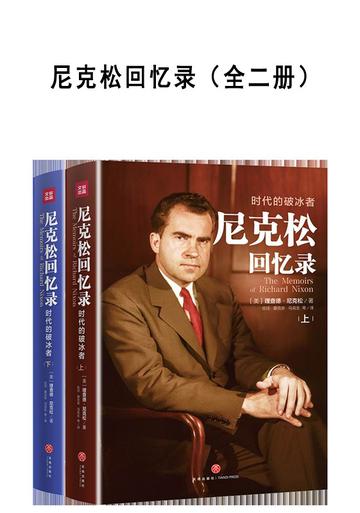
From a grassroots son to the President of the United States, from a stubborn "anti-communist" to an "old friend of the Chinese people," Nixon eased U. S.-Soviet relations and Sino-U. S. Relations, ended the Vietnam War, and implemented the policy of desegregation until the Watergate incident, when he became the first president in the history of the United States to resign due to impeachment. As a political figure that spanned the entire Cold War period, his life was full of legends and he was one of the most controversial presidents in American history. When the Watergate scandal broke out, his entire political reputation was destroyed overnight. In the following years, Nixon continued to care about and intervene in the domestic and foreign affairs of the United States as an opposition figure until the end of his life. When he died, Clinton and four former presidents attended the funeral.
This book is Nixon's only memoir and contains a large amount of first-hand information, especially Nixon's notes, dictated diary records, and dictated recordings of meetings, conversations, or events. "The reports based on these tapes are more complete than any reports in the past." Entering this book from the perspective of the person at the center of the event, you will find a more comprehensive and complex Nixon, and then understand the ideological context of U. S. Foreign policy, summarize the international political history of the Cold War, and understand the subsequent world development trends.
Reader comments
An autobiographical political memoir written by former U. S. President Richard Nixon. It mainly describes Nixon's experiences and thoughts during his tenure in the White House, as well as his views and evaluations of some events and historical figures. The first volume mainly records Nixon's early experience, activities and strategies when running for president, as well as domestic and foreign affairs, policy formulation and crisis management from 1969 to 1972. Among them, important events such as the improvement of relations with China, the Soviet Union's nuclear deterrence strategy, the Vietnam War, and the Watergate Incident are highlighted. The second volume mainly introduces Nixon's life and thinking after resigning from the presidency after the Watergate incident. He reviewed his achievements and shortcomings in governance, and his views and opinions on the democratic system, journalism and the future development of the United States.
For many Chinese, Nixon is perhaps one of the most familiar American presidents. It was during his term that China and the United States formally established diplomatic relations. Since then, China has had more friends in the world, laying the groundwork for development after reform and opening up. Taking an overview of Nixon's life through this book, it is not difficult to find that there were many contradictions and conflicts in his dramatic life. He tried his best to get from the bottom of society to the top of national governance, but his reputation was disgraced when his political power and reputation reached their peak. But overall, Nixon is worthy of being a great politician.
The language is simple and the details are very vivid, highlighting personal experience and perfectly expressing the excitement of his political career.
It is necessary to read more of these books.
Great harvest!
It seems that the United States really has very few things that need to be kept secret. There is no need to hide everything big or small.
A good book, real and moving, with real feelings. I really want to read it in one sitting.


An autobiographical political memoir written by former U. S. President Richard Nixon. It mainly describes Nixon's experiences and thoughts during his tenure in the White House, as well as his views and evaluations of some events and historical figures. The first volume mainly records Nixon's early experience, activities and strategies when running for president, as well as domestic and foreign affairs, policy formulation and crisis management from 1969 to 1972. Among them, important events such as the improvement of relations with China, the Soviet Union's nuclear deterrence strategy, the Vietnam War, and the Watergate Incident are highlighted. The second volume mainly introduces Nixon's life and thinking after resigning from the presidency after the Watergate incident. He reviewed his achievements and shortcomings in governance, and his views and opinions on the democratic system, journalism and the future development of the United States.
For many Chinese, Nixon is perhaps one of the most familiar American presidents. It was during his term that China and the United States formally established diplomatic relations. Since then, China has had more friends in the world, laying the groundwork for development after reform and opening up. Taking an overview of Nixon's life through this book, it is not difficult to find that there were many contradictions and conflicts in his dramatic life. He tried his best to get from the bottom of society to the top of national governance, but his reputation was disgraced when his political power and reputation reached their peak. But overall, Nixon is worthy of being a great politician.
The language is simple and the details are very vivid, highlighting personal experience and perfectly expressing the excitement of his political career.
It is necessary to read more of these books. Great harvest!
It seems that the United States really has very few things that need to be kept secret. There is no need to hide everything big or small.
A good book, real and moving, with real feelings. I really want to read it in one sitting.
Not bad, worth listening to.