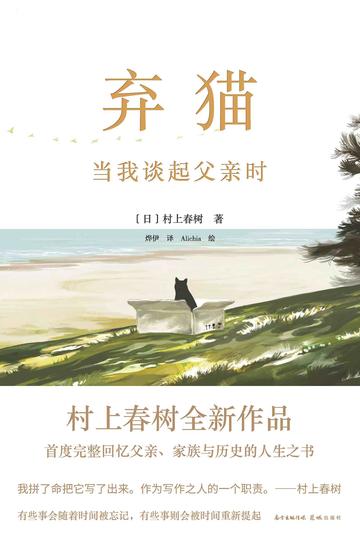
Abandoned Cat When I Talk About My Father
弃猫 当我谈起父亲时
- Status
- Completed
- Length
- 19k Words
- Updated
- 4y ago
- Source
- Fanqie
Stats
29Reads
9.4Score
3Chapters
4Listens
25.2kReads · all time
Tags
Synopsis
Reader comments
In booklists 2
A Healing and Gentle Book
A book that will limit your imagination and make people feel healed. It tells the most ordinary story, but it will make you feel very warm and comfortable.
6.9MViews452Books11hUpdated
I've Been so Bored Lately. I Feel Like I Can't Get Interested in Anything. I Want to Try Something with a New Theme.
73.2kViews127Books7dUpdated
The author Haruki Murakami is first of all worthy of admiration because he can admit Japan's brutal aggression against China. He has a kind heart, feels sorry for the Chinese, and respects the tenacious and unyielding Chinese warriors. My literary literacy is really average, so I didn't quite understand this book. It started from the abandoned cat to the father and then to the war. Forgive me for not understanding it [crying] The first time I wanted to read this book was when I saw Haruki Murakami's name in "Spring Breeze". The article mentioned that Haruki Murakami's works always have a touch of philosophy. I think I definitely felt that in this book. Here are two paragraphs: This is another clear memory from my childhood involving cats. It left a profound lesson to me when I was still young: "It is much harder to come down than to go up." To put it more generally - the result can easily swallow up the cause, causing the cause to lose its original power. This may sometimes kill a cat, sometimes it may kill a human. In other words, we are just a nameless drop among countless raindrops falling on the vast earth. It does exist, but it is also a drop that can be replaced. But in this drop of rain, there is its own unique memory. A raindrop has its own history, and has the responsibility and obligation to pass on this history. We should not forget this. Even if it will be easily swallowed up, lose its individual outline, be replaced by a certain whole, and gradually disappear. No, it should be said that we should remember it more precisely because it will be replaced by a certain whole and gradually disappear. There are a few lines of haiku in the article that I particularly like, as follows👇 Where are the birds returning? Where are they chirping? It's my hometown. One Tea Taboo: A Close Reading of Sad Haiku
It took less than an hour to read this work, which I will call a "book" for the time being. I was very moved after reading it and I really like the following paragraph. "We are just a nameless drop among countless raindrops falling on the vast land. It does exist, but it can also be replaced. But in this drop of rain, there is its unique memory. A raindrop has its own history, and it has the ability to pass on this history. We should not forget this. Even if it will be easily swallowed up, lost its individual outline, and gradually disappear, it should be said that it is precisely because it will be replaced by a certain whole that we should remember it. ——Haruki Murakami
Everyone is a mayfly creature carried away involuntarily by the tide of the times. But even if a mayfly flies by, life and death, the road traveled and the bitter wine drunk still have a clear-cut meaning with nothingness.
I think the author's perspective on history and historical inheritance is very profound. "History is not something from the past. It exists within the consciousness or subconscious mind, flowing into warm and living blood, and is involuntarily carried to the next generation.
What I like the most is what the author said. Everyone has happy memories with their father, as well as unpleasant memories. This sentence supported me to finish reading this book.
The result can easily swallow up the cause, causing the cause to lose its original power.
Peace is not easy, war is indeed cruel, and those of us who have not experienced it feel ethereal and distant, but its existence can easily change the fate of a group of people, and we should cherish life even more.
After reading this book, I finally understood a truth: it is precisely because people or things will die or disappear that they are finally remembered by others.
I was particularly confused last night, so I opened the search bar "Haruki Murakami". Maybe this article can't completely relieve my current confusion, but it can always calm my mind and reset everything to zero. Sometimes that is the best arrangement.
I have thought about it a long time ago to write a decent text about my father who passed away. Time flies, but I haven't been able to write it yet. How much and how deeply can war bring about a person's life and spirit - a very ordinary, unknown citizen?
I like the haiku in "I am a soldier and a monk, facing the bright moon from afar, with my hands clasped together" The illustrations in the article were bright and sunny. When I wrote about the war, I cried several times. But I felt very peaceful after reading it at the end. The author is very good. I hope Tomato🍅 can have other books by him.
In fact, I don't really like the author's descriptions of battlefields. Maybe it's too routine and I lose my patience. I really like the author's writing style, which is like a spring breeze. I feel that my father is very gentle, although I think some Japanese people are really gentle.
Murakami Haruki's writings are easy for people to get into and feel everything in the book. The first time I read it, I was very familiar with it. After reading other articles, I should have more feelings. There is a sentence in it that is particularly touching. It probably means that what you think and think in your heart must be recorded on paper to make sense. The power of words is infinite. When the inspiration comes to you, it is also the moment when you write like a god.
Some things will be forgotten over time and some things will be mentioned again over time
Everyone has more or less unforgettable heavy memories. The endless accumulation of small things in life has allowed us to grow into what we are today. After reading "Abandoned Cat", you will find that letting go is the cure for everything. I hope each of us can find our own salvation from the book!
There is always a touch of philosophy in Haruki Murakami's works.
Plain narration, simple but steady and peaceful language, thoughts about "past events" and "old friends". It depicts profound philosophy in a simple way, and the article has a unique temperament.
This book is like a cup of light tea. Haruki Murakami tells the story of him and his father in delicate words. What impressed me deeply was the plot of them going to the beach to abandon the cat together. The simple description has indescribable emotions. Haruki Murakami's portrayal of fragments of daily life made me feel the true love between father and son, and also made me cherish the people around me more. Recommended to friends who like family stories.
We are born in the hypothesis of history. No matter what, we exist and there are people and things that we need to bear and face. We need to face it.
The story is wonderful and the feelings are sincere. The master is worthy of being a master! 666666
I feel the same way. I also like and am used to writing down some experiences and thoughts, as if I can save them and archive them. But often after careful thinking,
The effect can easily swallow up the cause and make the cause lose its power.
This is the first time I read an article by Haruki Murakami. The article has a strong affinity. Naturally, I like this feeling.
I really like this kind of personal short film, which enriches the image of Haruki Murakami. The memory of my father also triggers thinking about the fate of life. The harvest is quite big
After reading it, I felt deeply
Wraygood is good, good
This book enriches my image of Haruki Murakami
March 25, 2023 11:25
It's a pretty good book, I can finish it quickly.