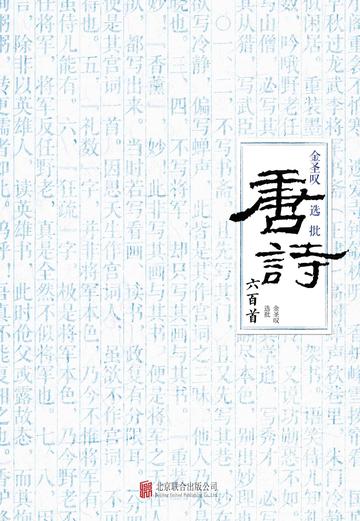
The characteristic of Jin Shengtan's anthology lies not only in the selection, but also in the evaluation, paying more attention to comments and appreciation.
Jin Shengtan has selected nearly 600 seven-character verses from the early Tang Dynasty to the Five Dynasties for detailed commentary, focusing on trying to figure out the various layouts and patterns of succession, transition, etc. In the seven-character verses of the Tang Dynasty. He either penetrates the meaning or makes use of the topic, which is of great reference value for appreciating and studying Tang poetry.
Jin Shengtan used the "seven-law decomposition method" to comment on Tang poetry. He divided Tang poetry into "pre-interpretation" and "post-interpretation", analyzing the ups and downs hidden behind the poems, "which may enable future generations to see not only the words of Tang poetry, but also the poetry of Tang poetry."
"The Biography of Seven Hundred Famous People in the Qing Dynasty: The Biography of Jin Renrui" says of him: "His criticisms are as bright as fire and as pungent as those of an old official. His writing dances with his sentences, and those who see him often sigh that he is the reincarnation of a spirit ghost."
Reader comments
The book selects 600 works from Tang Dynasty poetry, covering representative works from various periods and schools. The selected poems cover various themes, including works with different content ranges such as natural landscapes, human feelings, love and farewell, and philosophical thinking. Each poem is accompanied by comments and annotations by Jin Shengtan. Jin Shengtan is a well-known literary critic and expert on classical poetry. His comments can help readers gain a deeper understanding of the connotation and artistic characteristics of poetry.
Just as he said, "Poetry is a great virtue." The charm of poetry spans time and space. This reminds me of "Human Words", both of which provide unique comments on poetry. Every time I read a book like this, I can feel the power of poetry, and it strengthens my determination to go out of the mountains and pursue a broader world.
We Chinese are most familiar with Tang poetry and Song lyrics. However, sometimes, maybe because of our own cultural limitations, sometimes because we are too far away from that era, we cannot quickly and accurately tell the true meaning of these poems, and sometimes there are even some errors. At this time, what we have to do is to read these annotations and annotations. They can give us good and correct explanations. It is recommended to read.
Jin Shengtan, what a hero! A wise eye looks at the world, and a wonderful pen produces flowers!
The book selects 600 works from Tang Dynasty poetry, covering representative works from various periods and schools. The selected poems cover various themes, including works with different content ranges such as natural landscapes, human feelings, love and farewell, and philosophical thinking. Each poem is accompanied by comments and annotations by Jin Shengtan. Jin Shengtan is a well-known literary critic and expert on classical poetry. His comments can help readers gain a deeper understanding of the connotation and artistic characteristics of poetry.
Just as he said, "Poetry is a great virtue." The charm of poetry spans time and space. This reminds me of "Human Words", both of which provide unique comments on poetry. Every time I read a book like this, I can feel the power of poetry, and it strengthens my determination to go out of the mountains and pursue a broader world.
We Chinese are most familiar with Tang poetry and Song lyrics. However, sometimes, maybe because of our own cultural limitations, sometimes because we are too far away from that era, we cannot quickly and accurately tell the true meaning of these poems, and sometimes there are even some errors. At this time, what we have to do is to read these annotations and annotations. They can give us good and correct explanations. It is recommended to read.
Jin Shengtan, what a hero! A wise eye looks at the world, and a wonderful pen produces flowers!