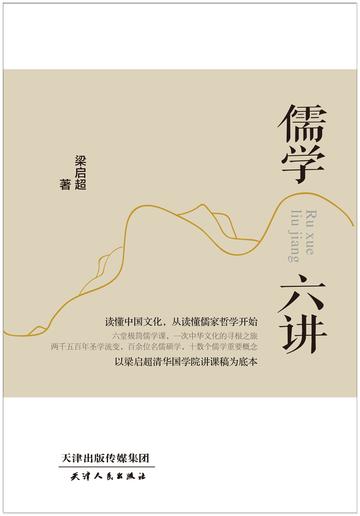
"Six Lectures on Confucianism" is a popular reading book that Liang Qichao, a master of traditional Chinese culture, explains Confucian culture to general readers. It represents the essence of Liang Qichao's Confucian research.
"Six Lectures on Confucianism" systematically narrates the origin, changes, inheritance, evolution and influence of Confucianism in the 2,500 years from Confucius to the end of the Qing Dynasty and the beginning of the Republic of China. It introduces the theoretical propositions of Confucius, Dong Zhongshu, Cheng Yi, Cheng Hao, Zhang Zai, Zhu Xi, Lu Jiuyuan, Wang Yangming and other representatives of Confucianism, helping readers understand the evolution and changes of various schools of Confucianism in different time and space. "Six Lectures on Confucianism" is based on Liang Qichao's lecture notes at Tsinghua University. It is easy to understand, profound and comprehensive. It is a must-read classic for readers to understand Confucian philosophy and Chinese culture.
Reader comments
After seeing half of it, I felt inexplicably excited. Leave a review first! One of my plans last year was to read "The Analects" a hundred times. After finishing it, I would read many modern Western humanities works and feel that they are all my younger brothers. A very important standard in Chinese aesthetics is implicitness, which naturally includes Chinese language. Therefore, it is highly condensed, concise, beautiful, and full of philosophy. I think there is no language in the world that can be like ours. Language itself is art. Not to mention its profound ideological connotation, all-encompassing philosophy about people and people, about how to behave in the world, and cultivate one's mind with integrity. Many modern works are footnotes to ancient words. Listening to Ren Gong's lecture on Confucianism today made me understand the Analects more deeply. I am so proud to be a Chinese!
The book systematically explains the origin and development of Confucianism, allowing me to understand the thoughts and ideas of different schools. I thought of my own experience in relationships and understood the importance of the golden mean advocated by Confucianism. It taught me to keep a balance, not to overdo it, and not to overcompromise. This book is not only a transfer of knowledge, but also an inspiration for life.
After seeing half of it, I felt inexplicably excited. Leave a review first! One of my plans last year was to read "The Analects" a hundred times. After finishing it, I would read many modern Western humanities works and feel that they are all my younger brothers. A very important standard in Chinese aesthetics is implicitness, which naturally includes Chinese language. Therefore, it is highly condensed, concise, beautiful, and full of philosophy. I think there is no language in the world that can be like ours. Language itself is art. Not to mention its profound ideological connotation, all-encompassing philosophy about people and people, about how to behave in the world, and cultivate one's mind with integrity. Many modern works are footnotes to ancient words. Listening to Ren Gong's lecture on Confucianism today made me understand the Analects more deeply. I am so proud to be a Chinese!
The book systematically explains the origin and development of Confucianism, allowing me to understand the thoughts and ideas of different schools. I thought of my own experience in relationships and understood the importance of the golden mean advocated by Confucianism. It taught me to keep a balance, not to overdo it, and not to overcompromise. This book is not only a transfer of knowledge, but also an inspiration for life.
Very good, well written