It tells the history passed down from ancient times to the present, which is half true and false. Perhaps when those ancient and elegant traditional Chinese characters were first combined into official history books, they were already lies.
For the dignity of the imperial power, for the need of governance, or as Confucianism puts it, "to keep tabs on for the honorable and to hide for the sage," history writers throughout the ages have hidden the truth of the past in the corner where light and darkness meet. Thousands of years later, only "if" is left...
Reader comments
I have almost no knowledge of the history of the Song Dynasty, and reading this work can just supplement my knowledge in this area. After reading it, I feel that throughout the history of the Song Dynasty, officials have been accompanying the rise and fall of the Song Dynasty for three hundred years, and there are many unsolved mysteries in history. The Song Dynasty, like other dynasties, never lacked Machiavellians. The author interprets the laws of history, politics and power, and reveals how many ruthless strategies and incomparable patience were involved in the rise and fall of these three hundred years. After briefly reading this series, my knowledge of the Song Dynasty has increased a lot.
I never thought there were such beautiful history books. The more you learn about the past, the more you can appreciate the present!
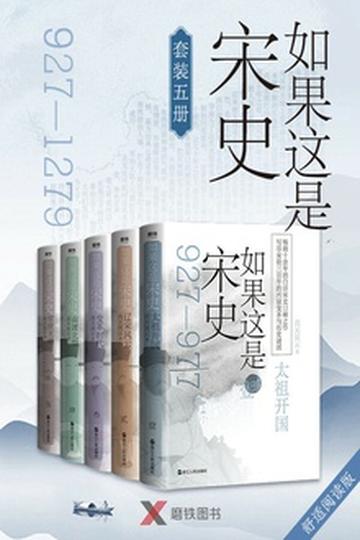
Song Dynasty - the dynasty in Chinese history that succeeded the Yuan Dynasty under the Five Dynasties and Ten Kingdoms. The author has studied the history of the Song Dynasty for many years, and his works are well-known. The book has 1.2 Million words, which fully describes the story in the author's heart, but it is far from describing the prosperity of the Song Dynasty. The existing history is half true and false, and the real history may have long been covered in dust, just like the word "if" in the title. Regardless of whether the existing historical materials are true or false, that story is inspiring. "Reading history makes people learn clearly." Only by understanding the past can we cherish the present.
The author of "Those Things in the Ming Dynasty", Xiang Mingyue, said, "The biggest gain or the biggest disadvantage of reading history is that you are always making historical mistakes. If you don't do what you know, do it." After reading this book, we will naturally have the same sigh. In the book, the author criticizes the current ills and reveals the political truth in naked language: There is a rule in China that almost every dynasty has an extremely dangerous and difficult period in the second or third generation of monarchs after its establishment. It has been proven countless times in history that the more ferocious the invaders, the more they have to emphasize their majesty, as if they are glorious. After reading this book, we will have a more in-depth thinking about political and historical changes.
Gao Tianliuyun, whose real name is Liu Yuquan, has been engaged in research on Song history for many years. His published historical works "If This is the History of the Song Dynasty" series are currently the best-selling vernacular Song history on the market. This book uses plain and humorous language to comprehensively reproduce the rise and fall of the Song Dynasty Empire over three hundred years. "To keep taboos for the venerable, to hide for the sage." The orthodox historical records may not all be true, and the denied unofficial histories may not be fictional. This book combines official history and unofficial history, and infers based on events. If the history of the Song Dynasty is like this, how should we judge the merits and demerits? The author provides us with another perspective on history.



I have almost no knowledge of the history of the Song Dynasty, and reading this work can just supplement my knowledge in this area. After reading it, I feel that throughout the history of the Song Dynasty, officials have been accompanying the rise and fall of the Song Dynasty for three hundred years, and there are many unsolved mysteries in history. The Song Dynasty, like other dynasties, never lacked Machiavellians. The author interprets the laws of history, politics and power, and reveals how many ruthless strategies and incomparable patience were involved in the rise and fall of these three hundred years. After briefly reading this series, my knowledge of the Song Dynasty has increased a lot.
I never thought there were such beautiful history books. The more you learn about the past, the more you can appreciate the present!
Song Dynasty - the dynasty in Chinese history that succeeded the Yuan Dynasty under the Five Dynasties and Ten Kingdoms. The author has studied the history of the Song Dynasty for many years, and his works are well-known. The book has 1.2 Million words, which fully describes the story in the author's heart, but it is far from describing the prosperity of the Song Dynasty. The existing history is half true and false, and the real history may have long been covered in dust, just like the word "if" in the title. Regardless of whether the existing historical materials are true or false, that story is inspiring. "Reading history makes people learn clearly." Only by understanding the past can we cherish the present.
The author of "Those Things in the Ming Dynasty", Xiang Mingyue, said, "The biggest gain or the biggest disadvantage of reading history is that you are always making historical mistakes. If you don't do what you know, do it." After reading this book, we will naturally have the same sigh. In the book, the author criticizes the current ills and reveals the political truth in naked language: There is a rule in China that almost every dynasty has an extremely dangerous and difficult period in the second or third generation of monarchs after its establishment. It has been proven countless times in history that the more ferocious the invaders, the more they have to emphasize their majesty, as if they are glorious. After reading this book, we will have a more in-depth thinking about political and historical changes.
Gao Tianliuyun, whose real name is Liu Yuquan, has been engaged in research on Song history for many years. His published historical works "If This is the History of the Song Dynasty" series are currently the best-selling vernacular Song history on the market. This book uses plain and humorous language to comprehensively reproduce the rise and fall of the Song Dynasty Empire over three hundred years. "To keep taboos for the venerable, to hide for the sage." The orthodox historical records may not all be true, and the denied unofficial histories may not be fictional. This book combines official history and unofficial history, and infers based on events. If the history of the Song Dynasty is like this, how should we judge the merits and demerits? The author provides us with another perspective on history.
A good book, full of prosperity and sadness.
I really want to read it all the way to the end