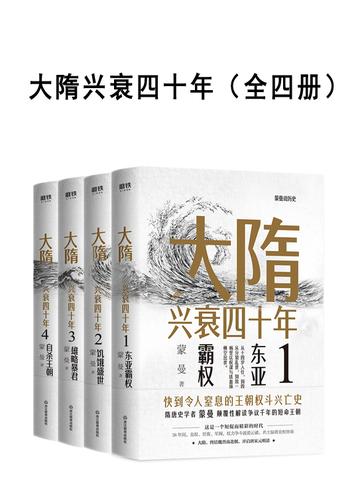
The Rise and Fall of the Sui Dynasty (4 Volumes in Total)
大隋兴衰四十年(全四册)
- Status
- Completed
- Length
- 467k Words
- Genre
- Historical
- Updated
- 3y ago
- Source
- Fanqie
Stats
1.1kReads
9.5Score
353Shelves
76Chapters
359Listens
67.4kReads · all time
Tags
Synopsis
Reader comments
In booklists 5
Looking for Some High-Quality Books Where You Can Learn Knowledge
I want to read a book similar to "The Pyramid Principle". There is no limit to the content. Reading it can broaden your horizons, increase your knowledge, and learn something.
22.9MViews502Books1dUpdated

Looking for a Historical Time Travel Article, I Can't Help but Read It Again and Again.
2.6MViews293Books2dUpdated
Chinese Extracurricular Reading Accumulation (Necessary for Internal Volume)
Every nation has its own culture and famous works, each of which is worth appreciating. If you have any favorite literary works, can you recommend them?
845.2kViews325Books3dUpdated
Books That Reflect Real History
I want to read a book similar to "A set of books to read through the Three Kingdoms (7 volumes in total)". I want to read history books that reflect real history without excessive artistic processing. Excessive distortion of facts not only makes reading meaningless, but also distorts values.
548.6kViews454Books2dUpdated
A Book Where You Can Learn Real Skills
I would like to read a book similar to "Record of Destiny Change (Practical Techniques for Changing Destiny)".
224.1kViews108Books9dUpdated
Compared to the Qin Dynasty, I don't know much about the Sui Dynasty. After reading this book, I discovered that the Sui Dynasty and the Qin Dynasty both achieved unification and were both very short-lived. They only lasted forty years, rising to decline, and had extraordinary and legendary historical characteristics. Unity, prosperity, and civilization coexist with short-livedness, tyranny, and rebellion. This was a prosperous and civilized dynasty, but it was also a short-lived and tyrannical dynasty. Its emperor built the Great Wall, built the Eastern Capital, opened canals, and traveled south of the Yangtze River, causing no peace for the country and the people.
Thoughts after reading "The Rise and Fall of the Sui Dynasty in Forty Years": People's hearts are the scale to know the rise and fall Before I opened "The Rise and Fall of the Sui Dynasty for Forty Years", my knowledge of the Sui Dynasty was actually very thin, and it only stopped at a few fragmented labels: I only knew that the Sui Dynasty was the second and last dynasty founded by Emperor Wen of the Sui Dynasty and succeeded by Emperor Yang of the Sui Dynasty. I remember that Emperor Yang of the Sui Dynasty ordered the construction of the Grand Canal. When I was studying the history of the Tang Dynasty, I accidentally learned about his conquest of Goguryeo. Later, when I read the comic "Sword Horse", I became acquainted with the names Pei Ju and Chishiro sporadically. This was all I knew about the history of the Sui Dynasty. It is precisely because of this that this time I calmed down and read this set of books, which is the first time I have truly entered the historical context of the Sui Dynasty. But when I finished reading this book, I realized that the history of the Sui Dynasty was far from as thin as I had previously thought. Emperor Wen of the Sui Dynasty was cold and boring, Emperor Yang of the Sui Dynasty was heroic and heroic, these are vivid character traits that I have never known. The author is obviously trying to tell the history of the rise and fall of the dynasty from the perspective of Emperor Yang of the Sui Dynasty, and this way of interpretation that breaks out of the inherent cognition makes the history written more vivid and real. Especially at the end of the book, the author compares the similarities between Emperor Yang of the Sui Dynasty and Emperor Taizong of the Tang Dynasty, and raises a very interesting question: Why did the two people have many things in common, but Emperor Yang of the Sui Dynasty ended up being the king of subjugation and died at the hands of Xiao Xiao, while Emperor Taizong of the Tang Dynasty achieved eternal achievements and became an eternal king? Emperor Yang of the Sui Dynasty is often evaluated as "the sins of the present time, but the achievements of the future." He built the eastern capital of Luoyang, dug the Grand Canal, defended the Turks in the north, and expanded the Western Regions in the west. These measures seemed to exhaust the people's power, but in fact they laid a solid foundation for the later prosperity of the Tang Dynasty. But his majestic talents and strategies were ultimately divorced from reality, and he even ignored the two words "people's hearts and minds" that rulers should value most in traditional Chinese Confucian culture. This also made me ponder over and over again when writing my own novel: What exactly does it mean to "win the hearts and minds of the people"? Many of the measures implemented by Emperor Yang of the Sui Dynasty were not wrong in the long run, and even paved a smooth path for future generations. However, he completely ignored the endurance of the people at the time and finally did something that seemed right, but ultimately failed. After all, power and intrigue are trivial matters, and the world and the people's hearts are fundamental. Even if a person has supreme power by virtue of his machinations, if he does not have the world in mind and does not care about the people, even if he is extremely talented, he will not be able to become the true co-owner of the world. As an emperor, being able to become a saint respected by the world has never been because of sitting on the throne, but because in every thought and every decision, he always puts the people of the world and the support of the people first. Only those who have the world in mind and are in the right position can bear the name of "the world's saint". Of course, these views of mine inevitably come with the benefit of hindsight. But the significance of reading history has never been just about knowing the past, but also about gaining reflection and vigilance from it - no matter how times change, the nature of human heart has never changed, and everyone has darkness and shortcomings hidden in their heart. As Li Shimin said, "If we take history as a mirror, we can know the ups and downs." What history has left us is this kind of sobriety to face ourselves and examine our choices. We can't help but wonder if we could do better if we could put ourselves in the era and position of Emperor Yang of Sui Dynasty. Perhaps the reason why popular time-travel novels fascinate people today is because the protagonist can return to the past with a macro-perspective of history, which naturally surpasses the world at that time. But novels are, after all, illusory imaginations. We are all ordinary people. We neither have the ability to predict the future nor the courage to shake the world. All we can do is to understand the weight of people's hearts from the gains and losses of history and keep our true intentions.
This was a prosperous but short-lived dynasty. Its mere existence makes countless people curious. Its treasury was filled with more food than could be eaten in fifty or sixty years, yet it was overturned so quickly. Perhaps it was because the emperor was too impatient and built the Great Wall and opened canals, which made the people miserable. "The profound and profound history lets us know that no matter how lofty our ideals are, in the real world, we have to walk step by step without running or flying. The same history also lets us know that without lofty ideals, we will not even be able to take the next step and can only wander on the wrong road."
Mengman holds a PhD in history from Peking University and is currently an associate professor at the School of History and Culture at Minzu University of China. He mainly studies Chinese history and culture. He is knowledgeable, humble, funny and dignified. He has participated in the Chinese Poetry Competition as a judge and as a lecturer in Baijia Forum. Mengman claims that his speech style will not simply follow the chronological clues, nor will it be introduced in a straightforward manner. Instead, he will talk with questions and use suspense to attract the audience. Her works are loved by many readers.
The Sui Dynasty and the Qin Dynasty were both short-lived dynasties that died after their death, but I have to say that they were both very important and made great contributions to Chinese civilization! Except for being a bit dim in his later years and mishandling his son's affairs, Emperor Wen of the Sui Dynasty Yang Jian was considered a wise king in my opinion, and he also initiated the rule of Kaihuang! Emperor Sui Yang really ended the great situation created by his father for more than ten years. What a pity! Even if the things he did at the beginning included building the eastern capital of Luoyang, building the canal, and patrolling the west, they were all things he should do. Things that were beneficial also reflected his political vision and talent. What a pity! His style of doing things has greatly compromised all the effects and mixed praise and praise. In my opinion, he is not a wise king at the beginning, let alone later! In such a good situation, Emperor Sui Yang actually lost his country. If the unification of the Qin Dynasty had been in this situation, Qin Shi Huang would not have been so difficult! The demise of the Qin Dynasty was very helpless and powerless. The demise of the Sui Dynasty was such a pity. Even an ordinary conservative king could not destroy the country!
When studying Chinese history, the Sui Dynasty is like a meteor, shining brightly and destroying instantly in Chinese history. So what happened in the forty years of the Sui and Tang Dynasties? Who shines in this era? The specific historical characteristics of this era: unity, prosperity, civilization and short-lived, tyrannical and rebellious coexistence. Where will the emperor of this era go? With the change of dynasties, have there been any major changes in people's lives? In history, Emperor Wen of the Sui Dynasty was still a new emperor at the time, but he used both force and strategy to split the Turkic Empire and replace it as the hegemon in East Asia. What happened? We'll find the answers one by one in this book.
The writing is good, but the author seems to like Yang Guang very much. Whenever Yang Guang puts forward policies or ideas, no matter what they are, he can find good points to brag about them.
It would be better if there were no comments from the author. If you want to read something that simply states the facts, you can decide what is right or wrong.
A unified dynasty as short-lived as the Qin Dynasty, the Sui Dynasty, died in less than forty years. Although short-lived, the Sui Dynasty also had the same extraordinary and legendary historical characteristics as the Qin Dynasty: unity, prosperity, civilization, and short-lived, tyrannical, and rebellion coexisted. This was a prosperous and civilized dynasty. Its warehouses were filled with food that could not be eaten for fifty or sixty years. Its emperor was hailed as the "Saint Khan" by the Turks. This was also a short-lived and violent dynasty. Its emperor built the Great Wall, built the Eastern Capital, opened canals, and traveled south of the Yangtze River. The country and the people had no peace. The name "Sui" is like a meteor, shining brightly and destroying instantly in Chinese history.
I think this book is very good! Teacher Mengman explained the rise and fall of the Sui Dynasty very clearly, which gave me a deeper understanding of that period of history. And I think the Sui Dynasty and the Qin Dynasty are quite similar. They were both short-lived but had a profound impact on subsequent history. I like Emperor Yang Guang of the Sui Dynasty the most. Although his evaluation in history is not high, he is actually quite ambitious, but sometimes he does things too hastily. I also think of Qin Shihuang in "The Qin Empire", and I feel that they are the kind of people who want to do something big. But I really hate Yu Wenji. This person is so bad. He has to bear a lot of responsibility for the demise of the Sui Dynasty! Overall, this book is worth reading and I recommend it to you!
The content of this book is wonderful and the thinking is clear.
This is the first time I have seen a relatively comprehensive evaluation of Emperor Yang of the Sui Dynasty. The characters are vivid and the clues are clear. It is worth reading.
Every book by a super-good-looking author is super-good-looking. Every book by the author makes you want to read it. It is very well-written, and has a relaxed tone and humor, which makes people feel very happy to read it.
Mengman holds a PhD in history from Peking University and is currently an associate professor at the School of History and Culture at Minzu University of China. He mainly studies Chinese history and culture. He is knowledgeable, humble, funny and dignified. He has participated in the Chinese Poetry Competition as a judge and as a lecturer in Baijia Forum. Mengman claims that his speech style will not simply follow the chronological clues, nor will it be introduced in a straightforward manner. Instead, he will talk with questions and use suspense to attract the audience. Her works are loved by many readers.
In this book, Emperor Yang of the Sui Dynasty is a flesh-and-blood person, and the timeline of events is clear, making it easy to understand like listening to a story!
The text is easy to understand, concise and smooth, a popular read, and beautiful!
A good book, with detailed historical events and solid analysis and comments. It is worth reading and I have learned a lesson from it. Thanks
This book talks about the rise and fall of the Sui Dynasty. Although in just a few decades, the frugality of Emperor Wen of the Sui Dynasty was in sharp contrast to the atrocities of Emperor Yang of the Sui Dynasty, the great construction projects had a profound impact on later generations. The author describes the frugality of Emperor Wen of the Sui Dynasty using an interesting word. The words of love, the old miser, are impressive; although Emperor Yang of the Sui Dynasty was headstrong, perhaps it was because of his talent and strong political ambition that he surpassed Emperor Wu of the Han Dynasty that he became arrogant and insisted on his own way, which caused the demise of the Sui Dynasty!
The writing style is quite comfortable and the historical description is not boring.
Nice. Thorough analysis.
Really good books should be read
Yang Jian and his son are both extraordinary emperors!
Wonderful... Wonderful... Just right... Just right [like]
Ahhhhhhhhhhhhhhhhhhhhhhhhhhh
I didn't expect that Teacher Mengman's level is so high, reading is like a spring breeze.
The Great Sui Dynasty passed by like a meteor, short but brilliant
Thank you very much to the author for introducing a different Emperor Yang of Sui Dynasty!
Mengman's writing really has the feeling of taking a class. [Cover face] The writing is very clear, but it is too formal and lacks excitement.
Quoting from classics, analyzing thoroughly, with clear components and strong logic.
Like! If asked why: The writing is smooth, the narrative is objective, and thought-provoking!