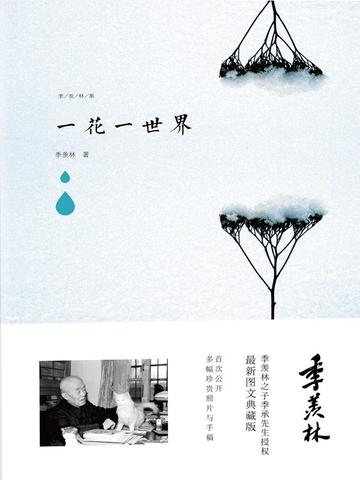
"One Flower, One World" mainly introduces the formation and development of Buddhism in India, the historical origin and language issues of primitive Buddhism, the introduction of Buddhism into China and the localization of Buddhism, and the mutual learning and exchanges between China and India in Buddhism.
Reader comments
Some famous figures in history also have deep research and obsession with Buddhist culture. Many people will enter an extreme state after studying it, and there are many famous and great people among them. The author said that he studies Buddhism but has never believed in any religion, and Buddhism is no exception. He has an experience: as long as you seriously use scientific methods to explore any religion in the world, you will find that its doctrines and rituals have a historical development process and their origins. They are all man-made, full of flaws and self-contradictions, and some are simply ridiculous. I also agree with these views.
Generally speaking, regardless of any religion, the deeper the research, the weaker the belief. If a researcher actually believes in a religion, this itself shows that his research is not realistic, not deep enough, and deceiving himself. Of course, the same is true for Buddhism. When we read this book, the more immersed we are in it, the more we will agree with many of the author's research opinions. After reading this book, we feel that our inherent thoughts and opinions will jump out and open up different thinking. Some people may ask, if this is the case, why should we study Buddhism? The author also gives answers in the book. Interested friends can read this book carefully and they will definitely find the answer.
Buddhism was introduced to China by the time of Faxian in the Eastern Jin Dynasty, which has a history of about 300 years. There are two main systems of disseminated content: one is the Prajna Buddhism of Mahayana Buddhism represented by Zhixie and Zhiqian; the other is Hinayana Zen Buddhism represented by An Shigao. Both Hinayana and Mahayana were introduced. Judging from the chronological order, there are generally three periods when the teachings were most prosperous: during the time of Zhiqian and Zhufahu, many prajna prescriptions were translated; during the Dao'an period, many sutras and treatises were translated; and during the time of Kumarajiva, Mahayana studies were extremely prosperous. Buddhism has penetrated deeply into Chinese culture.
"The philosophical thoughts and religious beliefs of these ascetics are different from those of Brahmins. They simply do not believe in the great gods in the Veda that Brahmins believe in. They believe in reincarnation. The theory of karma, which is the basis of the theory of reincarnation, is the core of their religious beliefs. The so-called theory of karma means that the good or bad deeds done in this life determine the reincarnation in the next life. Good or bad. No matter whether they do good or bad things, they must be reincarnated anyway. But they hate rebirth and do not want to be reincarnated again, so they try every means to escape from reincarnation. "This book is a good introduction to the exchanges between China and India.
Let us love nature and embrace nature. This is an illustrated picture book with flowers as the theme. Through gorgeous illustrations and concise text, it conveys praise and understanding of nature and life. This book uses the perspective of flowers to show their growth, blooming and withering in different seasons, as well as their connection with humans and the natural world. "One Flower, One World" is suitable for readers who are interested in illustration art and natural beauty, especially those who like to appreciate exquisite illustrations and feel nature.
This book is very informative and gave me a deeper understanding of the development of Buddhism in India. The book mentions the localization process of Buddhism after it was introduced to China, which is very interesting. I like the part about cultural exchanges between China and India in the book. Mr. Ji Xianlin's research is very thorough. The experiences and stories he shared in the book also made me feel his erudition and charisma. Recommended to friends who are interested in Buddhist culture.



Some famous figures in history also have deep research and obsession with Buddhist culture. Many people will enter an extreme state after studying it, and there are many famous and great people among them. The author said that he studies Buddhism but has never believed in any religion, and Buddhism is no exception. He has an experience: as long as you seriously use scientific methods to explore any religion in the world, you will find that its doctrines and rituals have a historical development process and their origins. They are all man-made, full of flaws and self-contradictions, and some are simply ridiculous. I also agree with these views.
Generally speaking, regardless of any religion, the deeper the research, the weaker the belief. If a researcher actually believes in a religion, this itself shows that his research is not realistic, not deep enough, and deceiving himself. Of course, the same is true for Buddhism. When we read this book, the more immersed we are in it, the more we will agree with many of the author's research opinions. After reading this book, we feel that our inherent thoughts and opinions will jump out and open up different thinking. Some people may ask, if this is the case, why should we study Buddhism? The author also gives answers in the book. Interested friends can read this book carefully and they will definitely find the answer.
Buddhism was introduced to China by the time of Faxian in the Eastern Jin Dynasty, which has a history of about 300 years. There are two main systems of disseminated content: one is the Prajna Buddhism of Mahayana Buddhism represented by Zhixie and Zhiqian; the other is Hinayana Zen Buddhism represented by An Shigao. Both Hinayana and Mahayana were introduced. Judging from the chronological order, there are generally three periods when the teachings were most prosperous: during the time of Zhiqian and Zhufahu, many prajna prescriptions were translated; during the Dao'an period, many sutras and treatises were translated; and during the time of Kumarajiva, Mahayana studies were extremely prosperous. Buddhism has penetrated deeply into Chinese culture.
"The philosophical thoughts and religious beliefs of these ascetics are different from those of Brahmins. They simply do not believe in the great gods in the Veda that Brahmins believe in. They believe in reincarnation. The theory of karma, which is the basis of the theory of reincarnation, is the core of their religious beliefs. The so-called theory of karma means that the good or bad deeds done in this life determine the reincarnation in the next life. Good or bad. No matter whether they do good or bad things, they must be reincarnated anyway. But they hate rebirth and do not want to be reincarnated again, so they try every means to escape from reincarnation. "This book is a good introduction to the exchanges between China and India.
Let us love nature and embrace nature. This is an illustrated picture book with flowers as the theme. Through gorgeous illustrations and concise text, it conveys praise and understanding of nature and life. This book uses the perspective of flowers to show their growth, blooming and withering in different seasons, as well as their connection with humans and the natural world. "One Flower, One World" is suitable for readers who are interested in illustration art and natural beauty, especially those who like to appreciate exquisite illustrations and feel nature.
This book is very informative and gave me a deeper understanding of the development of Buddhism in India. The book mentions the localization process of Buddhism after it was introduced to China, which is very interesting. I like the part about cultural exchanges between China and India in the book. Mr. Ji Xianlin's research is very thorough. The experiences and stories he shared in the book also made me feel his erudition and charisma. Recommended to friends who are interested in Buddhist culture.