Stats
5.8Score
Synopsis
No synopsis yet.
We haven’t got an English blurb for this one. It appears once the source description has been translated.
We haven’t got an English blurb for this one. It appears once the source description has been translated.


The history from the Western Zhou Dynasty to the Eastern Zhou Dynasty is very difficult to examine, and there are very few historical materials. This part of history cannot be verified because of its long history. It can only be explored and remembered sporadicly based on sparse historical records and historical biographies. The author consulted a large amount of information and conducted research. Using the timeline as an axis, he narrated the changes in the historical dynasties of various emperors in the Zhou Dynasty. Using multiple angles, we try to truly restore and reproduce the historical and cultural social features of the time and reflect the cultural customs of the time.
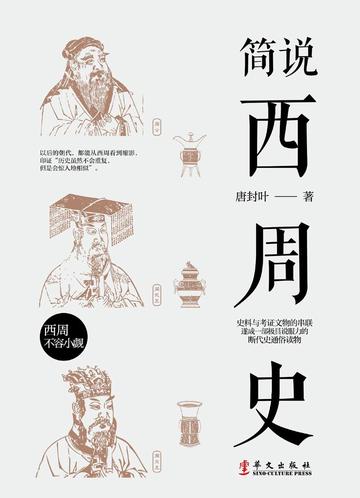
By chance, I came across the book "A Brief History of the Western Zhou Dynasty". The author is Mr. Tang Fengye, a director who has produced literary and historical programs for several years. Mr. Tang synthesized a large number of Shang and Zhou bronze inscriptions, pre-Qin bamboo slips and a series of latest archaeological data to create it. It gradually presents a different Western Zhou Dynasty to readers. The book mainly introduces the establishment process of the Zhou Dynasty, the political system, economic and cultural development of the Zhou Dynasty, and the major historical events during the period of King Xiao of Zhou. The author also intersperses some interesting stories and legends in the book, which completely subverts the Western Zhou Dynasty in the minds of ordinary people.
Do Houji and Shangqi really have the same father, Emperor Ku? Why did the Taiwang pass the throne to his grandson Ji Chang? Why did King Zhou want to conquer Dongyi? Is Jiang Taigong really a late-blooming and inspirational "Phoenix Man"? How could King Zhou release Ji Chang from Youli City? Is there really such a thing as "Meng Jin watching troops" in history? Was King Wu's attack on Zhou a "death of Zhou" or a "flow of blood"? What happened to Duke Zhou's regency? Who killed Wu Geng who rebelled? What did "Gong, Hou, Bo, Zi, Nan" originally mean? Which country was the backbone of the Zhou Dynasty's feudal state with the same surname in the southern part of the country? Does King Zhao's failure to return from his southern expedition have something to do with the state of Chu with the surname Mi? What magical experience did King Mu have during his journey to the west? What is the astronomical scene of "Tian Zai Dan" in the first year of King Yi? Are the Qin people in the west really the descendants of Dongyi? Why is it said that King Zhou Li was actually the "Fierce King" with great martial arts skills? Did King You of Zhou really do something as stupid as "playing with the princes with beacon fire"? Which one, King Ping of Zhou or King Xie of Zhou, was initially considered orthodox by the princes? When did King Ping move eastward? After reading this book, you will definitely have a more updated understanding of the history of the Western Zhou Dynasty.
This book introduces the history from the Western Zhou Dynasty to the Eastern Zhou Dynasty. This part of history cannot be verified because of its long history. It can only be explored and remembered sporadicly based on sparse historical records and historical biographies. The author consulted a large amount of information and conducted research. Using the timeline as an axis, he narrated the changes in the historical dynasties of various emperors in the Zhou Dynasty. Using multiple angles, we try to truly restore and reproduce the historical and cultural social features of the time and reflect the cultural customs of the time.
The History of the Western Zhou Dynasty is in chronological order and focuses on the Zhou kings. It integrates handed down historical documents and modern paleography and archaeological achievements. It uses a rigorous academic attitude, a writing style of narrative, discussion, and textual research, and a relaxed and easy-to-understand language. It introduces the historical events and character stories of the Western Zhou Dynasty in the past 300 years. It also organically and skillfully intersperses the knowledge of the Western Zhou ritual and music system, land system, life customs, language and literature, and relevant important archaeological discoveries in modern times to restore the period that established Chinese culture in an all-round and multi-angle way. Very nice.
The Zhou Dynasty was the heyday of ancient Chinese society. Starting from the Zhou Dynasty, the various ethnic groups and tribes within the territory continued to integrate. During this period, the Chinese nation gradually formed. In the later period, social conflicts became increasingly intensified. The competition for land and political power accelerated the demise of the Western Zhou Dynasty. The riots of the Chinese people directly shook the foundation of the Western Zhou Dynasty's rule. After sorting out a large amount of historical materials, the author of this book no longer analyzes history through traditional politics, economics, and culture, but explains historical events based on characters.
It uses archaeological data to explain many doubts about the Western Zhou Dynasty, making it easy to understand and remember. A very good book, I plan to buy another physical book
Good! ! ! Refreshed and educated.
Good, good, good, good, good, good, good, good
Quoting from classics and supporting it with archaeological data, it's very good.
Quoting from scriptures, it is reasonable and well-founded. Explain the profound things in a simple way and the text is vivid. Very nice!
It's eloquent, plain and interesting.
Very good, it makes up for a lot of historical knowledge that was unclear before
The views are clear, the scriptures are cited, the historical context is clear, and the benefits are huge!
There is evidence to check, there are things to test, the materials are detailed, and the argument is reasonable.