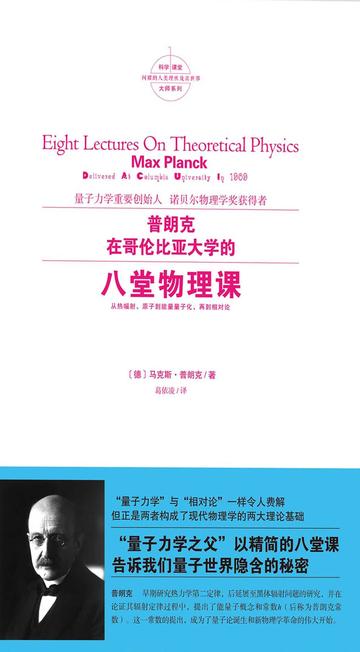
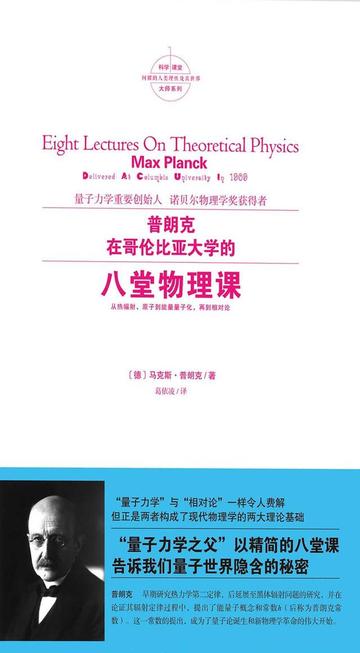
This book is a collection of eight lectures given by Planck at Columbia University.
In the first lecture, Planck first gave a comprehensive statement on the current research status of theoretical physics, and briefly outlined the basic laws, important assumptions and important concepts in physics. It then extends from the law of conservation of energy and the second law of thermodynamics to the concepts of reversibility and irreversibility. Planck believed that all reactions occurring in nature can be divided into reversible processes and irreversible processes, and explained them in detail, eventually introducing the concept of "entropy". Then, combined with Clausius's theory, the second law of thermodynamics and its derivative theories, he derived the principle of entropy increase.
In the second lecture, starting from the principle of entropy increase, Planck elaborated on important thermodynamic research results based on Gibbs and beyond him. These results involve the law of dilution, for which Planck gave a clear relationship.
The third lecture conducted an in-depth study of atomic theory. Planck believed that only through atomic theory can all physical processes be divided into reversible processes and irreversible processes, that is, irreversibility must lead to atomic theory. Planck took this as a starting point, introduced atomic theory into the physical system, and explained atomic theory through analogy with probability. Planck then introduced it into the theory of thermal radiation. To ensure objectivity, he interpreted the second law of thermodynamics from both macroscopic and microscopic perspectives.
In the fourth lecture, Planck used the general law of the concept of irreversibility to calculate the entropy of an ideal monatomic gas in a given state, and deduced its thermodynamic properties. The main content was to calculate the probability of a given gas state. The calculation of probabilities, without attaching special assumptions, allows us not only to find the thermodynamic properties of known gases, but also to draw conclusions that essentially go beyond purely thermodynamic properties.
Lectures 5 and 6 discuss the issue of thermal radiation. In the fifth lecture, Planck summarized the important influence of electromagnetic theory on the characteristic quantities of thermal radiation. It mainly measures the amount of heat rays passing through any position in the medium and determines the state of its radiant heat. The sixth lecture, based on the fifth lecture, explores a very critical issue in thermal radiation theory, that is, the establishment of a universal function that regulates the energy distribution in the normal energy spectrum. The resonator is placed in a vacuum filled with blackbody radiation, which excites steady-state vibrations from which the resonator's entropy can be calculated.
Lectures 7 and 8 enter the field of dynamics. In the seventh lecture, Planck first elaborated on the principle of minimum action. He believed that this principle had decisive advantages over other principles and had direct significance for mechanics, electrodynamics and thermodynamics. Then, Planck elaborated on how this principle was applied to individual cases. The principle of least action covers all known reversible processes and can therefore also serve as the basis for general dynamics. Lecture 8 begins to enter a more vast field - the theory of relativity. Planck started from the development history of the theory of relativity and described the theoretical construction of the theory of relativity with examples.
Reader comments
I particularly enjoyed his in-depth study of atomic theory and his unique interpretation of thermodynamics. This book gave me a deeper understanding of the world of physics and made me admire this great scientist even more. I think this book is not only suitable for physics enthusiasts, but also for people who want to understand scientific ideas. Highly recommended!


I particularly enjoyed his in-depth study of atomic theory and his unique interpretation of thermodynamics. This book gave me a deeper understanding of the world of physics and made me admire this great scientist even more. I think this book is not only suitable for physics enthusiasts, but also for people who want to understand scientific ideas. Highly recommended!