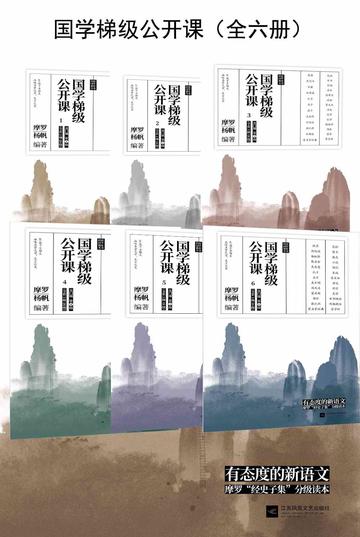
Based on the principle of starting low and proceeding step by step, the first level "Jibu" and "Zibu" have relatively simple selections of articles, mainly articles from the late Qing Dynasty.
In the "Graded Open Course on Chinese Studies 1", Liang Qichao, Kang Youwei, Lin Zexu, Ji Xiaolan, Zeng Guofan, Liu Dakui, etc. Are all famous figures with far-reaching influence. They carry rich information about modern Chinese history and culture. Their participation in the "Graded Open Course on Chinese Studies" can quite stimulate the cultural enthusiasm and inquiring minds of learners.
The articles in this volume include novels, fables, epilogues, biographies, letters, diaries, etc., Involving classics, history, sociology, and geopolitics. Jibu selected a section from Luo Guanzhong's "The Romance of the Three Kingdoms" where Liu Bei persuaded Zhuge Liang to come out and help the Han Dynasty. The classics include Confucius's quotations on learning from The Analects. The History Department selects the classic story of Xiao He chasing Han Xin from "Historical Records". The sub-texts mainly select works from "Zeng Guofan's Family Letters" and "Yongxianzhai Notes". They are all interesting stories and highly readable.
"Chinese Studies Cascade Open Course 2" includes classics by famous scholars such as Shen Kuo, Zeng Guofan, Liu Xiang, Confucius, Mencius, Zuo Qiuming, Sima Qian, Wang Fuzhi, Huang Zongxi, Tan Sitong, Li Shizhen, etc. It includes prefaces, biographies, memorials, essays, expository essays and other styles, involving classics, history, sociology, pharmacy, eloquence, military and other disciplines. Among them, "Zuo Zhuan" selects a chapter by Shu Sun Bao on the theory of "three immortals". The historical anthology contains stories about Guan Bao's friendship and Guan Zhong's assistance to Duke Huan of Qi in dominating the princes. The supplementary texts are selected from "Manuscripts of the History of the Qing Dynasty", Kang Youwei's "Letter on the Bus" and Ji Xiaolan's "Notes from the Yuewei Cottage".
Reader comments
It records that Liang Qichao, Kang Youwei, Lin Zexu, Ji Xiaolan, Zeng Guofan, Liu Dakui, etc. Are all great figures with great influence and far-reaching influence. They carry rich information about modern Chinese history and culture as well as famous classics, including prefaces, biographies, memorials, essays, expository essays and other styles, involving classics, history, sociology, pharmacy, eloquence, military and other disciplines. Among them, "Zuo Zhuan" selects a chapter by Shu Sun Bao on the theory of "three immortals". The historical anthology contains stories about Guan Bao's friendship and Guan Zhong's assistance to Duke Huan of Qi in dominating the princes.
Chinese studies are both Chinese academics. Chinese culture is broad and profound, and Chinese studies naturally have a far-reaching inheritance and huge heritage. This is certainly worth learning and carrying forward as younger generations. This book is dedicated to allowing us to learn a little bit of Chinese culture knowledge every day, and then accumulate it over time. As long as we can persevere, maybe in the near future, each of us can become a master of Chinese studies? This may also be the best answer to those ancestors.
Moro, a native of Duchang, Jiangxi Province, is a researcher at the Institute of Chinese Culture of the Chinese Academy of Arts. He is recruiting master's students in cultural strategy and Chinese education, and doctoral students in Chinese education. Tutor of Jingya Academy Reading Club. His major works include "China's Pain: Criticism of National Character and the Dilemma of Cultural Politics", "The Origin of the King", "Thinker: Sima Qian's New Hat", etc. Yang Fan, a native of Duchang, Jiangxi, is an editor and reviewer of the Chinese Modern Literature Museum of the Chinese Writers Association. His major works include "The Sun Shines: Selected Works on Liang Qichao's National Character Research" (co-editor), "The Cold Light of the Moon: Lu Xun's Selected Works on National Character Criticism" (co-editor), "The Recovery of Human Nature: The Origin and Reflection of National Criticism" (co-editor), etc.
I never expected to see this type of book in Tomato Novels. In my mind, this type of book should be placed in the library, so I went in to read it out of curiosity. The content of the book is very good, it teaches classical Chinese and traditional culture. The language is simple and clear, and there are many character stories and introductions to characters from various eras. The content is easy to understand. It is a classic worth collecting, in which you can learn about history, Chinese cultural spirit, and language. It is a spiritual delicacy. Occasionally, you can take it out and read more to experience the beauty of Chinese classical Chinese and the splendor of Chinese traditional culture.
The selected texts in the book are rich and diverse, including novels, fables, epilogues, etc., And also select classic works by many famous writers. I particularly like the scene in "The Romance of the Three Kingdoms" in which Liu Bei persuades Zhuge Liang to come out. It feels particularly exciting. However, I kind of hate Ji Xiaolan, he is always so witty and makes people a little jealous! Overall, this book is well worth reading.
To be honest, classical Chinese is the treasure of Chinese culture, but now very few people take the initiative to understand and study classical Chinese, and only a few are understanding and learning about traditional Chinese culture. Chinese traditional culture is gorgeous and colorful, and classical Chinese is a treasure handed down from the five thousand years of civilization of the Chinese nation. So I was really shocked when I saw this book. The content in it is to teach us to learn classical Chinese and traditional culture. The content is simple and easy to learn. I hope we can learn more about our culture. After all, it is the spiritual wealth left to us by our ancestors, which is irreplaceable. The cultural essence inside is inexhaustible.
Easy to understand and suitable for self-study
It has both the original text and the explanation. The most important thing is that the explanation is concise and clear, without any nonsense. It is worth reading.
It records that Liang Qichao, Kang Youwei, Lin Zexu, Ji Xiaolan, Zeng Guofan, Liu Dakui, etc. Are all great figures with great influence and far-reaching influence. They carry rich information about modern Chinese history and culture as well as famous classics, including prefaces, biographies, memorials, essays, expository essays and other styles, involving classics, history, sociology, pharmacy, eloquence, military and other disciplines. Among them, "Zuo Zhuan" selects a chapter by Shu Sun Bao on the theory of "three immortals". The historical anthology contains stories about Guan Bao's friendship and Guan Zhong's assistance to Duke Huan of Qi in dominating the princes.
Chinese studies are both Chinese academics. Chinese culture is broad and profound, and Chinese studies naturally have a far-reaching inheritance and huge heritage. This is certainly worth learning and carrying forward as younger generations. This book is dedicated to allowing us to learn a little bit of Chinese culture knowledge every day, and then accumulate it over time. As long as we can persevere, maybe in the near future, each of us can become a master of Chinese studies? This may also be the best answer to those ancestors.
Moro, a native of Duchang, Jiangxi Province, is a researcher at the Institute of Chinese Culture of the Chinese Academy of Arts. He is recruiting master's students in cultural strategy and Chinese education, and doctoral students in Chinese education. Tutor of Jingya Academy Reading Club. His major works include "China's Pain: Criticism of National Character and the Dilemma of Cultural Politics", "The Origin of the King", "Thinker: Sima Qian's New Hat", etc. Yang Fan, a native of Duchang, Jiangxi, is an editor and reviewer of the Chinese Modern Literature Museum of the Chinese Writers Association. His major works include "The Sun Shines: Selected Works on Liang Qichao's National Character Research" (co-editor), "The Cold Light of the Moon: Lu Xun's Selected Works on National Character Criticism" (co-editor), "The Recovery of Human Nature: The Origin and Reflection of National Criticism" (co-editor), etc.
I never expected to see this type of book in Tomato Novels. In my mind, this type of book should be placed in the library, so I went in to read it out of curiosity. The content of the book is very good, it teaches classical Chinese and traditional culture. The language is simple and clear, and there are many character stories and introductions to characters from various eras. The content is easy to understand. It is a classic worth collecting, in which you can learn about history, Chinese cultural spirit, and language. It is a spiritual delicacy. Occasionally, you can take it out and read more to experience the beauty of Chinese classical Chinese and the splendor of Chinese traditional culture.
The selected texts in the book are rich and diverse, including novels, fables, epilogues, etc., And also select classic works by many famous writers. I particularly like the scene in "The Romance of the Three Kingdoms" in which Liu Bei persuades Zhuge Liang to come out. It feels particularly exciting. However, I kind of hate Ji Xiaolan, he is always so witty and makes people a little jealous! Overall, this book is well worth reading.
To be honest, classical Chinese is the treasure of Chinese culture, but now very few people take the initiative to understand and study classical Chinese, and only a few are understanding and learning about traditional Chinese culture. Chinese traditional culture is gorgeous and colorful, and classical Chinese is a treasure handed down from the five thousand years of civilization of the Chinese nation. So I was really shocked when I saw this book. The content in it is to teach us to learn classical Chinese and traditional culture. The content is simple and easy to learn. I hope we can learn more about our culture. After all, it is the spiritual wealth left to us by our ancestors, which is irreplaceable. The cultural essence inside is inexhaustible.
Easy to understand and suitable for self-study
It has both the original text and the explanation. The most important thing is that the explanation is concise and clear, without any nonsense. It is worth reading.