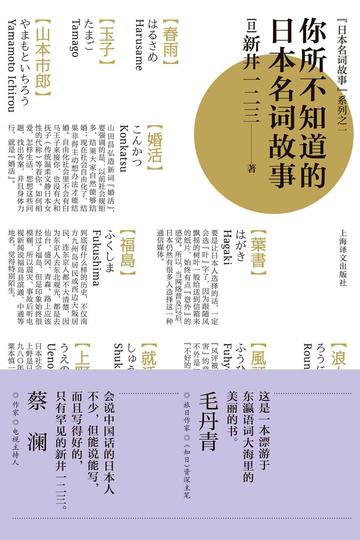
When Arai Yijisan writes articles, he always tries to open up his perspective on world civilization through small things and stories in life. The articles included in this book interpret Japanese culture through specific Japanese terms, talking about Japanese food life, Japanese worldview, Japanese characters, Japanese male-female relations, Japanese social atmosphere, etc. Each article talks about trivial things that others may think are trivial, but they can provide readers with a perspective that they could not imagine in advance. After reading the entire book, you will definitely have a slightly different view of Japan than the original one.
Reader comments
In terms of content, I can give it two points. It writes some Japanese vocabulary replacement history that is unfamiliar to Japanese people. I don't quite understand why it should be written specifically in Chinese. Maybe it's because of the novelty of foreign lands. Not many people would be interested in the history of Chinese vocabulary changes. But the author cleans up Chizuru Ueno. Although I know this is a chronic disease of popular culture and follow the trend of the introduction, there is no indication of Chizuru Ueno's various bad deeds, including but not limited to two-faced people, anti-China activists, militaristic spiritualists, spokespersons who have pushed the Western public opinion war to the fore, marketing experts who started in shock groups, low-level porcelain clowns, "feminists" with questionable remarks, favorites of marketing accounts, idols of Douban Weibo boxers. Points are deducted to the end.
This book is very interesting! Arai Yijisan interpreted Japanese culture through specific Japanese terms, which gave me a new understanding of Japan. This reminds me of the book "The Chrysanthemum and the Sword", which also starts with some details to reveal the characteristics of Japanese culture. Moreover, the author's experience of studying abroad in China also resonated with me. I am also a person who has lived abroad. Learning the local language and culture is an important way to integrate into local life. As the author said, learning the pronunciation of some insignificant words and sentences may inadvertently bring us unexpected gains. This book gave me a deeper understanding of different cultures and made me more eager to explore more unknowns.




In terms of content, I can give it two points. It writes some Japanese vocabulary replacement history that is unfamiliar to Japanese people. I don't quite understand why it should be written specifically in Chinese. Maybe it's because of the novelty of foreign lands. Not many people would be interested in the history of Chinese vocabulary changes. But the author cleans up Chizuru Ueno. Although I know this is a chronic disease of popular culture and follow the trend of the introduction, there is no indication of Chizuru Ueno's various bad deeds, including but not limited to two-faced people, anti-China activists, militaristic spiritualists, spokespersons who have pushed the Western public opinion war to the fore, marketing experts who started in shock groups, low-level porcelain clowns, "feminists" with questionable remarks, favorites of marketing accounts, idols of Douban Weibo boxers. Points are deducted to the end.
This book is very interesting! Arai Yijisan interpreted Japanese culture through specific Japanese terms, which gave me a new understanding of Japan. This reminds me of the book "The Chrysanthemum and the Sword", which also starts with some details to reveal the characteristics of Japanese culture. Moreover, the author's experience of studying abroad in China also resonated with me. I am also a person who has lived abroad. Learning the local language and culture is an important way to integrate into local life. As the author said, learning the pronunciation of some insignificant words and sentences may inadvertently bring us unexpected gains. This book gave me a deeper understanding of different cultures and made me more eager to explore more unknowns.