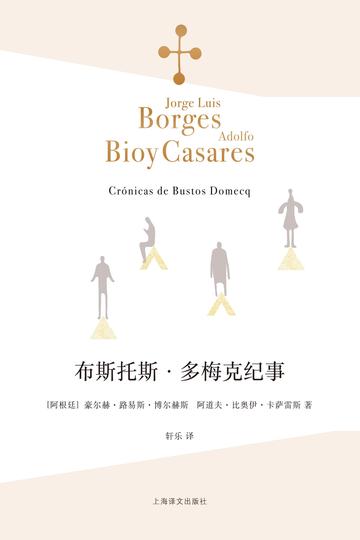
A four-hand collaboration between literary masters Borges and Casares. [About the author] Jorge Luis Borges (1899-1986), Argentine poet, novelist, critic, translator, and master of Spanish literature.
Born in Buenos Aires on August 24, 1899, he lived in Europe with his family when he was a boy.
In 1923, he published his first collection of poems, "The Passion of Buenos Aires", in 1925, his first collection of essays, "Collection of Explorations", and in 1935, his first collection of short stories, "Biographies of Villains", gradually establishing his position in the Argentine literary world. His representative poetry collections "Notes of Saint Martin" and "The Tiger's Gold", novel collections "The Garden of Forking Paths" and "Aleph", essay collections "Eternal History" and "Discussions" have won him international reputation. Translated works by Wilde, Woolf, Faulkner and other writers.
He once served as Director of the National Library of Argentina and Professor of Literature at the University of Buenos Aires. He has won many literary awards such as the Argentine National Literary Award, the Formento International Publishing Award, the Jerusalem Award, the Barzan Award, the Chino del Duca Award, and the Cervantes Award.
He died of illness in Geneva, Switzerland on June 14, 1986.
Adolfo Bioy Casares (1914-1999) was an Argentine journalist, novelist, and translator.
In 1940, he published the novel "The Invention of Morel" and won the first Buenos Aires Municipal Literary Award. Later, he successively won the Cervantes Award, the Honorary Award of the Argentine Writers Association, and the French Legion of Honor.
In 1932, he met Jorge Luis Borges. The two formed a deep friendship and collaborated on many works, including a series of short stories, screenplays and fantasy stories written under the pseudonyms of Honorio Bustos Domec and Benito Suárez Lynch. [Introduction] "One rainy morning Bioy said to me that we should write something based on this story. I reluctantly agreed. That morning we decided on the signature of the novel, namely Honorio Bustos Domec. Domec is the name of one of Bioy's great-grandfathers, and Bustos is the name of one of my great-grandfathers."
"The Chronicle of Bustos Domec" is a fictional sketch co-written by Borges with the Argentinian writer and his close friend Adolfo Bioy Casares, published in 1967. The two writers invented a fictional author named Bustos Domec, and used his mouth to describe the imaginary modern eccentric artists - architects, sculptors, poets, novelists, tailors... The novel is written in the style of a pious modern critic, with fiction and reality, reality and fantasy. The style itself is a kind of joke.
Reader comments
This book is very interesting! Borges and Casares create a fictional author through whose eyes a variety of eccentric artists are described in a playful style that makes it easy to read. And it can be seen that they have a good understanding of each other when creating, and the behavior of the characters in the story is also very interesting, which gave me a deeper understanding of the diversity of art and literature. All in all, this is a book well worth reading.
It's so amazing, what I thought was the life story of the fictional character Bustos turned out to be various criticisms and life discoveries of Bustos. The characters in it are all fictitious. Between fiction and reality, I sometimes can't tell the difference between truth and fiction.
It was only after the article on the study of human immortality that I suddenly realized that it was all fake, because that kind of immortality was so terrifying that it scared Bustos away and changed his name overnight, hahahahaha.


This book is very interesting! Borges and Casares create a fictional author through whose eyes a variety of eccentric artists are described in a playful style that makes it easy to read. And it can be seen that they have a good understanding of each other when creating, and the behavior of the characters in the story is also very interesting, which gave me a deeper understanding of the diversity of art and literature. All in all, this is a book well worth reading.
It's so amazing, what I thought was the life story of the fictional character Bustos turned out to be various criticisms and life discoveries of Bustos. The characters in it are all fictitious. Between fiction and reality, I sometimes can't tell the difference between truth and fiction. It was only after the article on the study of human immortality that I suddenly realized that it was all fake, because that kind of immortality was so terrifying that it scared Bustos away and changed his name overnight, hahahahaha.