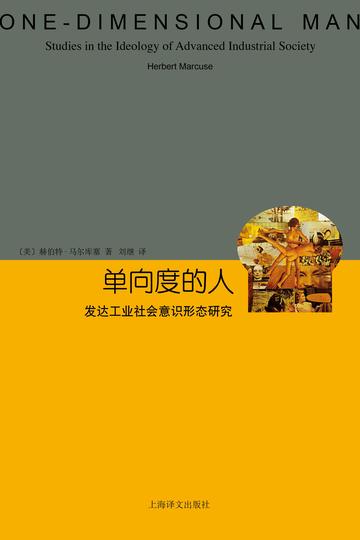
Herbert Marcuse (1898-1979) was the main left-wing representative of the Frankfurt School. This book is his most famous work, which aims to reveal the totalitarian characteristics of contemporary advanced industrial societies. After this book was published in the United Kingdom and the United States, it was published in German and French versions in Germany and France. It was later translated into multiple languages and published in many countries. It is known as the textbook of the Western university rebellion movement in the late 1960s.
In addition to the introduction, the book includes three parts: "One-dimensional Society", "One-dimensional Thought" and "Opportunities for Alternative Choices". Through analysis and criticism of politics, life, thought, culture, language and other fields, the author points out how developed industrial society has successfully suppressed the negative, critical and transcendent dimensions in people's hearts, making this society a one-dimensional society and the people living in it have become one-dimensional people. Such people have lost their freedom and creativity and no longer imagine or pursue another life different from real life. This book makes a relatively profound exposure and exploration of modern capitalist society, but it exposes the utopian nature of its social critical theory. This book has important theoretical value for studying the development of the Lankfurt School and Marcuse's theory.
Reader comments
In the increasingly fast pace of life, we succumb to material desires, lose freedom and creativity, and no longer imagine or pursue possibilities that are different from real life. It is scary to think about it. The author's criticism in the article points out that a one-dimensional society may limit individual development and the existence of diversity. It continues to deprive people of their rights to different choices and perspectives, leaving us in a state of fixed and rigid thinking. The author calls on people to reject one-dimensional thinking and dare to question and challenge existing concepts and structures.
The views of this book are very profound! It points out the impact of modern industrial society on people, and reminds me of the book "1984". They both criticize totalitarianism. Marcuse believed that people have become one-dimensional and lost their freedom and creativity. This is really thought-provoking. I especially liked the analysis of culture and ideas in the book. It made me think about the society we live in. However, the book does have a somewhat utopian feel to it. In short, this is a book worth reading and will bring you a lot of inspiration.
The book starts with the core question "Why do people's negative power and critical thinking gradually disappear in today's society and what method does society use to make people's thinking disappear?", And answers it with "Modern society uses technological rationality to develop one-dimensionally in multiple fields such as politics, science and technology, culture, etc., Causing people to be disciplined towards one-dimensionality, causing people to fall into false consciousness and lose their own thoughts." It then proposes several core concepts such as "one-dimensionality", "false consciousness" and "technical rationality". The author's point of view is certainly a fresh and extremely reasonable perspective, but I personally believe that although society is disciplined in one direction, it does not mean that people must be unidirectionally transformed and compliant in the process of social one-way development. Sometimes one-way development in certain fields is for the sake of a more stable and long-term future, and people can fully realize their own free development and maintain their own criticality within this reasonable range.
Marcuse's criticism is powerful, and we can use his point of view to look at current social issues with our own thinking, but he does not seem to distinguish between two types of "one-dimensionality." One is a totalitarian one-dimensionality that completely eliminates negativity (such as dystopia); the other is a one-dimensionality that reaches consensus on the basic order but still retains space for criticism within the scope of the consensus. The latter may not be perfect, but it may not completely abolish human freedom as he said. The unified regulations on production safety and public health in modern society are precisely to ensure that people can live more freely. As readers, we can use a more comprehensive and objective perspective to combine his views to form our own understanding.
It's such a pity that no one reviews this great book!
One-dimensional people are instrumental people.
A one-dimensional society is a hell of homogeneity!
When we use tools, we also become tools and are dominated. What dominates us is material desire or being a member of a group... The organizational structure of modern companies is intelligent and systematic. To a certain extent, it objectifies individuals and weakens their individuality... It is a book worth reading.
It's so in line with my preference. It's just a pure pleasure to read. I'm a bit of a word fetishist.





In the increasingly fast pace of life, we succumb to material desires, lose freedom and creativity, and no longer imagine or pursue possibilities that are different from real life. It is scary to think about it. The author's criticism in the article points out that a one-dimensional society may limit individual development and the existence of diversity. It continues to deprive people of their rights to different choices and perspectives, leaving us in a state of fixed and rigid thinking. The author calls on people to reject one-dimensional thinking and dare to question and challenge existing concepts and structures.
The views of this book are very profound! It points out the impact of modern industrial society on people, and reminds me of the book "1984". They both criticize totalitarianism. Marcuse believed that people have become one-dimensional and lost their freedom and creativity. This is really thought-provoking. I especially liked the analysis of culture and ideas in the book. It made me think about the society we live in. However, the book does have a somewhat utopian feel to it. In short, this is a book worth reading and will bring you a lot of inspiration.
The book starts with the core question "Why do people's negative power and critical thinking gradually disappear in today's society and what method does society use to make people's thinking disappear?", And answers it with "Modern society uses technological rationality to develop one-dimensionally in multiple fields such as politics, science and technology, culture, etc., Causing people to be disciplined towards one-dimensionality, causing people to fall into false consciousness and lose their own thoughts." It then proposes several core concepts such as "one-dimensionality", "false consciousness" and "technical rationality". The author's point of view is certainly a fresh and extremely reasonable perspective, but I personally believe that although society is disciplined in one direction, it does not mean that people must be unidirectionally transformed and compliant in the process of social one-way development. Sometimes one-way development in certain fields is for the sake of a more stable and long-term future, and people can fully realize their own free development and maintain their own criticality within this reasonable range. Marcuse's criticism is powerful, and we can use his point of view to look at current social issues with our own thinking, but he does not seem to distinguish between two types of "one-dimensionality." One is a totalitarian one-dimensionality that completely eliminates negativity (such as dystopia); the other is a one-dimensionality that reaches consensus on the basic order but still retains space for criticism within the scope of the consensus. The latter may not be perfect, but it may not completely abolish human freedom as he said. The unified regulations on production safety and public health in modern society are precisely to ensure that people can live more freely. As readers, we can use a more comprehensive and objective perspective to combine his views to form our own understanding.
It's such a pity that no one reviews this great book!
One-dimensional people are instrumental people. A one-dimensional society is a hell of homogeneity!
When we use tools, we also become tools and are dominated. What dominates us is material desire or being a member of a group... The organizational structure of modern companies is intelligent and systematic. To a certain extent, it objectifies individuals and weakens their individuality... It is a book worth reading.
It's so in line with my preference. It's just a pure pleasure to read. I'm a bit of a word fetishist.
Read him. Get it.